Reported by Simon Daniel Yusuph l Journalist at Weng Global
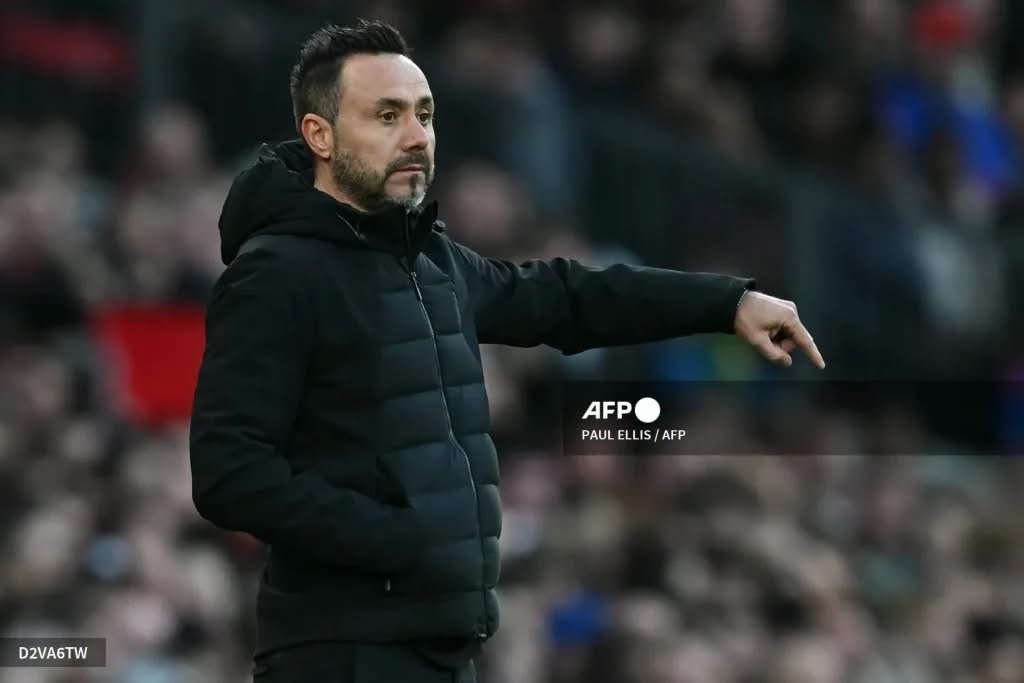
Tottenham Hotspur head coach Roberto De Zerbi has explained why he kissed midfielder Rodrigo Bentancur and thanked him after the Uruguayan was sent off during Tottenham’s dramatic 1-1 draw against Manchester United in the English Premier League on Saturday, October 10, 2026.
Bentancur received a straight red card following an altercation with Manchester United defender Luke Shaw at Old Trafford, leaving Tottenham to finish the contest with 10 players. Despite the setback, Spurs fought back to secure a point through Dominic Solanke’s stoppage-time equaliser.
De Zerbi said his reaction was not an endorsement of Bentancur’s decision to retaliate, which he acknowledged was a mistake. Instead, the Italian manager focused on what he considered the team’s response to adversity, describing the fight shown by his players as an important step towards rebuilding Tottenham’s confidence and competitive spirit.
The incident attracted attention because of the unusual contrast between Bentancur’s dismissal and his manager’s affectionate response. De Zerbi made clear that he wanted his players to demonstrate greater courage, unity and determination, while also recognising that the midfielder’s actions were not appropriate.
De Zerbi Explains Why He Kissed Bentancur
Speaking after the match, De Zerbi said he kissed Bentancur and thanked him, even though the midfielder’s dismissal had left Tottenham in a difficult position.
The coach explained that the red card was a mistake but argued that the situation prompted his team to respond with greater energy and determination.
According to Tottenham’s official account of the post-match press conference, De Zerbi said: “I kissed Rodrigo and I said thanks, because it’s clear — it’s a mistake from Rodrigo, because it’s not the right reaction in football, but now Tottenham needs to react.”
His comments reflected the distinction he was making between the player’s conduct and the collective response that followed.
De Zerbi did not suggest that Bentancur had acted correctly by reacting to Shaw. Rather, he viewed the team’s refusal to surrender after losing a player as an example of the mentality he wants Tottenham to develop.
He explained that Tottenham appeared to play with more courage and energy after being reduced to 10 men. For the manager, the response demonstrated the importance of collective responsibility when a match turns against a team.
The coach also stressed that talent alone would not be enough to improve Tottenham’s results. He wants his players to combine their technical ability with commitment, discipline, character and the willingness to work for one another.
The reaction was significant for a side seeking greater consistency. However, De Zerbi’s praise for the team’s determination did not remove the need for players to avoid unnecessary disciplinary incidents.
What Happened Between Bentancur and Luke Shaw?
The flashpoint occurred during a tense period of the second half at Old Trafford.
Bentancur had entered the match as a substitute in the 66th minute. Manchester United subsequently took the lead through Bryan Mbeumo in the 73rd minute, increasing the pressure on Tottenham to find a response.
An altercation involving Bentancur and Shaw escalated after a physical challenge and a shove. Bentancur retaliated with a headbutt, prompting referee Stuart Attwell to send the Tottenham midfielder off for violent conduct.
The dismissal left Spurs with 10 players during the closing stages of a match they were already trailing.
The incident changed the challenge facing De Zerbi’s side. Tottenham had to pursue an equaliser while protecting themselves against Manchester United exploiting their numerical advantage.
Bentancur’s actions were costly because his team lost a midfielder at a crucial stage. His dismissal also highlighted the risks associated with retaliating during emotionally charged moments, when a player’s reaction can have consequences extending beyond the immediate confrontation.
Although De Zerbi praised the character Tottenham showed afterwards, his comments acknowledged that Bentancur should have handled the situation differently.
The distinction matters in professional football, where players are expected to manage their emotions even when opponents challenge or provoke them. A red card can alter a match, disrupt a team’s tactical plan and leave teammates carrying an additional physical and defensive burden.
For Tottenham, the challenge was no longer simply to equalise. The players also needed to reorganise, maintain concentration and continue competing against a side with an extra player.
Dominic Solanke Rescues a Point for Tottenham
Tottenham’s response came in stoppage time, when Dominic Solanke scored the equaliser to secure a 1-1 draw.
Manchester United had appeared to be heading towards victory after Mbeumo’s second-half goal. However, Tottenham continued to search for an opportunity despite Bentancur’s dismissal.
Sandro Tonali supplied the cross that Solanke converted in the 92nd minute, giving the visitors a late reward for their persistence.
The equaliser changed the outcome of a match that had threatened to deepen Tottenham’s difficulties. Instead of leaving Old Trafford empty-handed, Spurs took a point from a contest in which they had to overcome both a goal deficit and a numerical disadvantage.
Solanke’s contribution was particularly important because Tottenham had struggled to turn their attacking opportunities into goals. De Zerbi had been pleased with aspects of the team’s performance but acknowledged that the club needed better results to improve its position.
The manager also defended Solanke against criticism surrounding his contribution as Tottenham’s striker. He said the forward had suffered from the team’s difficulties in scoring and winning matches, rather than accepting the suggestion that Solanke was not good enough.
The late goal therefore carried significance beyond the result itself. It provided evidence that Tottenham could continue fighting when circumstances became unfavourable.
However, one equaliser does not resolve the club’s broader problems. Tottenham still need to turn promising performances into victories if they are to move away from the lower reaches of the league table.
De Zerbi Says Tottenham Finally Showed Team Spirit
De Zerbi described the performance as an important demonstration of togetherness, saying his players worked for one another and remained committed until the final whistle.
He explained that Tottenham had created opportunities before the interval but had not taken sufficient advantage of their attacking play. The team then faced a more difficult second half before responding after conceding and losing Bentancur.
The coach said the performance showed qualities he wanted to see more consistently, including collective defending, coordinated attacking and the determination to remain involved in the contest.
His assessment was not that Tottenham had solved every problem. Instead, he viewed the match as evidence that the players could compete with greater intensity and belief.
De Zerbi said he was pleased with the team’s performance and the way the players responded to the red card. He also acknowledged that Tottenham had to improve their mentality, spirit, courage, personality and physical condition.
Those comments indicate that his assessment extends beyond an isolated incident. The coach is attempting to establish a more reliable team identity in which Tottenham can maintain their level of commitment throughout a match, including when they face setbacks.
The distinction between playing well and winning remains important. A team may dominate periods of a contest without collecting three points, particularly when it fails to convert chances or makes costly mistakes.
Tottenham’s draw offered encouragement, but the club will need more consistent performances before the improvement can be regarded as sustained progress.
Why the Red Card Became a Turning Point
De Zerbi’s reaction drew attention because he appeared to welcome the change in intensity that followed Bentancur’s dismissal, even while acknowledging that the incident itself was wrong.
The coach said the red card provided a spark for the team. His argument was that Tottenham responded with greater courage after being forced to confront a difficult situation.
That interpretation should not be confused with approval of violent conduct. The manager explicitly described Bentancur’s reaction as a mistake and said it was not the correct response in football.
Instead, the episode exposed a challenge facing Tottenham: the need to develop a strong competitive mentality without allowing emotion to undermine discipline.
Teams regularly encounter difficult moments during a season. Injuries, goals conceded, controversial decisions and dismissals can all disrupt a match plan. How players respond can influence whether a team collapses under pressure or continues to compete.
Tottenham’s late equaliser illustrated the potential value of persistence. Nevertheless, relying on a red card to trigger a stronger performance would be an unsustainable approach. The team must show the same intensity from the beginning of matches and avoid unnecessary dismissals.
De Zerbi’s message was therefore two-sided. He praised the commitment displayed by his players after the setback, while recognising that the incident itself could have been avoided.
For Bentancur, the dismissal also serves as a reminder that individual decisions can affect the entire squad. His teammates had to finish the match with fewer players, while the club faced the consequences of losing a midfielder during a crucial contest.
Tottenham’s Premier League Challenges Remain
The draw provided Tottenham with a point, but it did not erase the concerns surrounding their early-season results.
According to Reuters’ match report, Tottenham entered the contest in a difficult league position and were still searching for their first Premier League victory of the season after six matches. The result offered a measure of encouragement but left the club with substantial work to do.
De Zerbi has been looking for signs that his approach is taking hold. His post-match comments suggested that he saw the performance at Old Trafford as evidence of progress in the team’s collective effort.
However, he also warned against treating one result as proof that Tottenham had escaped their difficulties. He said the team needed to continue improving and prepare for its next match with humility.
That caution is important. A draw against Manchester United can provide a psychological boost, especially when achieved after going behind and losing a player. But league progress depends on accumulating points over time, not simply producing one spirited performance.
Tottenham must now work on converting chances, maintaining defensive organisation and managing emotional pressure. Discipline will also be crucial, as further avoidable dismissals could undermine the team’s efforts to climb the table.
The match demonstrated that the players were capable of fighting back. Their next challenge is to reproduce that determination without needing a crisis to bring it out.
What Happens Next?
Tottenham are expected to turn their attention to their next fixture against Coventry, with De Zerbi making clear that the immediate priority is to prepare for the game and improve the club’s league position.
The coach said Tottenham could not afford to remain in their difficult situation and needed to keep working together to secure better results.
Bentancur’s dismissal may also carry disciplinary consequences, although the precise impact will depend on the applicable competition rules and any subsequent disciplinary decisions. The red card itself meant Tottenham had to complete the Manchester United match with 10 players.
For De Zerbi, the priority is to preserve the positive aspects of the performance while ensuring that the team learns from the incident. He wants his players to maintain their courage and energy but exercise better judgement when tensions rise.
The manager’s response to Bentancur has become a talking point because it combined criticism of the midfielder’s decision with appreciation for the team’s reaction. It also underlined the balance coaches must strike between demanding aggression in competition and insisting on discipline.
Tottenham’s late equaliser gave them a valuable point and a reason for encouragement. Whether the performance marks a genuine turning point will depend on what follows.
For now, De Zerbi has made his position clear: Bentancur made a mistake, but the team’s refusal to give up was the response he wants to see repeated.
Weng Global – stories beyond borders
Sources
- Tottenham Hotspur — Official post-match press conference and match reaction.
- Reuters — Report on Manchester United’s 1-1 draw with Tottenham Hotspur, published October 10, 2026.
- The Guardian — Match report and live coverage of Manchester United versus Tottenham Hotspur, October 10, 2026.