Reported by Weng Patrick Atokor l Journalist at Weng Global
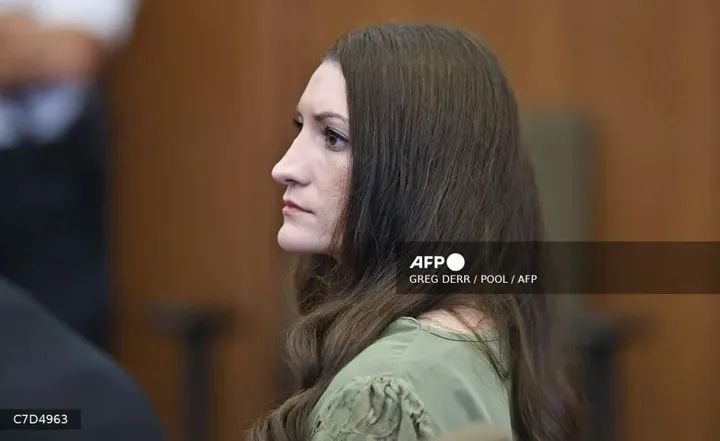
U.S. President Donald Trump has declined to intervene in the case of Lindsay Clancy, a Massachusetts mother accused of killing her three young children, after her defence lawyer publicly appealed for a presidential pardon following a mistrial.
Trump addressed the case on September 14, saying it was a “state situation” and that there was little he could do. His comments came days after Clancy’s lawyer, Kevin Reddington, appealed to him publicly to consider clemency for his client.
The case has attracted national attention because of the circumstances surrounding the deaths, Clancy’s defence of lack of criminal responsibility and the unresolved question of whether prosecutors will seek a second trial.
Trump Says Case Is a State Matter
Clancy, 36, is facing three first-degree murder charges in Massachusetts over the January 2023 deaths of her children — five-year-old Cora, three-year-old Dawson and eight-month-old Callan.
Her first trial ended in a mistrial on September 4 after jurors failed to reach a unanimous verdict. According to reporting by Reuters, the jury remained divided over whether Clancy was criminally responsible for the deaths.
After the mistrial, Reddington appeared on ABC’s Good Morning America and asked Trump to consider pardoning his client.
“Mr. President, I would hope that you would consider this young lady,” Reddington said while appealing to Trump to consider what Clancy had experienced.
Trump subsequently responded that the matter was a state case and indicated that he could not intervene through the federal presidential pardon power. CBS Boston reported that Trump described it as a “state situation” and said there was nothing he could do.
The development effectively ends the immediate push for Trump to use his presidential clemency authority in the case.
Why Trump Cannot Simply Pardon Clancy
The issue also highlights an important distinction between federal and state criminal cases in the United States.
Clancy’s prosecution is being handled under Massachusetts state law rather than federal law. The U.S. president’s pardon power generally applies to federal offences, not crimes prosecuted by individual states.
Massachusetts itself confirms that executive clemency for offences committed under state law rests with the state’s governor, with the advice and consent of the Massachusetts Governor’s Council.
That means Trump does not have the ordinary legal authority to erase the Massachusetts murder charges through a presidential pardon.
Massachusetts Governor Maura Healey has also previously explained that her clemency authority applies to state offences. The state’s clemency process involves review by the Advisory Board of Pardons before a recommendation can be made to the governor, with the Governor’s Council required to approve a grant of clemency.
However, Healey previously indicated that she could not consider a pardon for Clancy at the current stage because there was no conviction to pardon.
Clancy’s Defence Centres on Mental Health
The central issue at Clancy’s trial was not simply whether she caused the deaths. Her defence acknowledged that she killed the children but argued that she should not be held criminally responsible because she was suffering from severe postpartum psychosis.
The defence argued that Clancy experienced a serious psychiatric breakdown around the time of the killings.
Prosecutors, however, challenged the defence’s position and argued that Clancy remained capable of understanding and controlling her actions.
The disagreement over her mental state ultimately became central to the jury deliberations.
Reuters reported that the mistrial followed the jury’s inability to reach a unanimous decision on whether Clancy should be found not guilty by reason of insanity.
The outcome means that the case remains unresolved despite the lengthy trial.
What Happened to the Case After the Mistrial?
A mistrial does not automatically mean that the charges disappear.
Prosecutors must decide whether to pursue another trial or explore another legal resolution.
Clancy’s lawyer has separately asked the court to prevent a second trial, arguing that the evidence does not establish criminal responsibility. The Associated Press reported that Reddington filed a motion seeking an acquittal, which, if granted, would prevent prosecutors from retrying Clancy on the charges.
A further court hearing is expected on September 29.
Until the court makes a final determination, Clancy remains accused rather than convicted of the killings.
That distinction is important because the mistrial did not establish her guilt or innocence.
The Broader Debate Over Postpartum Mental Health
The case has also generated wider discussion about postpartum mental health, psychiatric treatment and the criminal justice system.
Clancy’s defence has maintained that postpartum psychosis played a significant role in her actions. The prosecution has disputed the legal consequences of that argument.
The case therefore raises difficult questions about how courts should assess criminal responsibility when severe mental illness is presented as a defence.
Those questions extend beyond Massachusetts.
Maternal mental health conditions can have serious consequences when symptoms are not recognised or adequately treated. At the same time, courts must determine whether a defendant meets the legal requirements for an insanity or lack-of-criminal-responsibility defence in a particular case.
The legal and medical questions are therefore related but not identical.
A diagnosis or allegation of mental illness does not by itself determine whether a person is legally responsible for a crime. That determination depends on the evidence and the applicable law.
Why the Trump Appeal Became Significant
The appeal to Trump attracted attention partly because presidential pardons have become a prominent feature of U.S. political and legal debates.
But the Clancy case demonstrates the constitutional limits of presidential clemency.
Even though Trump is president, his pardon authority does not ordinarily extend to state criminal prosecutions. Massachusetts has its own clemency framework for state offences.
Trump’s response therefore does not resolve Clancy’s criminal case.
The key legal questions remain in Massachusetts, where prosecutors and the courts must determine how the case proceeds after the mistrial.
What Happens Next?
The immediate focus is expected to remain on the Massachusetts court proceedings.
Clancy’s defence is seeking an outcome that would prevent a second trial, while prosecutors have not publicly announced a final decision on whether they will retry her.
The next major development could come from the court hearing scheduled for September 29.
Until then, the case remains unresolved.
Trump’s decision not to intervene does not constitute a finding on Clancy’s guilt or innocence. It simply reflects the jurisdictional limits surrounding a federal presidential pardon in a state criminal case.
For Weng Global readers, the case illustrates how questions of mental health, criminal responsibility, state and federal authority and victims’ rights can intersect in a single criminal proceeding.
Weng Global – Stories beyond borders
Sources
- Reuters — Reporting on the request for a presidential pardon and the subsequent mistrial.
- Associated Press — Reporting on the defence request to prevent a second trial.
- CBS Boston — Reporting on Trump’s response to the pardon request.
- Massachusetts Government — Information on state executive clemency and the governor’s pardon authority.
- ABC News — Reporting on the defence’s pardon appeal following the mistrial.