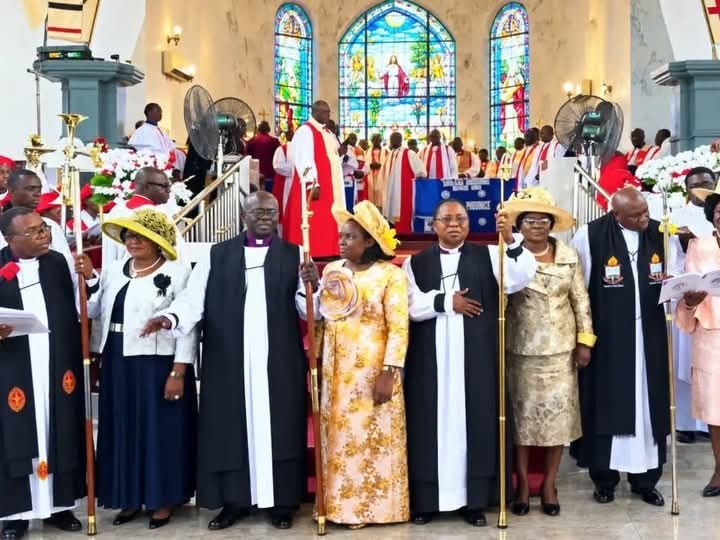
Reported by Weng Patrick Atokor l Journalist at Weng Global
The retired Anglican Bishop of Ibadan Diocese, Most Reverend Joseph Olatunji Akinfenwa, has urged church leaders in Nigeria to speak more openly against bad governance as citizens continue to face hunger, insecurity, unemployment and economic hardship.
Akinfenwa argued that the Church should not remain silent when Nigerians are confronted with conditions that affect their livelihoods, security and dignity.
His call places renewed attention on the role of religious institutions in Nigeria’s public life, particularly at a time when economic pressures and insecurity remain major concerns for many households.
The cleric has repeatedly used church platforms to comment on governance, leadership, corruption, insecurity and the responsibilities of political authorities. His latest position is therefore consistent with his long-standing argument that Christian leaders have a responsibility to address issues affecting society rather than restricting their voices to matters within the Church.
A call for the Church to speak
Akinfenwa’s message centres on the need for church leaders to use their influence to demand accountability from those entrusted with public office.
Nigeria has a large and influential Christian population, with churches playing significant roles in communities across the country. Beyond worship, many churches operate schools, hospitals, charitable programmes, counselling services and other social interventions.
For Akinfenwa, that social presence also creates a responsibility to engage with issues that directly affect ordinary Nigerians.
The concerns he highlighted include hunger, unemployment and insecurity — challenges that extend beyond individual households and have implications for Nigeria’s broader social and economic stability.
His position suggests that religious leadership should not be separated completely from questions of governance when government decisions directly affect the welfare and security of citizens.
The argument also reflects a broader tradition within Nigerian religious life in which church leaders have periodically challenged governments over corruption, insecurity, poverty and policies considered harmful to citizens.
Akinfenwa’s long-standing concerns about governance
Akinfenwa is not new to public commentary on Nigeria’s political and social conditions.
In previous interventions, he has criticised the quality of political leadership and warned against allowing ethnicity and religion to determine political choices.
In 2022, while serving as Bishop of Ibadan Diocese, he urged Nigerians to place greater emphasis on competence and capacity rather than ethnic or religious considerations when choosing political leaders.
He also called for greater attention to the future of young Nigerians and urged the government to address concerns affecting education.
His comments over the years have reflected a broader view that Nigeria’s political challenges cannot be addressed solely through changes in political parties or individual office holders. Leadership quality, accountability and the willingness of public officials to serve citizens are equally important.
That perspective is particularly relevant as Nigeria approaches another politically significant period, with political discussions around the 2027 elections already becoming increasingly prominent.
Insecurity remains a major concern
Insecurity has also been a recurring theme in Akinfenwa’s public interventions.
In December 2025, the bishop expressed concern over the security situation in parts of Nigeria, warning that fear and uncertainty were affecting Christians’ ability to celebrate Christmas freely.
He pointed to reported attacks on churches and cases involving the abduction of priests as evidence of the insecurity confronting communities.
In April 2026, during Easter reflections in Ibadan, Akinfenwa again expressed concern about insecurity and urged authorities to take concrete steps to protect citizens and make communities safer.
These interventions demonstrate that his latest call for church leaders to speak against poor governance is connected to concerns he has raised about the welfare and security of Nigerians over a longer period.
For communities facing violence or economic pressure, governance is not an abstract political issue. Decisions made by government authorities can influence access to food, employment, education, healthcare, security and other basic services.
Hunger and economic hardship
The reference to hunger comes against a wider backdrop of economic pressure in Nigeria.
For many Nigerians, the rising cost of essential goods has made household budgeting increasingly difficult. Food prices, transportation costs and other living expenses have become central issues in national discussions about the economy.
Economic hardship can also produce wider social consequences.
When households struggle to meet basic needs, families may reduce spending on education, healthcare and other essential services. Young people without employment opportunities may also become more vulnerable to exploitation, criminal recruitment and irregular migration.
This makes the question of economic management important beyond financial statistics.
A government’s economic policies ultimately affect the daily experiences of citizens, particularly low-income households and vulnerable communities.
Akinfenwa’s call therefore places the Church within a wider conversation about social responsibility and the obligation of leaders to respond to citizens’ material needs.
Why religious voices matter in Nigeria
Religious institutions occupy an important position in Nigerian society.
Churches often have direct contact with communities that government institutions may struggle to reach. Clergy interact with families, young people, business owners, students, farmers and vulnerable citizens on a regular basis.
Because of this proximity, church leaders can become important voices in discussions about social conditions.
However, speaking against bad governance also carries responsibilities.
Religious leaders need to distinguish between political advocacy and partisan politics. Criticism of government policies should be based on evidence and should not become an endorsement of a political party or candidate.
The same principle applies to all sides of Nigeria’s political divide.
A church leader can demand accountability from government without campaigning for the opposition. Similarly, a religious institution can support policies that benefit citizens without becoming an extension of a political organisation.
This distinction is important for maintaining public trust.
Akinfenwa has also criticised the Church
Akinfenwa’s comments have not been directed only at politicians.
In a 2026 interview published by the Nigerian Tribune, he expressed concern about the state of Christian leadership and questioned the spiritual depth of some people who present themselves as pastors.
He also criticised political leadership and linked Nigeria’s insecurity to what he described as recklessness among leaders.
That wider criticism is significant because it suggests that his position is not simply a demand for government action. He has also challenged the Church to examine its own conduct and responsibilities.
For the Church to effectively demand accountability from political leaders, it must also be willing to examine accountability within its own institutions.
That could include questions around financial transparency, leadership conduct, treatment of congregants, social responsibility and the use of religious influence.
The balance between faith and public responsibility
The debate over how far religious leaders should involve themselves in political and social matters has existed for decades.
Some argue that churches should concentrate primarily on spiritual matters. Others believe that faith communities cannot ignore poverty, violence, corruption and injustice because those issues directly affect human life.
Akinfenwa clearly falls within the latter tradition.
His position is that Christian leadership should include concern for the welfare of society.
That does not necessarily mean that churches should become political parties or that clergy should determine how citizens vote. Rather, it can mean using moral authority to demand justice, accountability, peace and responsible governance.
Such engagement can be especially important in a democracy where citizens and institutions have a role in holding public officials accountable.
What Akinfenwa’s message means for Nigeria
The significance of Akinfenwa’s intervention extends beyond the Church.
Nigeria’s governance challenges require participation from multiple parts of society, including government institutions, civil society, professional organisations, traditional institutions, religious bodies, the media and ordinary citizens.
Church leaders can contribute by drawing attention to problems affecting communities, encouraging peaceful civic participation and demanding transparency from those in authority.
They can also contribute through practical intervention.
Churches already provide assistance to vulnerable people in many communities. Expanding food support, educational programmes, healthcare assistance, skills training and youth development initiatives can complement calls for better government policy.
At the same time, social interventions by religious organisations cannot replace the responsibilities of government.
Long-term solutions to unemployment, insecurity, poverty and food insecurity require effective public institutions, sound policies, investment, accountability and sustained implementation.
The wider responsibility of leadership
At the heart of Akinfenwa’s message is a broader question about leadership.
Nigeria’s challenges cannot be solved simply by condemning bad governance. Leaders across society must also contribute to building institutions capable of delivering better outcomes.
Political leaders are responsible for governance.
Religious leaders have responsibilities to their congregations and wider communities.
Civil society organisations have a role in advocacy and accountability.
The media has a responsibility to report facts and scrutinise those in power.
Citizens also have a responsibility to participate peacefully and make informed decisions.
Akinfenwa’s call therefore provides an opportunity to consider the role of the Church not simply as a religious institution but also as an important part of Nigeria’s civil society.
What happens next
The immediate impact of the bishop’s call will depend largely on whether other church leaders and Christian organisations adopt similar positions and translate them into sustained engagement.
For such engagement to be meaningful, it would need to move beyond occasional statements and sermons.
Church leaders could strengthen their contribution by demanding measurable improvements in security, employment, food access, education, healthcare and public accountability while maintaining political neutrality.
They can also encourage citizens to engage peacefully with democratic institutions and evaluate political leaders based on performance, competence and integrity rather than ethnicity, religion or personality.
Ultimately, Akinfenwa’s intervention raises a fundamental question for Nigeria’s religious leadership: whether the Church will remain primarily a place where citizens seek spiritual comfort or also become a stronger voice for accountability when the conditions affecting those citizens become increasingly difficult.
For millions of Nigerians facing economic and security pressures, the answer matters because governance is experienced not only through political speeches and official policies but through the everyday realities of food prices, employment, safety and access to basic services.
The challenge now is for all institutions with influence in Nigerian society — including the Church — to turn calls for better leadership into constructive, evidence-based and sustained action.
Weng Global – Stories beyond borders
Sources
Punch Newspapers — report on Archbishop Joseph Akinfenwa’s call for church leaders to speak against bad governance.
The Guardian Nigeria — reporting on Akinfenwa’s concerns about insecurity and the need for government action.
Nigerian Tribune — interview with Archbishop Joseph Akinfenwa on Nigeria’s leadership, insecurity and the role of the Church.
Radio Nigeria Ibadan — reports on Akinfenwa’s interventions on insecurity, economic hardship and political leadership.
Church of Nigeria, Anglican Communion — official material on Archbishop Joseph Olatunji Akinfenwa and his ministry.