Reported by Weng Patrick Atokor l Journalist at Weng Global
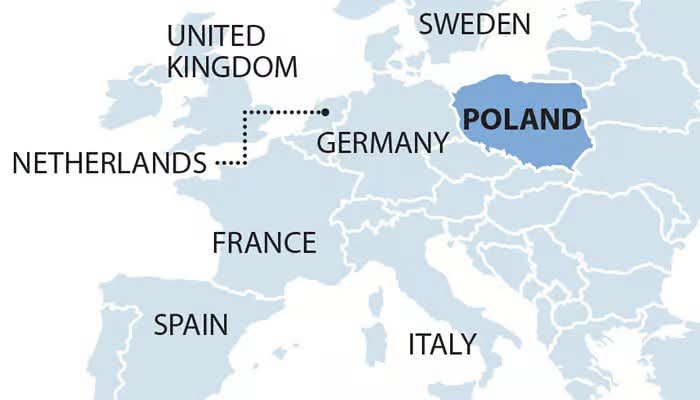
Poland deployed police officers around its Constitutional Tribunal in Warsaw on Friday, October 30, 2026, following the reported suspension of the court’s president, Bogdan Święczkowski, escalating a bitter political and judicial dispute between Prime Minister Donald Tusk’s government and the country’s nationalist opposition.
The developments prompted President Karol Nawrocki to interrupt his official trip to Senegal and return to Poland, saying the situation required his presence in the country.
The confrontation has intensified tensions over control of Poland’s highest constitutional court, with competing political and judicial figures disputing the legitimacy of appointments, the authority of judges and the direction of the country’s judicial system. reuters.com +2
Police Deployed as Protests Erupt Around Constitutional Tribunal
Police officers were deployed to the grounds of the Constitutional Tribunal in Warsaw as demonstrators gathered following reports that Święczkowski had been suspended from his duties.
The police operation came amid growing tensions surrounding the court’s leadership and concerns about possible disturbances involving judges, employees and protesters.
According to Polish police, officers responded to reports of dangerous objects being thrown at them during demonstrations outside the institution.
Authorities said the deployment was intended to maintain public safety and prevent disorder.
Polish Radio reported that three people were detained after incidents involving protesters, while police maintained that their officers were operating within their legal powers.
The Warsaw police department also rejected reports that officers had forcibly removed members of the tribunal’s security personnel from the building.
Police clarified that officers were present on the tribunal’s premises but had not entered the court building itself. English Section +2
Constitutional Court President Reportedly Suspended
The immediate trigger for the confrontation was the reported suspension of Constitutional Tribunal President Bogdan Święczkowski and Vice-President Bartłomiej Sochański.
Information published on the tribunal’s website indicated that both officials had been ordered to suspend their duties for one month.
The action was associated with allegations surrounding the administration of the court, including disputes over judicial appointments, the participation of judges in proceedings and the organisation of judicial panels.
Judge Anna Korwin-Piotrowska emerged as a central figure in the developments, with reports indicating that she announced the suspension and would assume responsibility for managing the institution.
However, the situation quickly became more complicated.
The Constitutional Tribunal’s official social media account challenged the legitimacy of the action, insisting that Święczkowski remained its president and Sochański its vice-president.
The tribunal also alleged that its website had been unlawfully taken over and described the developments as a coup d’état.
These competing claims have created uncertainty over who currently exercises legitimate administrative authority within the institution.
The allegations have not been independently established, and the rival positions reflect the wider constitutional dispute unfolding in Poland. English Section +2
Justice Minister Seeks Legal Action Against Court Officials
Poland’s Justice Minister and Prosecutor-General, Waldemar Żurek, has also become directly involved in the confrontation.
Żurek reportedly sought the lifting of judicial immunity for Święczkowski and his deputy, Sochański, as part of efforts to pursue allegations concerning the administration of the tribunal.
The move forms part of the government’s wider attempt to address what it considers irregularities within judicial institutions that were influenced by the previous Law and Justice administration.
Prime Minister Donald Tusk has defended his government’s actions, arguing that restoring the rule of law requires decisive measures.
His administration has maintained that Poland must address longstanding problems surrounding judicial independence and the constitutional order.
However, the opposition has strongly rejected the government’s approach, arguing that the actions against the tribunal’s leadership amount to an attack on judicial independence and the country’s constitutional institutions. Reuters +2
Nawrocki Aborts Senegal Visit and Returns to Poland
The political crisis also disrupted President Karol Nawrocki’s planned diplomatic engagement with Senegal.
Nawrocki and his delegation were travelling to Senegal for an official visit that was expected to include meetings with Senegalese President Bassirou Diomaye Faye and representatives of the African Union.
However, following the developments around the Constitutional Tribunal, the Polish president announced that he was cutting short his journey and returning home.
In a statement published on X, Nawrocki said:
“At such a moment, the President must be in Poland. I am cutting short my flight to Senegal. I am returning.”
The Polish presidency subsequently confirmed on its official website, on October 30, that the president had decided to interrupt his journey because of the developments surrounding the Constitutional Tribunal.
His decision highlights the political significance of the confrontation, which has become serious enough to disrupt an international diplomatic engagement.
The cancellation also comes at a time when Senegal is preparing to host major international sporting and diplomatic activities, including the 2026 Youth Olympic Games. prezydent.pl +2
How Poland’s Judicial Dispute Developed
The confrontation is rooted in years of disagreements over judicial appointments and the relationship between Poland’s political leadership and its constitutional institutions.
The Law and Justice party, commonly known by its Polish abbreviation PiS, governed Poland between 2015 and 2023.
During that period, its judicial reforms attracted sustained criticism from the European Union and other observers, who raised concerns about political influence over the judiciary and the independence of courts.
The controversy became a significant issue in Poland’s relationship with European institutions, with disagreements over judicial independence contributing to legal and financial disputes between Warsaw and Brussels.
Donald Tusk’s political coalition came to power in 2023 after defeating the previous governing party.
His administration subsequently pledged to restore judicial independence and address concerns surrounding the country’s legal system.
However, implementing those changes has proved difficult because of disagreements over the legitimacy of previous judicial appointments and the constitutional powers of different institutions.
The Constitutional Tribunal has been at the centre of this struggle.
Its responsibility is to determine whether legislation and other legal measures comply with Poland’s Constitution, making control of the institution particularly important in disputes involving government authority and constitutional interpretation.
The current confrontation reflects the difficulty of resolving competing claims over judicial legitimacy without further undermining public confidence in the country’s institutions. AP News +2
Tusk Government and Opposition Remain Divided
The latest developments have exposed the continuing division between Tusk’s centrist, pro-European government and the nationalist right represented by PiS.
Tusk has argued that his administration has a responsibility to restore constitutional order and correct what it considers longstanding violations of judicial independence.
His government maintains that some judges appointed under the previous administration have obstructed the functioning of the tribunal by refusing to recognise judges selected by the current parliamentary majority.
Nawrocki, who is politically aligned with the former governing camp, has opposed aspects of the government’s judicial restructuring.
Earlier in 2026, he refused to receive the oaths of three judges selected by parliament for positions on the Constitutional Tribunal.
The dispute has contributed to the court’s institutional paralysis, as different groups contest the authority and legitimacy of judicial appointments.
PiS figures have accused Tusk’s administration of attempting to take control of the judiciary through politically motivated actions.
The government, meanwhile, insists that its measures are necessary to restore the rule of law.
These competing positions illustrate how the disagreement extends beyond the suspension of two senior judicial officials to a broader struggle over the interpretation of Poland’s Constitution and the limits of executive and parliamentary authority. Reuters +2
Why the Crisis Matters for Poland and Europe
The confrontation carries implications for Poland’s democratic institutions, its judicial independence and its relationship with the European Union.
An independent judiciary is a fundamental element of constitutional democracy because courts are expected to operate without improper political interference.
When competing political authorities dispute the legitimacy of judges and court leadership, the resulting uncertainty can weaken confidence in the legal system.
For Poland, the immediate concern is whether the Constitutional Tribunal can continue performing its constitutional responsibilities amid the competing claims over its leadership.
The dispute also raises questions about how the country will reconcile judicial reforms introduced under previous administrations with the current government’s efforts to restore institutional independence.
For the European Union, developments in Poland remain important because the independence of national courts is closely connected to the bloc’s legal framework and the protection of democratic principles among member states.
The latest confrontation could therefore have consequences beyond domestic politics, particularly if the disagreement develops into a prolonged institutional crisis.
What Happens Next?
The immediate focus will be on the legal status of the reported suspensions of Święczkowski and Sochański, the authority of Korwin-Piotrowska and the response of Poland’s political and judicial institutions.
The proceedings involving requests to lift the immunity of the tribunal’s senior officials could also become an important part of the dispute.
Meanwhile, Nawrocki’s return to Warsaw places him at the centre of the unfolding political situation, particularly given his opposition to aspects of the government’s judicial restructuring.
Police have called for calm and urged demonstrators to comply with lawful instructions.
As of October 30, the competing claims over the tribunal’s leadership remained unresolved.
The coming days are likely to be important in determining whether Poland’s political and judicial authorities can reach a legal resolution or whether the confrontation will deepen the country’s constitutional tensions.
For now, the dispute has demonstrated how disagreements over judicial appointments and institutional authority can escalate into a wider political crisis, with consequences for domestic stability and international relations.
Weng Global – Stories beyond borders
Sources
1. Reuters – Polish President Turns Back from Senegal Trip as Top Court Chief Suspended
2. Associated Press – Police Secure Poland’s Constitutional Tribunal as Protests Erupt Over Court Chief’s Suspension
3. Polish Presidency – President Interrupts Flight to Senegal and Returns to Poland
4. Polish Radio – Polish President Turns Back from Senegal Trip as Top Court Chief Suspended
5. Anadolu Agency – Polish President Aborts Africa Trip as Power Struggle Erupts at Constitutional Tribunal