Reported by Weng Patrick Atokor l Journalist at Weng Global
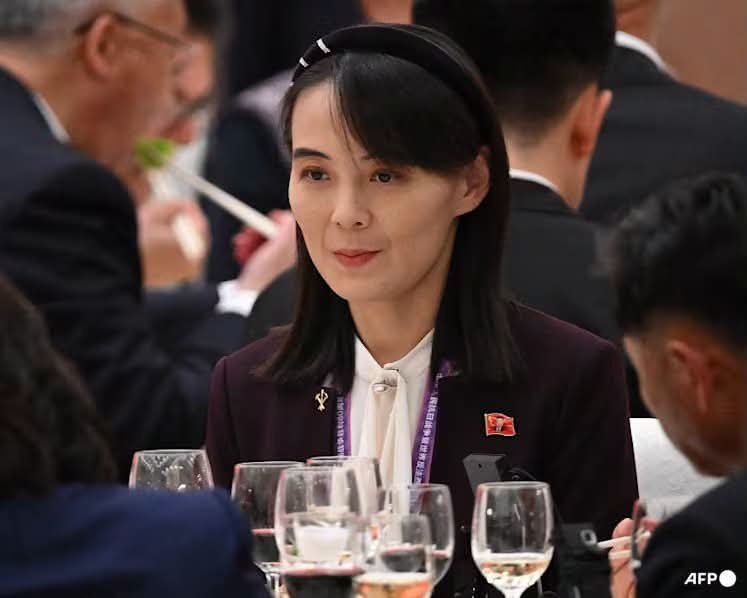
North Korea has again rejected international calls to abandon its nuclear weapons programme, with Kim Yo Jong, the sister of leader Kim Jong Un, declaring that the country’s status as a nuclear-armed state is “absolute” and cannot be reversed.
Kim Yo Jong made the remarks on Thursday, September 17, 2026, in a statement carried by North Korea’s state-run Korean Central News Agency (KCNA), as the International Atomic Energy Agency (IAEA) held its 70th General Conference in Vienna.
Her statement represents the latest rejection by Pyongyang of international efforts aimed at persuading North Korea to give up its nuclear weapons programme. It also comes as international concerns grow over the expansion of the country’s uranium-enrichment and nuclear facilities.
But what exactly does North Korea mean when it says its nuclear status is irreversible, and why has denuclearisation remained so difficult?
What did Kim Yo Jong say?
Kim Yo Jong dismissed renewed international calls for North Korea to denuclearise, describing them as repeated and ineffective.
According to Yonhap News Agency, her statement argued that North Korea’s position as a nuclear weapons state was “absolute” and could not be reversed. She also rejected criticism coming from the IAEA and Western countries.
The statement was issued as the IAEA General Conference discussed concerns about North Korea’s nuclear programme and called for the country to abandon its nuclear weapons programme in a complete, verifiable and irreversible manner.
North Korea rejects that objective.
For Pyongyang, nuclear weapons are not simply a temporary bargaining tool. Its leadership presents the nuclear programme as a permanent component of national security and state policy.
That distinction is central to understanding the latest statement.
Why does North Korea consider its nuclear programme permanent?
North Korea has progressively incorporated its nuclear weapons policy into its domestic legal and political framework.
Its leadership has repeatedly described the nuclear arsenal as essential to national defence and deterrence against perceived external threats.
Kim Yo Jong’s latest statement therefore does not represent an entirely new position. Rather, it reinforces a position North Korea has repeatedly communicated: that negotiations focused on complete denuclearisation are fundamentally inconsistent with Pyongyang’s current security strategy.
Yonhap reported that Kim said North Korea’s nuclear position had been permanently established both physically and legally.
This means that international calls for North Korea to simply surrender its nuclear weapons confront a government that publicly says it has no intention of doing so.
What is the IAEA concerned about?
The latest dispute comes at a time when international observers have reported developments suggesting that North Korea’s nuclear infrastructure is continuing to expand.
The IAEA has raised concerns about an increase in uranium-enrichment capacity and activity at North Korea’s nuclear facilities.
Reuters reported earlier in September that the agency had identified a new uranium-enrichment facility at the Yongbyon nuclear complex. Satellite imagery and other information indicated that the facility could accommodate a substantial number of centrifuge cascades. Reuters also reported that activity had expanded at another enrichment site near Pyongyang.
The significance is straightforward: uranium enrichment is an important part of the process used to produce material that can be used in nuclear weapons.
The IAEA does not currently have inspectors operating inside North Korea. As a result, international assessments rely heavily on satellite imagery, publicly available information and other forms of remote monitoring.
That limitation creates uncertainty over the precise scale of North Korea’s nuclear activities, even while international agencies continue to warn about the direction of the programme.
Why is the IAEA calling for denuclearisation?
The IAEA’s position is fundamentally different from Pyongyang’s.
The agency has continued to call for North Korea to comply with international non-proliferation obligations and abandon its nuclear weapons programme.
At its current General Conference in Vienna, concern was raised about the continued development of North Korea’s nuclear capabilities.
The wider international objective is not simply to reduce the number of nuclear weapons. It is to prevent the further spread and development of nuclear weapons and maintain international safeguards designed to limit nuclear proliferation.
North Korea, however, argues that its nuclear capability is necessary for national security.
That disagreement has remained at the centre of the nuclear dispute for years.
What does ‘denuclearisation’ actually mean?
Denuclearisation generally refers to the process of removing nuclear weapons and related capabilities from a country.
In the case of North Korea, international proposals have generally sought a process that would be:
- Complete
- Verifiable
- Irreversible
In practical terms, that would require more than North Korea announcing that it will stop testing nuclear weapons.
It would involve significant measures concerning its nuclear weapons, fissile-material production, enrichment facilities, weapons infrastructure and verification arrangements.
This is one reason the issue is extremely complicated.
A nuclear programme involves facilities, scientific expertise, production capabilities and military infrastructure. Removing the weapons themselves does not necessarily eliminate the knowledge and industrial capacity needed to rebuild the programme.
Why does this matter beyond the Korean Peninsula?
North Korea’s nuclear policy has consequences that extend beyond its borders.
The Korean Peninsula is surrounded by major military powers, including South Korea, Japan, China, Russia and the United States.
North Korea’s nuclear weapons therefore form part of a much wider security environment in East Asia.
Any major change in Pyongyang’s nuclear policy could affect military planning, diplomatic relations and security calculations across the region.
Conversely, continued development of North Korea’s nuclear capabilities can contribute to greater concern among neighbouring countries and influence discussions about military preparedness and deterrence.
Recent missile activity has also kept tensions high.
The Associated Press reported that North Korea launched several short-range ballistic missiles toward the sea on September 11, following a military exercise involving the United States, South Korea and Japan. North Korea has regularly criticised such exercises as provocative, while Washington and its allies describe their military cooperation as defensive.
These competing security claims help explain why the nuclear issue cannot be viewed separately from broader military tensions in the region.
What about possible talks with the United States?
The nuclear dispute has also remained connected to US-North Korea diplomacy.
Previous negotiations between Washington and Pyongyang produced temporary diplomatic openings but failed to produce an agreement that resolved the central disagreement over North Korea’s nuclear programme.
Kim Yo Jong’s latest comments therefore arrive against a background in which international actors continue to face the question of whether meaningful negotiations are possible while Pyongyang maintains that its nuclear status is permanent.
Her remarks do not indicate that North Korea is preparing to surrender its nuclear weapons.
Instead, they reinforce the position that any future engagement would have to take place with North Korea continuing to regard itself as a nuclear-armed state.
That creates a significant difference between the stated objectives of Pyongyang and those of international organisations advocating denuclearisation.
Is North Korea legally recognised as a nuclear-weapon state?
There is an important distinction between North Korea’s own declaration of its nuclear status and international legal recognition.
North Korea describes itself as a nuclear weapons state and has incorporated that position into its domestic laws and political doctrine.
However, its nuclear weapons programme remains subject to international opposition and United Nations Security Council sanctions.
North Korea’s nuclear activities have been the subject of international non-proliferation concerns for many years.
Therefore, when Pyongyang says its nuclear status is “absolute”, it is describing its own official position rather than announcing a universally accepted legal status within the international nuclear order.
What happens next?
For now, there is no indication from Kim Yo Jong’s latest statement that North Korea intends to accept the IAEA’s demand for denuclearisation.
The immediate issue will be how Pyongyang continues to develop its nuclear infrastructure and how the United States, South Korea, Japan, the IAEA and other governments respond.
The IAEA’s monitoring and reporting will remain important because international inspectors do not currently have unrestricted access to North Korea’s nuclear sites.
Future diplomatic developments will also matter.
If negotiations resume, the central question will be whether the parties can find common ground between North Korea’s insistence that its nuclear status is permanent and the international demand for complete, verifiable and irreversible denuclearisation.
For now, those positions remain sharply different.
The bigger picture
Kim Yo Jong’s latest statement is significant not because North Korea has suddenly changed its nuclear policy, but because it once again makes Pyongyang’s position explicit.
North Korea says its nuclear weapons are a permanent part of its national security strategy.
The IAEA and other international actors continue to demand denuclearisation and express concern about the expansion of the country’s nuclear capabilities.
The disagreement is therefore not simply about whether North Korea possesses nuclear weapons. It is about whether those weapons can ever become the subject of a credible process leading to their elimination.
Until that fundamental disagreement changes, the prospect of denuclearisation will remain one of the most difficult diplomatic issues surrounding the Korean Peninsula.
Weng Global – Stories beyond borders
Sources
- Yonhap News Agency — report on Kim Yo Jong’s September 17, 2026 statement and the IAEA General Conference.
- Reuters — report on Kim Yo Jong’s rejection of IAEA denuclearisation discussions.
- Reuters — report on developments at North Korea’s uranium-enrichment facilities.
- Associated Press — report on North Korea’s September 11 ballistic-missile launches and regional military tensions.
- AFP — report on Kim Yo Jong’s latest nuclear-policy statement.