Reported by Simon Daniel Yusuph l Journalist at Weng Global
Military Commander Reveals Financial Gains From Counter-Terrorism Operations
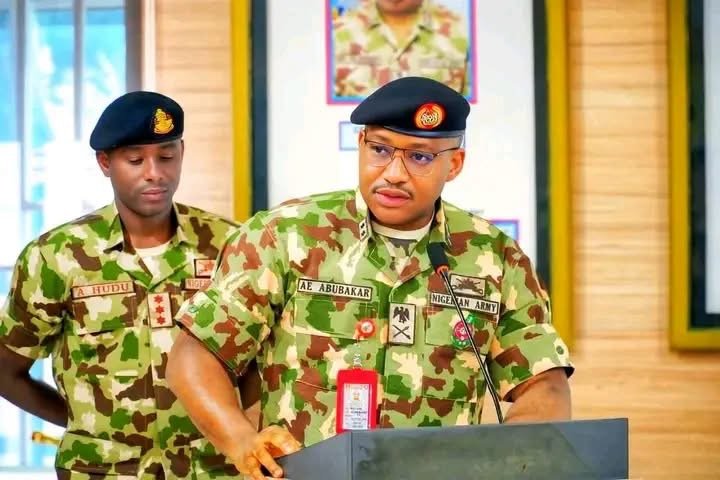
The outgoing Theatre Commander of Operation Hadin Kai, Major General Abubakar Abdulsalam, has disclosed that more than N350 million was recovered from terrorist financiers in Nigeria’s North-East during efforts to disrupt the financial networks supporting insurgent activities.
The disclosure was made as Abdulsalam prepares to leave the command following the Nigerian Army’s latest leadership changes affecting senior commanders.
The reported recovery highlights the growing importance of financial intelligence in Nigeria’s campaign against terrorism, particularly in the North-East, where military authorities continue operations against Boko Haram and Islamic State West Africa Province, ISWAP.
N350m Recovery Linked to Counter-Terrorism Efforts
According to the outgoing commander, the recovery of more than N350 million formed part of efforts to weaken the financial infrastructure supporting terrorist activities in the region.
Terrorist organisations depend on access to money to maintain their operations, including the movement of fighters, procurement of supplies, communication and other logistical requirements.
Disrupting those financial channels can therefore reduce the capacity of armed groups to sustain prolonged operations.
However, details on how the reported N350 million was recovered, the number of suspected financiers involved, the agencies that handled the funds and the legal status of the recovered money were not provided in the information available to Weng Global.
The identities of the suspected financiers were also not disclosed.
Weng Global therefore cannot independently verify the full breakdown of the amount reported by the outgoing commander.
Operation Hadin Kai’s Continuing Counter-Insurgency Role
Operation Hadin Kai remains one of Nigeria’s major military operations against insurgency in the North-East.
The operation covers a security environment that has been shaped by more than a decade of Boko Haram violence and the emergence of ISWAP as another significant armed group operating in the region.
The military campaign has involved ground operations, intelligence gathering, air operations and efforts to disrupt terrorist logistics.
Beyond direct military engagements, financial disruption has become an important part of the broader counter-terrorism response because terrorist groups require funding to maintain their networks.
The reported recovery therefore illustrates how counter-terrorism operations increasingly involve not only confronting armed fighters but also attempting to dismantle the systems that sustain them.
Leadership Change at Operation Hadin Kai
The disclosure comes as Major General Abubakar Abdulsalam leaves his position as Theatre Commander of Operation Hadin Kai.
He is being replaced by Major General Ibikunle Ademola Ajose as part of a wider Nigerian Army leadership reshuffle.
The change represents another transition in the command of Nigeria’s principal military operation against insurgency in the North-East.
The incoming commander will inherit responsibility for continuing military pressure against terrorist groups while dealing with the wider security challenges facing communities across the region.
The transition also comes at a time when Nigerian security agencies continue to face pressure to improve intelligence gathering, protect civilians and prevent terrorist groups from rebuilding their operational capabilities.
Why Terrorist Financing Matters
The fight against terrorism is not limited to military confrontation.
Terrorist networks require financial resources to survive, and money can facilitate the procurement of equipment, transportation, food, communications and other forms of logistical support.
This makes financial intelligence an important tool for security agencies.
Nigeria has previously strengthened cooperation among security, intelligence and financial institutions to trace suspicious transactions and identify individuals or organisations suspected of facilitating terrorism.
The reported N350 million recovery therefore has significance beyond the amount itself.
If properly investigated and followed by appropriate legal action, financial recoveries can help authorities identify wider networks and potentially prevent funds from reaching terrorist organisations.
North-East Security Challenge Remains Complex
Despite years of military operations, the security situation in the North-East remains challenging.
Boko Haram and ISWAP have demonstrated the ability to adapt to military pressure, relocate their operations and exploit difficult terrain and local conditions.
The military has consequently continued to combine offensive operations with intelligence-led actions aimed at disrupting terrorist movements and supply networks.
The broader challenge also extends beyond military action.
The long-term stabilisation of affected communities requires effective law enforcement, economic opportunities, humanitarian support, rehabilitation and measures capable of preventing vulnerable populations from being drawn into extremist networks.
What the New Commander Faces
Major General Ajose will inherit an operation requiring sustained pressure on terrorist groups while maintaining protection for civilians and military personnel.
One of the major priorities will be ensuring that intelligence gathered from military and security operations is translated into effective action against terrorist leadership, logistics and financing networks.
The continued disruption of terrorist funding could be particularly important because financial networks often extend beyond the immediate areas where armed groups operate.
Effective cooperation among the Nigerian Army, intelligence agencies, financial investigators, police and other relevant institutions will therefore remain important.
The Wider Significance
The reported recovery of more than N350 million demonstrates the importance of looking beyond battlefield engagements when assessing Nigeria’s counter-terrorism campaign.
The ability to identify and disrupt financial networks can potentially reduce the resources available to terrorist organisations and provide investigators with information about their wider support structures.
At the same time, financial recoveries must be accompanied by transparent investigations and lawful judicial processes.
Recovering money alone does not necessarily eliminate the networks behind terrorist financing.
Authorities must also establish how the funds were obtained or transferred, identify those responsible and pursue appropriate legal action where evidence supports prosecution.
What Happens Next
The immediate focus under the new Operation Hadin Kai leadership is expected to remain on counter-insurgency operations, intelligence gathering and the disruption of terrorist logistics and financing.
The effectiveness of the reported financial recovery will ultimately depend on whether investigators can use the information obtained to identify broader financing networks and prevent further movement of funds to terrorist organisations.
For residents of Nigeria’s North-East, however, the most important measure of progress remains improved security, safer communities and the restoration of normal economic and social activity.
The reported recovery represents one component of a much broader counter-terrorism campaign whose success will depend on sustained military operations, intelligence cooperation, financial investigations and community support.
Weng Global – Stories beyond borders
Sources
- Nigerian Army — information concerning Operation Hadin Kai and the outgoing Theatre Commander.
- Major General Abubakar Abdulsalam — remarks concerning the reported recovery of more than N350 million from terrorist financiers.
- Reuters — reporting on developments involving Nigeria’s military leadership and counter-insurgency operations.
- The Guardian Nigeria — reporting on Nigerian Army command changes and security operations.
- Premium Times — reporting and background on Nigeria’s counter-terrorism and security operations.