Reported by Weng Patrick Atokor l Journalist at Weng Global
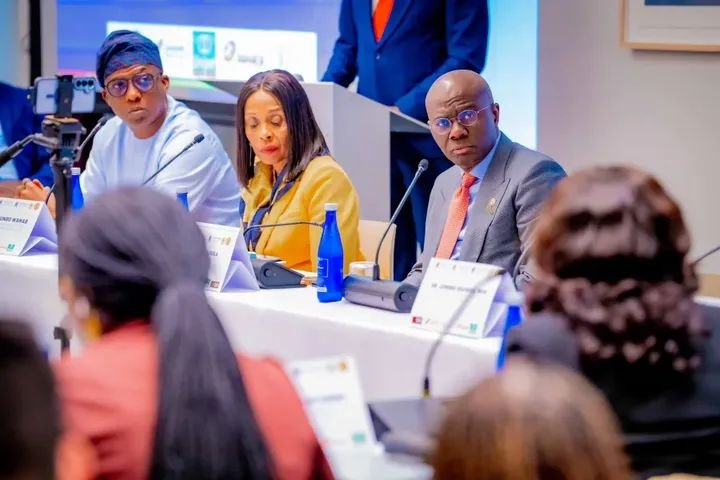
Lagos State Governor Babajide Sanwo-Olu has convened a high-level roundtable involving United Nations-linked networks and regional partners as the state seeks stronger international cooperation and financing to address flooding, coastal erosion and other climate-related threats facing Lagos.
The strategic meeting brought together the Lagos State Office of Sustainable Development Goals (SDGs), the United Nations Global Compact Networks and partners from Africa and the Caribbean to discuss practical measures for protecting coastal communities, infrastructure and economic assets from worsening environmental risks.
The engagement took place in New York on the sidelines of the 81st Session of the United Nations General Assembly, placing Lagos’ climate-resilience agenda within a wider international discussion about rising sea levels, coastal vulnerability and the financing required to protect exposed cities.
Lagos Faces Growing Climate Risks
Sanwo-Olu said Lagos’ position as a low-lying coastal megacity leaves it directly exposed to the effects of climate change.
According to the governor, the challenges include rising sea levels, coastal erosion and recurrent urban flooding, with the consequences extending beyond the environment to roads, homes, businesses and other critical infrastructure.
The vulnerability is significant because Lagos is one of Nigeria’s most economically important urban centres. Disruptions caused by flooding or coastal degradation can affect transportation, commercial activity, housing, public infrastructure and household livelihoods.
The Federal Ministry of Information and National Orientation also reported in August that the Federal Government and Lagos State had reaffirmed their commitment to strengthening cooperation on flood resilience, sustainable water management, urban water reforms and sanitation.
The ministry said Lagos’ coastal geography, rapid urbanisation, climate change, rising sea levels and increasingly intense rainfall were among factors contributing to the state’s recurring flooding problems.
Climate Financing Takes Centre Stage
A major issue discussed during the New York roundtable was how to close the financing gap for large-scale climate-resilience projects.
Sanwo-Olu said government resources alone would not be sufficient to finance the long-term infrastructure required to protect Lagos from increasingly severe environmental pressures.
The governor stressed the importance of working with the private sector and international development partners to mobilise additional resources and develop practical solutions for climate resilience.
The proposed approach goes beyond responding to flooding after disasters occur. It places greater emphasis on preparing infrastructure and financial systems before extreme weather events cause major disruption.
For Lagos, this could involve investments in coastal protection, drainage systems, resilient infrastructure, urban planning and other measures designed to reduce exposure to climate-related hazards.
The roundtable’s collaborative framework is also intended to support scalable approaches to coastal defence, infrastructure reinforcement and climate-resilient urban development across Lagos State.
UN and Regional Partnerships
The involvement of the United Nations Global Compact Networks and partners from Africa and the Caribbean reflects the cross-border nature of climate risks affecting coastal cities.
Lagos is not alone in facing pressure from rising sea levels, flooding and coastal erosion. The United Nations has described sea-level rise as a growing threat to low-lying coastal cities and communities, with consequences for infrastructure, housing, food and water security, tourism, livelihoods and public services.
The UN is holding a high-level plenary meeting on sea-level rise at its New York headquarters on September 24, 2026, bringing together governments and other stakeholders to discuss international cooperation and responses to the threat.
The timing of Lagos’ engagement therefore places the state’s climate-resilience concerns within a broader international conversation about how vulnerable coastal areas can prepare for environmental changes.
The participation of Caribbean partners also provides an opportunity for cities and regions facing similar challenges to exchange experiences, approaches and potential financing models.
Lagos’ Flood Challenge Extends Beyond Emergency Response
The latest initiative builds on existing efforts by Lagos State and the Federal Government to strengthen flood resilience.
In August, the Federal Ministry of Water Resources and Sanitation said Lagos was among states facing significant flood risks and highlighted the importance of proactive planning, early-warning systems and stronger coordination between government institutions.
The ministry said the 2026 Annual Flood Outlook issued by the Nigeria Hydrological Services Agency identified Lagos among 33 states at high risk of flooding.
It also pointed to the National Flood Intelligence Monitoring System and Multi-Hazard Flood Early Warning System as federal initiatives designed to improve flood forecasting and support earlier action.
The development of early-warning systems is important because effective flood management is not limited to building physical infrastructure. Authorities also need reliable information, coordinated emergency planning and timely communication with communities.
Lagos State has previously outlined broader climate-adaptation plans recognising the city’s exposure to rising sea levels, extreme rainfall and heatwaves. Its climate adaptation and resilience planning has framed climate change as a threat to infrastructure, the economy and the wider wellbeing of residents.
Lagos Seeks Long-Term Resilience
The latest discussions indicate an effort to move climate policy towards long-term resilience rather than relying primarily on emergency responses after flooding occurs.
This includes finding financing mechanisms capable of supporting major infrastructure projects over extended periods.
The challenge is particularly important for Lagos because climate resilience requires significant investment while the state’s population, urban footprint and economic activity continue to grow.
The Federal Government has also identified integrated water resources management, improved drainage infrastructure, nature-based solutions, urban planning and stronger institutional coordination as areas that can contribute to flood resilience.
International partnerships could complement those domestic measures by bringing additional financing, technical expertise and experience from other coastal regions.
Lagos’ Wider Climate Agenda
The roundtable is also part of a broader climate agenda pursued by the Lagos State Government.
In June 2026, Lagos signed a memorandum of understanding with the Climate Group as part of its move towards the Under2 Coalition, a global network involving states and regions working towards net-zero emissions and climate action.
The Lagos State climate office has also highlighted efforts to attract climate investment, promote clean-energy initiatives and use international partnerships to support sustainable economic development.
These initiatives suggest that the state’s climate strategy is increasingly being linked to investment, infrastructure and economic development rather than being treated solely as an environmental issue.
For Lagos, the economic dimension is particularly important. The city is a major centre for commerce, finance, transportation, manufacturing, real estate and technology. Climate-related disruptions therefore have the potential to affect businesses and households well beyond communities directly exposed to flooding.
Why the Partnership Matters
The significance of the latest engagement lies partly in the search for sustainable financing.
Building and maintaining climate-resilient infrastructure requires substantial and continuing investment. Government budgets can provide part of that funding, but Lagos is seeking additional support from private investors, development institutions and international partners.
A successful financing framework could help the state undertake projects that may otherwise be difficult to fund through public resources alone.
The approach also recognises that climate risks do not respect administrative boundaries. Coastal flooding, sea-level rise and environmental degradation can affect interconnected communities, infrastructure networks and economic systems.
Partnerships between governments, international organisations, financial institutions and private companies can therefore help coordinate responses and spread technical and financial risks.
However, the success of such initiatives will ultimately depend on implementation, financing commitments and the ability of institutions to translate international discussions into projects that deliver measurable protection for communities.
What Happens Next
Lagos is expected to continue engaging international partners on climate financing, coastal resilience and infrastructure protection as the state develops its broader climate-action agenda.
The United Nations’ high-level meeting on sea-level rise on September 24 provides another international platform for governments and stakeholders to discuss coordinated responses to coastal risks.
At the domestic level, flood forecasting, drainage improvement, urban planning, water management and early-warning systems remain important components of Lagos’ resilience efforts.
The immediate challenge for Lagos will be turning commitments and partnerships into adequately funded projects capable of protecting communities, businesses and critical infrastructure.
For a coastal megacity facing recurring flooding and erosion, the issue is not simply how to respond when disasters occur. It is increasingly about how to plan, finance and build a city capable of withstanding the environmental pressures ahead.
Weng Global – Stories beyond borders
Sources
- Punch — report on Sanwo-Olu’s climate-resilience roundtable with UN Global Compact Networks and regional partners.
- Federal Ministry of Information and National Orientation — Federal Government and Lagos State partnership on flood resilience, water management and sanitation.
- United Nations — high-level meeting on the threats posed by sea-level rise.
- TheCable — Lagos’ 2026 entry into the Under2 Coalition.
- Lagos State Climate Adaptation and Resilience Plan.