Reported by Simon Daniel Yusuph l Journalist at Weng Global
Traders at the Lagos Trade Fair Complex along the Lagos-Badagry Expressway have protested the alleged involvement of some Chinese nationals in retail trading, accusing the businesses of competing directly with Nigerian retailers and putting pressure on their livelihoods.
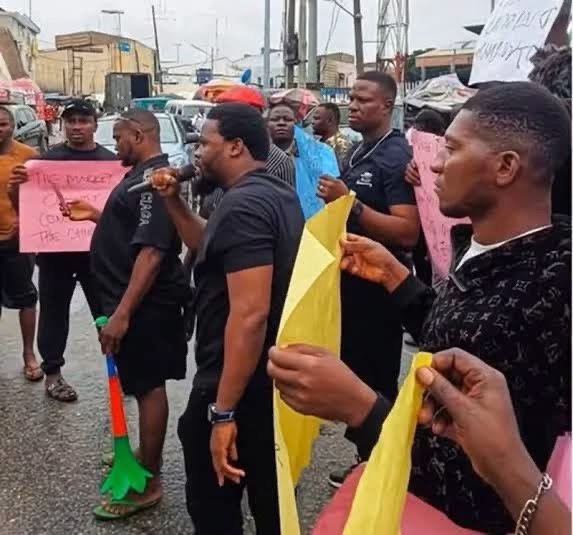
The protest took place at markets within the Trade Fair Complex, where traders carried placards expressing opposition to what they described as the expansion of Chinese businesses from wholesale trading into direct retail sales.
The demonstration was reported on Monday, September 14, 2026, with further reactions from the Lagos State Police Command and representatives of the Chinese business community emerging on Tuesday.
The protesters argued that Chinese businesses with direct access to manufacturers and suppliers in China can obtain goods at lower prices and sell them directly to Nigerian consumers, making it difficult for local retailers to compete.
Traders Raise Concerns Over Retail Competition
According to reports from the protest, some Nigerian traders alleged that Chinese nationals initially came to Nigeria primarily to operate wholesale businesses but that some have increasingly entered the retail market.
One trader, speaking during the demonstration, alleged that some Chinese businesses had rented shops and established warehouses within the Trade Fair Complex before beginning to sell directly to consumers.
The trader also alleged that Chinese businesses were able to offer lower prices because of their direct relationships with manufacturers and suppliers in China.
He said the situation was reducing sales for Nigerian retailers who traditionally purchase imported goods and resell them to consumers.
The allegations made by the protesters have not been independently verified by Weng Global.
Traders Call for Protection of Local Businesses
Some protesters carried placards with messages including “Chinese must go” and “They should go far from our market environment and not be taking our customers.”
However, one of the traders who spoke during the protest said the demonstration was not intended to promote violence against Chinese nationals or damage their businesses.
He said Nigerian traders had maintained business relationships with Chinese merchants but wanted Chinese businesses to refrain from directly competing with local retailers in the same market.
The traders’ concerns centre on competition, pricing and access to customers rather than on Chinese nationality alone, according to accounts of the demonstration.
Police Say Situation at Trade Fair Complex Is Peaceful
The Lagos State Police Command subsequently responded to the situation, saying the Trade Fair Complex remained peaceful.
The Area E Commander, Assistant Commissioner of Police Chike Oti, said during a briefing at the Auto Spare Parts and Machinery Dealers Association market that there had been no fight at the complex.
Oti described those involved in the protest as a small group and said those responsible had been cautioned, with possible arrests to follow.
The police assured Nigerian traders, customers and foreign investors that security had been maintained within the complex.
The Chairman of Amuwo-Odofin Local Government Area, Prince Lanre Sanusi, also spoke during the briefing and said authorities had been informed about the situation.
The police response provides an important counterpoint to reports and social media posts suggesting heightened tension at the market.
Chinese Business Community Responds
A representative of the Chinese business community at the Auto Spare Parts and Machinery Dealers Association also said Chinese traders were continuing their activities peacefully.
The representative said Chinese businesses remained open and were operating within the market without conflict.
She described Nigeria as a major market and said Chinese businesses were interested in continuing to operate in the country.
The response indicates that Chinese traders do not accept the protesters’ characterization of the situation as a threat requiring their withdrawal from the market.
At the time of reporting, there was no evidence cited by the police or market authorities that the protest had resulted in physical clashes or destruction of property.
Dispute Centres on Wholesale and Retail Trading
At the heart of the dispute is the distinction between wholesale and retail trading.
Nigerian traders who participated in the protest argued that Chinese businesses should primarily supply wholesalers rather than compete with Nigerian retailers by selling directly to final consumers.
They claim that Chinese businesses have structural advantages because of their direct links to manufacturers and suppliers in China.
Local traders, by contrast, often operate as importers, distributors or retailers and may incur additional costs before goods reach consumers.
The protesters argue that direct competition at the retail level could make it harder for Nigerian-owned businesses to remain profitable.
However, the allegations about pricing practices, customer solicitation and the precise scale of Chinese involvement in retail trading remain claims made by protesters and have not been independently established.
Wider Business and Economic Context
The dispute highlights a broader question facing Nigeria: how to balance foreign investment and international trade with opportunities for locally owned businesses.
Nigeria maintains extensive commercial ties with China, which is one of the country’s major trading partners. Chinese companies and traders participate in several sectors of the Nigerian economy, while Nigerian businesses also depend heavily on Chinese manufacturers and suppliers for imported goods.
For local retailers, however, increased competition can become particularly sensitive when foreign-owned businesses are perceived to be entering segments traditionally dominated by Nigerian entrepreneurs.
The Lagos Trade Fair Complex is an important commercial centre containing businesses involved in various forms of wholesale, retail, manufacturing and distribution.
Any policy response to the dispute would therefore need to consider existing Nigerian laws governing business registration, immigration, taxation, trade and the participation of foreign nationals in economic activities.
Similar Debate Across Africa
The Lagos dispute comes amid wider debates in several African countries over foreign participation in small and medium-sized businesses.
Kenya, for example, has recently taken measures concerning foreign nationals involved in certain small-scale trading activities, according to reports by Premium Times.
Such developments demonstrate that questions surrounding foreign competition, local enterprise protection and economic openness are not unique to Nigeria.
However, the legal and economic circumstances differ from country to country, and policies adopted elsewhere cannot automatically be applied to Nigeria.
Need for Dialogue and Regulatory Clarity
The events at the Lagos Trade Fair Complex have brought renewed attention to the need for clear rules governing the activities of foreign businesses in Nigeria.
For Nigerian traders, the central concern is whether they can compete fairly in markets where foreign businesses may have different supply chains, financing structures and access to manufacturers.
For foreign investors and traders, clear and consistently enforced regulations are important for maintaining confidence and avoiding uncertainty.
The police intervention and involvement of market authorities could provide an opportunity for dialogue between Nigerian traders, Chinese businesses, market associations and relevant government agencies.
Such engagement could help establish whether any businesses are operating outside the conditions of their permits or applicable Nigerian regulations.
What Happens Next?
The immediate priority is maintaining peace at the Trade Fair Complex while the concerns raised by traders are addressed through appropriate channels.
The Lagos State Police Command has said the situation is under control, while representatives of the Chinese business community have maintained that they are operating peacefully.
The allegations made by Nigerian traders will require verification by the relevant authorities, particularly if they concern violations of immigration, business, tax or trading regulations.
For now, the dispute remains primarily a disagreement over competition and the alleged expansion of Chinese businesses into retail trading.
A sustained resolution is likely to depend on dialogue, enforcement of existing laws and clear rules governing the participation of both Nigerian and foreign businesses in the retail and wholesale sectors.
Weng Global – Stories beyond borders
Sources
- Premium Times — Report published September 15, 2026, on traders protesting alleged Chinese retail trading at the Lagos Trade Fair Complex and the claims made by protesters.
- The Cable — Report published September 15, 2026, on the protest and traders’ allegations that Chinese nationals were selling directly to Nigerian consumers.
- The Punch — Report published September 15, 2026, on the Lagos State Police Command’s response to the Trade Fair Complex protest and statements from police, market authorities and the Chinese business community.
- Business Post Nigeria — Report published September 15, 2026, on Nigerian traders’ complaints about Chinese vendors allegedly selling directly to consumers at lower prices.