Reported Simon Daniel Yusuph l journalist at wengglobal
OSOGBO, Osun State — Afrobeats superstar David Adeleke, popularly known as Davido, has described his uncle Ademola Adeleke’s re-election as Governor of Osun State as an exceptionally difficult political contest, saying the incumbent prevailed despite what he characterised as the combined weight of numerous political heavyweights.
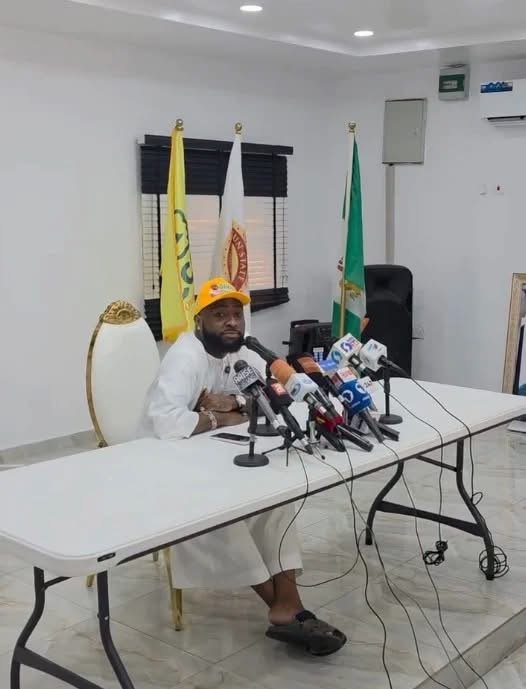
Davido made the remarks on Tuesday, August 18, 2026, while addressing journalists at a surprise congratulatory gathering held in honour of Governor Adeleke following his victory in the August 15 Osun State governorship election.
The singer said the contest was far more than an ordinary political battle, describing it as a “war” in which, according to him, 17 governors, about 50 senators and members of the House of Representatives were mobilised against his uncle.
“Let me congratulate my governor for his re-election for the hard-fought battle. Let me not say battle but war, where you have 17 governors, 50 senators, House of Reps, I don’t know how many they were against one man and he came out victorious. God is good,” Davido said.
His comments were reported by New Telegraph and Daily Post in coverage of the post-election celebration, with the singer also praising Osun voters for what he described as their determination to support Adeleke and protect their ballots. (New Telegraph)
Davido credits Osun voters for Adeleke’s victory
Beyond celebrating his uncle, Davido attributed the outcome to voters across the state, saying the support demonstrated by residents during the election was particularly moving to him and other members of the Adeleke family.
He said he became emotional several times during election day because of what he described as the scale of public support for the governor.
The musician also praised voters for remaining engaged from polling units through the collation process, portraying the result as an expression of the electorate’s preference.
The remarks come after months of intense political campaigning in Osun, where Adeleke sought a second term under the Accord Party against a field of 13 challengers.
The Independent National Electoral Commission had listed 14 political parties and their candidates for the August 15 governorship election. The major contenders included Adeleke of Accord, All Progressives Congress candidate Munirudeen Bola Oyebamiji and African Democratic Congress candidate Najeem Salam. (Punch Newspapers)
The contest attracted significant national attention because of the political influence surrounding the APC campaign and the strategic importance of Osun ahead of the 2027 general elections.
A high-stakes political contest
Davido’s reference to 17 governors and 50 senators reflects the wider political dimension of the election rather than a conventional description of the candidates on the ballot.
The APC’s campaign drew support from senior party figures and governors, while its national structure treated the Osun contest as an important opportunity to reclaim a state the party lost to Adeleke in 2022.
The APC candidate, Bola Oyebamiji, repeatedly presented himself as the candidate capable of restoring the state to the party and claimed to have President Bola Tinubu’s support. In June, Oyebamiji said he was the president’s “only anointed candidate” for the Osun governorship election. (The Nation)
The APC also established a national campaign council chaired by Imo State Governor Hope Uzodimma, with senior political figures including Senate President Godswill Akpabio and House of Representatives Speaker Tajudeen Abbas listed in leadership roles.
The scale of the mobilisation helps explain why Davido characterised the election as a contest against formidable political forces.
However, his numerical reference to 17 governors and 50 senators should be understood as his description of the political forces he believed were arrayed against Adeleke, rather than as an independently verified count of every politician who formally campaigned against the governor.
That distinction is important for maintaining factual accuracy in reporting the singer’s post-election comments.
Adeleke’s political journey
The victory represents another significant milestone in Adeleke’s political career.
He first became governor after winning the 2022 Osun governorship election on the platform of the Peoples Democratic Party, defeating the then-incumbent Governor Adegboyega Oyetola of the APC.
In that election, INEC declared Adeleke the winner with 403,371 votes against Oyetola’s 375,027 votes. Adeleke won 17 of the state’s 30 local government areas, while Oyetola secured 13. (Punch Newspapers)
The 2026 election was different in several respects.
Adeleke was no longer contesting under the PDP. After a prolonged internal crisis within the party’s Osun structure, he left the PDP and joined Accord, subsequently emerging as the party’s governorship candidate.
The PDP itself did not field a candidate in the 2026 election, according to the final list released by INEC. (Punch Newspapers)
Adeleke secured Accord’s ticket after polling 145 votes out of 150 delegates at the party’s primary in Osogbo, with five ballots declared void. INEC representatives observed the exercise. (Thisdaylive)
His re-election campaign consequently became both a personal contest for another term and a test of whether his political structure could survive outside the party platform that originally brought him to office.
Davido’s role in the campaign
Davido was not a passive supporter during the election campaign.
The international music star became one of the most visible personalities in Adeleke’s re-election effort after being appointed head of youth mobilisation for the campaign.
In May, he inaugurated the Imole Youth Campaign Mobilisation Team and announced that he would temporarily suspend his music activities to focus on his uncle’s campaign.
The PUNCH reported that Davido led a 43-member youth committee covering the state’s senatorial districts, federal constituencies and local government areas. (Punch Newspapers)
The singer also obtained an Accord Party membership card and formally declared his political support for Adeleke’s second-term bid.
Channels Television and other major Nigerian outlets previously reported on Davido’s increasing involvement in the campaign, while The PUNCH reported that he used his public profile to mobilise young voters and campaign for continuity. (Punch Newspapers)
His role was particularly significant because of his popularity among young Nigerians and his ability to command large audiences through entertainment platforms and social media.
Davido also became increasingly vocal about electoral integrity during the campaign.
In June, he warned against attempts to manipulate the Osun election and said he would be present to defend the votes. The Nation reported that he pledged to be on the ground on election day and urged supporters to protect the electoral process. (The Nation)
Davido urges leaders to learn from Adeleke
At the congratulatory gathering, Davido went beyond celebrating the election result and presented Adeleke’s victory as an example for other political leaders.
He argued that the result demonstrated the importance of maintaining a direct relationship with voters and delivering programmes that affect ordinary citizens.
“My uncle should be an example to all other people out there. It shows all other governors out there that if you work for the people, the people will be with you and God,” Davido said, according to New Telegraph. (New Telegraph)
The statement reflects one of the central themes of Adeleke’s re-election campaign, which focused heavily on his administration’s record in infrastructure, healthcare, education, agriculture and economic development.
Adeleke had promoted an updated five-point agenda built around citizen and worker welfare, infrastructure, agro-industrial expansion, healthcare and education, and an improved business environment for job creation. (Osun State Official Website)
The governor and his campaign argued that his administration’s performance justified another term.
Opposition parties, however, offered a different assessment and accused the government of shortcomings in areas including resource management and infrastructure delivery.
That political disagreement formed a major part of the campaign and remains relevant as Adeleke begins his second term.
Davido announces sports and youth development plans
Beyond politics, Davido used the occasion to disclose plans for youth and sports development in Osun State.
The singer, who serves as chairman of the state’s Sports Trust Fund, said he had deliberately waited until after the election before pursuing some of his proposed initiatives.
According to his remarks reported by New Telegraph, the plans include supporting the development of a recreational centre for young people equipped with facilities such as football fields, swimming pools and basketball courts. (New Telegraph)
The proposed initiative could become one of the most visible areas of Davido’s involvement in Osun beyond electoral politics.
Nigeria’s youth population represents a substantial potential workforce and talent pool, while sports remain a major avenue for employment, social development and international visibility.
If implemented effectively, investment in grassroots sports facilities could provide young people with structured opportunities to develop athletic skills and participate in organised activities.
However, the success of such a project will ultimately depend on transparent funding, proper planning, maintenance and accessibility to young people across the state rather than only in selected communities.
What Adeleke’s second term means for Osun
Adeleke’s re-election now shifts attention from the political contest to governance.
Having secured another mandate, the governor faces expectations from voters who supported him and scrutiny from opponents who challenged his administration.
The first major test will be whether his government can translate campaign promises into measurable improvements in areas such as employment, infrastructure, healthcare, education and economic opportunities.
The governor’s supporters have argued that his first term produced visible improvements, while opponents have maintained that significant challenges remain.
The political environment also means that the administration will be expected to work beyond partisan divisions.
The August election was preceded by heightened political tension, prompting candidates to sign a peace accord ahead of the poll. The Nation reported that Adeleke, Oyebamiji and 12 other candidates or their representatives signed the agreement on July 31. (The Nation)
That backdrop makes the post-election period particularly important.
A credible transition from campaign politics to governance will require attention to the concerns of voters who supported different candidates, as well as those who did not participate in the election.
A victory with wider political implications
For Davido and the Adeleke family, the result represents a major political achievement.
For Osun State, however, the significance of the election extends beyond a family celebration.
The poll was widely viewed as an important test of Nigeria’s electoral institutions ahead of the 2027 general elections. Civil society organisations and observers had urged political actors to maintain peaceful and issue-based campaigns and warned that voter inducement and political violence could undermine public confidence in the process. (The Guardian Nigeria)
Davido’s description of the election as a “war” therefore captures the intensity of the political contest but also underscores the need for restraint after the ballots have been counted.
Political competition ends with the declaration of results; governance begins afterwards.
As Adeleke settles into his second term, the central question will be whether the administration can convert electoral support into sustained improvements in living standards and economic opportunity across Osun State.
For Davido, the next phase appears likely to focus partly on youth development and sports, areas where he says he intends to use his public profile and position within the state’s sports structure to contribute to development.
The singer’s intervention in Osun politics has demonstrated the growing role of celebrity influence in Nigerian electoral campaigns. But the durability of that influence will ultimately be judged not by campaign crowds or social media engagement, but by whether political participation translates into meaningful civic and developmental outcomes.
For now, Davido is celebrating what he sees as a remarkable political victory for his uncle.
His “war” description has become one of the defining soundbites from the aftermath of the 2026 Osun governorship election, while his call for leaders to emulate Adeleke places renewed emphasis on the relationship between political performance and electoral support.
The next four years will determine whether that political narrative becomes a lasting record of governance or simply another campaign-era claim.
Sources
- New Telegraph — Osun Election: Davido Promises Sports Development for Youths
- Daily Post — Osun Election: 17 Govs, 50 NASS Members Against One Man — Davido
- The PUNCH — Davido Leads Youth Push for Adeleke, Takes Break From Music
- The PUNCH — Davido Backs Adeleke’s Re-election and Joins Campaign Mobilisation
- The Nation — Osun 2026: I’ll Be Available to Defend Votes, Davido Assures Adeleke
- The Guardian Nigeria — Adeleke, Oyebamiji Get Kudos for Political Maturity Ahead of Osun Poll
- Osun State Government — Governor Adeleke Says His Re-election Is Unstoppable as Davido Drums Support
- The PUNCH — INEC Finalises Candidates for 2026 Osun Governorship Poll