Reported by Simon Daniel Yusuph l Journalist at Weng Global
The Nigerian Air Force (NAF) has taken delivery of five new helicopters as part of the Federal Government’s ongoing efforts to modernise Nigeria’s airpower and strengthen military operations against terrorism, kidnapping and banditry.
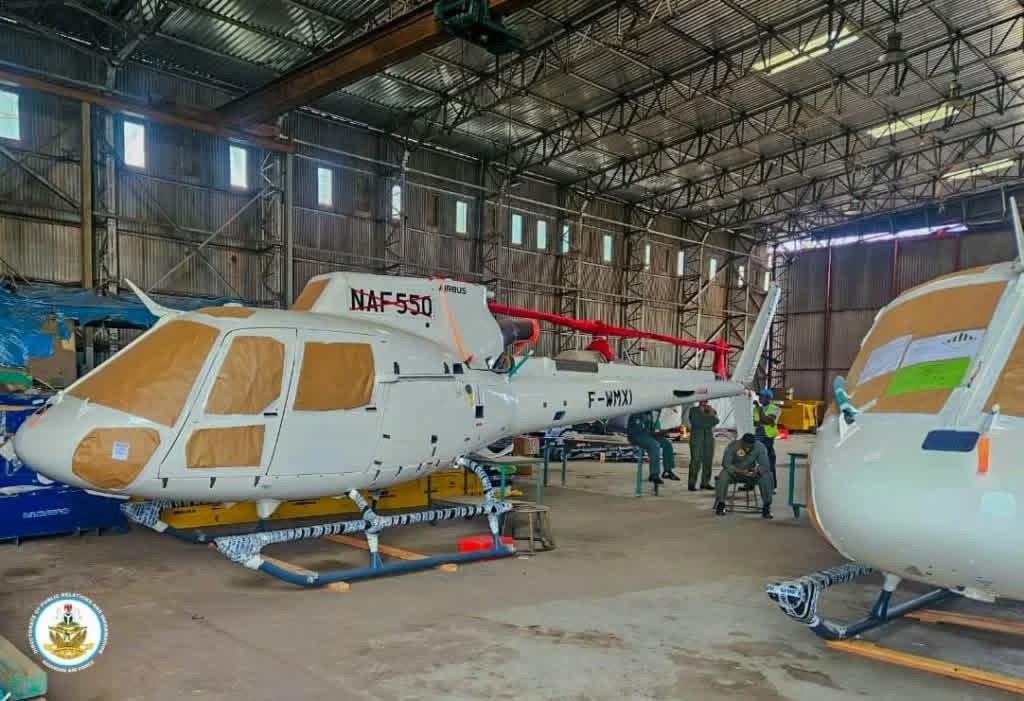
The newly delivered platforms comprise three AW-109 Trekker B helicopters manufactured by Leonardo Helicopters of Italy and two H-125 helicopters produced by Airbus Helicopters.
The latest acquisition is expected to increase the availability of rotary-wing aircraft for military operations while improving the Nigerian Air Force’s ability to provide air support to troops operating across different security theatres.
According to the Nigerian Air Force, the three AW-109 Trekker B helicopters arrived in Lagos on September 15, 2026, while the two H-125 helicopters had been delivered earlier.
The three AW-109s are part of a larger procurement of 10 helicopters by the Federal Government. The NAF said the remaining seven aircraft are expected to be delivered before the end of 2026.
NAF Expands Rotary-Wing Capability
The arrival of the helicopters represents another step in Nigeria’s efforts to expand and modernise the operational capabilities of its armed forces.
The Chief of the Air Staff, Air Marshal Sunday Aneke, described the acquisition as a significant milestone in the government’s sustained investment in the modernisation and re-equipment of the Nigerian Air Force.
Aneke said the additional helicopters would improve the availability of aircraft and strengthen the service’s responsiveness across multiple operational theatres.
He said the new platforms would provide greater flexibility in the use of airpower in support of ground troops engaged in ongoing operations.
For a military facing simultaneous security challenges in different parts of the country, the ability to deploy helicopters quickly can be important for troop support, surveillance, evacuation and other missions.
AW-109 Trekker B Helicopters to Support Multiple Missions
The AW-109 Trekker B helicopters are expected to play several roles within the Nigerian Air Force’s operational structure.
According to the NAF, the aircraft will strengthen capabilities in intelligence, surveillance and reconnaissance, close air support, armed escort and combat search and rescue, among other joint operations.
These functions are particularly relevant to Nigeria’s counterterrorism and internal security campaigns, where military units often operate across difficult terrain and in areas where rapid air support can be crucial.
The helicopters can also provide commanders with greater flexibility in responding to emerging threats and supporting troops deployed away from major military bases.
The NAF has increasingly emphasised the importance of modern aircraft, improved logistics and greater operational availability as part of its broader effort to transform the service.
H-125 Helicopters Add Light Aviation Capability
The two H-125 helicopters will provide another layer of operational flexibility.
The NAF said the aircraft would offer versatile light-helicopter support for different operational requirements.
While the AW-109 Trekker B platforms are expected to contribute to a range of military missions, including surveillance and close air support, the H-125s can provide additional capacity for lighter aviation tasks.
The combination of different helicopter platforms gives the Air Force a broader range of aircraft options for missions depending on operational requirements.
This is particularly relevant in a security environment where the military may need to conduct surveillance, troop support, transportation, search and rescue and other missions simultaneously.
New Helicopters Still Undergoing Operational Preparation
Although the five helicopters have now been delivered, they are not immediately being treated as fully operational assets.
The Nigerian Air Force said the newly delivered platforms were undergoing post-delivery assembly ahead of their formal induction and operationalisation.
The process includes technical preparations and crew-readiness activities designed to ensure that the aircraft can be safely and effectively deployed.
The development highlights an important aspect of military aviation procurement: acquiring aircraft is only one part of building sustainable airpower.
Aircraft require trained pilots, engineers, technicians, spare parts, maintenance facilities, logistics support and reliable operational planning before they can consistently deliver their intended capabilities.
The NAF leadership said it would prioritise effective employment, maintenance and logistics sustainment to ensure the new helicopters contribute meaningfully to ongoing operations.
Support for Counterterrorism and Anti-Banditry Operations
Nigeria continues to face a complex security environment involving terrorism, banditry, kidnapping and other forms of armed violence.
The Nigerian military has been conducting operations across several regions, including the North-East, North-West and North-Central zones.
In this environment, airpower has become an important component of joint military operations, allowing aircraft to provide surveillance, reconnaissance, troop support and other forms of assistance to ground forces.
The NAF said the increased rotary-wing capacity would strengthen support for joint forces conducting operations against terrorism, kidnapping and banditry.
The service also said the acquisition was expected to improve the speed, reach and effectiveness of air support provided to troops on the ground.
The significance of the latest delivery therefore extends beyond the number of aircraft involved. It forms part of a wider effort to improve the ability of Nigeria’s armed forces to respond to security threats through better-equipped and more sustainable military capabilities.
Nigeria’s Broader Airpower Modernisation
The delivery also fits into a wider programme of Nigerian Air Force modernisation that has involved the acquisition and induction of different aircraft over recent years.
Nigeria has invested in both fixed-wing and rotary-wing platforms as the military seeks to improve its ability to conduct counterterrorism, counterinsurgency and other security operations.
The NAF has previously expanded its fleet with platforms such as A-29 Super Tucano aircraft and other helicopters and surveillance assets.
The service has also been working with international partners on additional capabilities, including the planned acquisition of AH-1Z attack helicopters from the United States.
The modernisation programme is aimed not simply at increasing the number of aircraft in the fleet but also at improving the service’s ability to maintain aircraft, train personnel and sustain operations over time.
This distinction is important because the effectiveness of military aviation depends heavily on aircraft availability rather than simply the size of the total fleet.
US-Nigeria Defence Cooperation Continues
The latest helicopter delivery comes at a time when Nigeria is also deepening aspects of its defence cooperation with international partners.
Earlier in September, the United States delivered military equipment to the Nigerian Air Force under a Foreign Military Sales arrangement.
The US Africa Command said the equipment delivery was intended to support Nigerian-led efforts to counter terrorism in the region and strengthen the security partnership between Washington and Abuja.
The delivery of the US equipment, alongside Nigeria’s own investment in new aviation platforms, illustrates the combination of domestic procurement, international cooperation and military capacity-building being used to address the country’s security challenges.
However, the success of these investments will ultimately depend on how effectively the equipment is integrated into operational structures and maintained.
Why the Helicopter Delivery Matters
For communities affected by terrorism, kidnapping and banditry, improvements in military aviation can have direct security implications.
Helicopters can provide mobility and operational support in areas where conventional ground movement may be difficult or dangerous.
They can also support reconnaissance missions, search-and-rescue operations and other activities requiring rapid deployment.
For the Nigerian Air Force, the additional aircraft could therefore help address one of the persistent challenges facing military aviation: maintaining sufficient aircraft availability while supporting operations across a large geographical area.
At the same time, new aircraft alone cannot resolve Nigeria’s security challenges.
Effective intelligence gathering, cooperation between security agencies, ground-force capabilities, logistics, community engagement and sustained training remain critical components of a broader security strategy.
The new helicopters should therefore be viewed as part of a wider national security effort rather than a standalone solution.
What Happens Next?
The immediate priority for the Nigerian Air Force is to complete the technical, assembly and crew-readiness processes required before the newly delivered helicopters are formally inducted and deployed.
The NAF has also indicated that the remaining seven AW-109 helicopters from the 10-aircraft procurement are expected to arrive before the end of 2026.
Once operationalised, the new aircraft are expected to strengthen the service’s rotary-wing capacity and provide additional support to troops engaged in ongoing security operations.
The effectiveness of the investment will depend on sustained maintenance, availability of spare parts, adequate training and the ability of the Air Force to integrate the aircraft into coordinated joint operations.
For Nigeria, the broader objective remains clear: build an air force capable of responding more quickly and effectively to evolving security threats while protecting civilians and supporting troops on the ground.
Weng Global – Stories beyond borders
Sources
- Nigerian Air Force (NAF) — Official information on the delivery, modernisation programme, operationalisation and intended roles of the new helicopters.
- Punch Newspapers — September 15, 2026 report on the delivery of the five helicopters and statements by Chief of the Air Staff Air Marshal Sunday Aneke.
- U.S. Africa Command (AFRICOM) — Information on recent US military equipment support to Nigeria and ongoing counterterrorism cooperation.
- Channels Television — Reporting on the September 2026 US military equipment delivery to Nigeria and the wider defence partnership.
- TheCable — Reporting on US military support and Nigeria’s ongoing counterterrorism cooperation with the United States.