Reported by Weng Patrick Atokor l Journalist at Weng Global
Leaders of nationalist parties in Scotland, Wales and Northern Ireland have signed a joint memorandum asserting their nations’ right to self-determination and calling on the British Government to prepare for possible constitutional change.
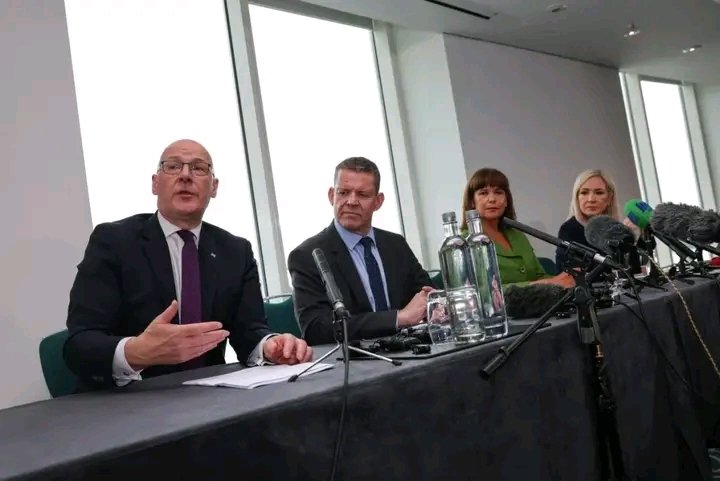
The agreement was signed in Cardiff, Wales, on Monday, September 14, 2026, by leaders of the Scottish National Party (SNP), Plaid Cymru and Sinn Féin.
The development represents a significant new challenge to the constitutional structure of the United Kingdom, although it does not itself create a legal process for Scotland, Wales or Northern Ireland to leave the UK.
The parties said their nations should have the ability to determine their own constitutional futures and argued that Westminster should not prevent democratic decisions on independence or Irish reunification.
What the Parties Agreed
The memorandum was signed by SNP leader and Scottish First Minister John Swinney, Plaid Cymru leader and Welsh First Minister Rhun ap Iorwerth, and Sinn Féin leaders Michelle O’Neill and Mary Lou McDonald.
O’Neill is also First Minister of Northern Ireland, while McDonald is president of Sinn Féin and leader of the opposition in Ireland.
The leaders met as political party leaders rather than as representatives formally acting on behalf of their respective governments. That distinction is important because the agreement is a political commitment between parties rather than a constitutional settlement that automatically changes the UK’s legal arrangements.
The memorandum states that Scotland, Wales and Ireland have a right to self-determination and calls for the British Government to prepare for, plan and facilitate constitutional change in each jurisdiction.
It also acknowledges that the three parties have different constitutional positions and that each nation will determine its future according to its own circumstances and timetable.
The parties further expressed a desire to strengthen cooperation in areas including economic development, energy, international relations and relationships with the European Union.
They also argued that their countries’ future should involve stronger European links.
A Coordinated Challenge to Westminster
The agreement is significant because pro-independence or pro-unification parties now lead the devolved governments in Scotland, Wales and Northern Ireland.
The SNP campaigns for Scottish independence, while Plaid Cymru supports Welsh independence. Sinn Féin seeks the reunification of Northern Ireland with the Republic of Ireland.
Although the objectives are different, the parties have found common ground around the broader principle that people in the three jurisdictions should have a decisive say over their constitutional future.
The memorandum describes the political landscape across the islands as changing and argues that constitutional change is becoming increasingly important.
John Swinney said the parties were united around the principle of self-determination, while the agreement called for greater cooperation between the movements.
The development therefore goes beyond a single independence campaign. It represents an attempt by three political movements to coordinate their positions and increase pressure on the government in London.
Scotland’s Independence Question
Scotland’s constitutional debate has been active for more than a decade.
In 2014, Scottish voters were given the opportunity to decide whether Scotland should become independent from the United Kingdom. The proposal was rejected, with 55 percent voting to remain in the UK and 45 percent voting for independence.
The SNP has continued to campaign for another referendum.
Swinney has recently increased pressure on Prime Minister Andy Burnham to establish a legal mechanism that would allow another Scottish independence vote. Earlier in September, the Scottish First Minister wrote to Burnham after the prime minister compared the circumstances for a Scottish referendum with the need for a clear consensus on Irish unity.
The Scottish Government has also separately strengthened cooperation with Wales through the Cardiff Agreement, covering areas such as economic growth, child poverty, climate policy, international engagement and relations with the European Union.
However, signing the new political memorandum does not automatically give Scotland the legal authority to hold another independence referendum.
That remains one of the central constitutional disputes between Edinburgh and Westminster.
Wales Takes a Different Approach
Wales also has a growing independence movement, but its political position differs from Scotland’s.
Plaid Cymru supports Welsh independence, yet its leadership has indicated that the question does not necessarily require an immediate referendum.
The party’s approach has included building support for greater Welsh autonomy while focusing on economic, social and political issues affecting the country.
The recent agreement nevertheless places Welsh independence firmly within the wider constitutional discussion.
The Welsh Government and Scottish Government have separately agreed to cooperate on issues ranging from living standards and child poverty to economic development, climate change, culture and relations with Europe.
The political significance of the Cardiff meeting is therefore not limited to a demand for independence. It also creates a framework for closer cooperation between political movements and governments in areas where their interests overlap.
Northern Ireland Has a Different Legal Path
Northern Ireland’s constitutional position is different from that of Scotland and Wales.
Under the 1998 Good Friday Agreement, which helped end decades of conflict known as the Troubles, a referendum on Irish unity can be held if the UK Secretary of State for Northern Ireland believes it is likely that a majority would vote for Northern Ireland to leave the UK and join a united Ireland.
That means Northern Ireland has an established legal pathway for a potential constitutional change that does not exist in exactly the same form for Scotland or Wales.
Sinn Féin has continued to advocate for Irish reunification, and Michelle O’Neill has argued that the question of Irish unity is becoming increasingly relevant.
Recent comments from US President Donald Trump supporting Irish reunification have also brought additional international attention to the issue. O’Neill said the remarks demonstrated that the unity debate remained active.
The question remains politically sensitive, particularly because Northern Ireland’s constitutional future is closely connected to the political identities and historical experiences of both nationalist and unionist communities.
London Opposes Break-Up of the Union
The agreement is likely to intensify political pressure on the UK Government.
Prime Minister Andy Burnham has maintained his support for the United Kingdom’s union. His government has faced demands from nationalist parties over the constitutional future of the devolved nations.
The British Government’s position is particularly important because Westminster retains control over major constitutional matters, including the legal framework governing independence referendums.
The UK operates under a devolved system in which Scotland, Wales and Northern Ireland have their own elected institutions and significant responsibilities in areas such as health, education, transport and other domestic matters.
However, powers including defence and foreign affairs remain primarily controlled at the UK level.
This creates the central tension behind the new agreement: nationalist parties argue that the people of their nations should have the right to determine their futures, while the UK Government maintains the constitutional authority of the United Kingdom.
Why the Agreement Matters
The Cardiff memorandum does not mean that the United Kingdom is about to break apart.
There is no automatic independence process triggered by the document, and Scotland, Wales and Northern Ireland face different legal and political circumstances.
Its importance lies instead in the level of political coordination it represents.
For the first time in the current devolved political landscape, leading parties in all three jurisdictions have formally presented a shared argument for self-determination while agreeing to cooperate on practical policy issues.
The memorandum also connects constitutional questions with broader issues such as economic policy, energy, international relations and European cooperation.
That could make the debate more consequential than a narrow argument over whether individual territories should become independent.
For supporters, the agreement provides an opportunity to argue that Scotland, Wales and Northern Ireland can develop closer relationships with each other and with Europe while making decisions independently from Westminster.
For unionists, however, the agreement raises concerns about the future stability and integrity of the United Kingdom.
Public Support Remains Mixed
Political momentum does not necessarily translate into majority support for independence.
Recent polling cited by international media has shown varying levels of support across the three jurisdictions.
One Survation poll cited by Al Jazeera put support for Scottish independence at 47 percent, while other surveys placed support for Irish reunification and Welsh independence at lower levels.
This illustrates the gap between political leadership and public opinion.
The three parties may now share a stronger institutional position, but any future constitutional change would still depend on political negotiations, legal mechanisms and, where required, public consent.
The situation is particularly complex in Wales, where independence has historically attracted less support than in Scotland, while Northern Ireland’s debate is shaped by the distinct provisions of the Good Friday Agreement.
What Happens Next?
The immediate consequence of the Cardiff agreement is likely to be increased political pressure on Westminster.
The nationalist parties are expected to continue campaigning for mechanisms that would allow their respective populations to decide their constitutional futures.
Scotland’s SNP is likely to maintain its push for another independence referendum, while Plaid Cymru will continue its longer-term campaign for greater Welsh autonomy and independence.
In Northern Ireland, Sinn Féin is expected to continue advocating for preparations for a potential referendum on Irish reunification.
However, the timing and legal conditions for any future votes remain unresolved.
The British Government will therefore face continued pressure to clarify how it intends to respond to demands for constitutional change while maintaining the United Kingdom.
For now, the Cardiff agreement should be understood as a major political declaration rather than an immediate legal step towards the dissolution of the UK.
What happens next will depend on public opinion, elections, negotiations between devolved administrations and Westminster, and the ability of nationalist parties to turn political momentum into sustained public support.
The agreement has nevertheless placed the future structure of the United Kingdom firmly back at the centre of European political debate.
Weng Global – Stories beyond borders
Sources
- Scottish Government — Cardiff Agreement and Scotland-Wales cooperation.
- AFP — Report on the September 14 Cardiff meeting and memorandum on self-determination.
- Associated Press — Analysis of the new challenge to UK unity.
- BBC/ABC News — Background on the positions of Scotland, Wales and Northern Ireland.
- The Guardian — Reporting on the Cardiff summit and constitutional demands.
- Irish Times — Details of the SNP, Plaid Cymru and Sinn Féin memorandum.