Reported by Weng Patrick Atokor l Journalist at Weng Global
The Social Democratic Party (SDP) has outlined an economic and governance programme it says would rebuild and transform Nigeria if it wins the 2027 presidential election, placing poverty, insecurity, electricity, employment, productivity and institutional reform at the centre of its proposed agenda.
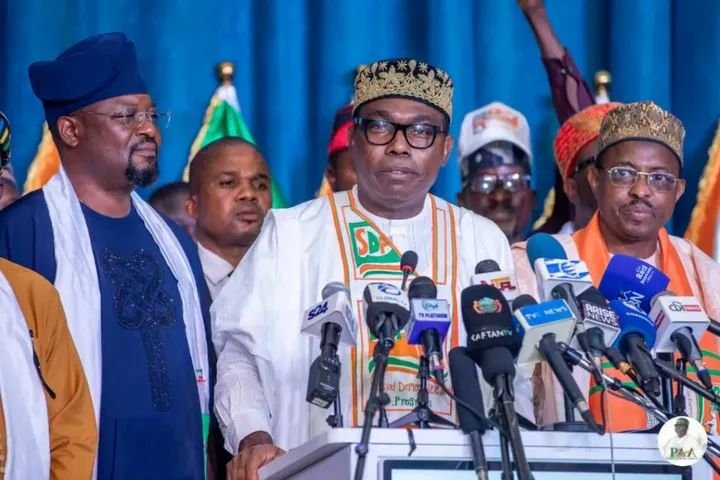
The party’s presidential candidate, Prince Adewole Adebayo, presented a policy blueprint in Abuja in September 2026 titled “Farewell to Poverty and Insecurity: Governance & Accelerated Development – Blueprint of a New Nigeria, 2027–2031.”
According to reports on the presentation, the blueprint is intended to set out the party’s proposed priorities for a four-year administration. The SDP says its approach would focus on measurable improvements in citizens’ living standards rather than simply counting government projects.
The proposals come as political parties begin positioning themselves ahead of Nigeria’s 2027 general elections, with economic conditions, insecurity, employment and the cost of living expected to remain major issues in the national political debate.
What is the SDP proposing?
The SDP’s 2027 blueprint focuses on several broad areas, including security, economic productivity, human development, social welfare, infrastructure and institutional reform.
Adebayo has argued that Nigeria’s problems are not caused by a lack of natural resources or human potential but by weaknesses in governance and economic management.
The party’s proposed programme therefore seeks to link government spending and policy decisions to measurable outcomes for citizens.
Among the issues highlighted by the SDP are poverty, unemployment, insecurity, inadequate electricity supply, low productivity and challenges affecting education and social welfare.
The party has also presented its proposals as an alternative approach to economic management, with greater emphasis on productivity, employment and infrastructure.
Electricity is a major part of the proposal
One of the most ambitious elements associated with Adebayo’s 2027 programme is electricity generation.
Earlier in August, the SDP presidential candidate said an administration led by him would seek to increase Nigeria’s electricity generation capacity substantially, with a target ranging between 50,000 and 75,000 megawatts.
The Guardian reported that Adebayo’s five-point agenda included tackling insecurity, unemployment, low productivity, inadequate electricity supply and weak institutions.
The electricity proposal is significant because unreliable power supply has long affected Nigerian households and businesses, particularly manufacturers and small businesses that depend on alternative sources of electricity.
However, the proposed generation target is an objective of the SDP rather than an achieved result. Whether such a target could be delivered would depend on factors including investment, transmission capacity, distribution infrastructure, regulation, gas supply and the financial condition of the electricity sector.
That distinction is important when evaluating political campaign promises: a proposed target should not be confused with a guaranteed outcome.
Tackling poverty and insecurity
The SDP has placed poverty and insecurity at the centre of its proposed political programme.
The blueprint’s title, Farewell to Poverty and Insecurity, reflects the party’s stated intention to address the two issues through a combination of economic and security policies.
Voice of Nigeria reported that the party said it would focus on poverty, insecurity, education and national productivity if elected.
Adebayo has also proposed stronger community-level security structures and action against terrorism, kidnapping, illegal mining and other criminal activities.
The party’s position is that security cannot be treated solely as a military issue. Its proposals link security with economic opportunity, local development and institutional effectiveness.
This is an important part of the SDP’s argument because insecurity in Nigeria has economic consequences beyond the immediate threat to lives and property. Persistent insecurity can disrupt farming, trade, transport, investment and access to education and healthcare.
The effectiveness of any proposed security strategy, however, would depend on implementation, coordination among security institutions, intelligence gathering, policing, judicial processes and the capacity of government at federal and subnational levels.
Economic productivity and jobs
The SDP also says Nigeria needs to move beyond economic growth figures and concentrate on productivity and employment.
Adebayo has argued that economic growth should translate into jobs, higher productivity, improved living standards and better opportunities for businesses.
The party’s approach therefore places employment and productive activity alongside traditional economic indicators.
This distinction matters because an economy can record growth without every household experiencing an equivalent improvement in income or living standards.
The SDP has also proposed measures aimed at improving public revenue management and separating public officials from government contracting, according to reports of Adebayo’s campaign proposals.
Such measures are presented by the party as part of a broader effort to improve transparency and reduce conflicts of interest in public administration.
Proposed reforms go beyond the economy
The SDP’s programme is not limited to economic policy.
Its stated objectives also include institutional reform and changes to governance.
The party’s official policy material describes its broader mission in terms of social justice, democratic governance, accountable leadership and economic development.
Its stated principles include transparency, accountability, the rule of law, social democracy and sustainable development.
The SDP therefore presents its 2027 programme as a governance project as well as an economic programme.
This means the party’s campaign argument is not simply that Nigeria needs more infrastructure or higher economic output. It is also arguing that institutions and government processes must change if economic reforms are to produce lasting results.
What does the blueprint mean for ordinary Nigerians?
For ordinary citizens, the significance of the SDP’s programme lies in whether its proposed policies would eventually translate into practical improvements.
For households, the most directly relevant issues are likely to include employment, electricity, security, education, healthcare, purchasing power and access to economic opportunities.
For businesses, electricity reliability, infrastructure, taxation, regulation, access to finance and economic stability would be important.
For communities affected by insecurity, the effectiveness of proposed security measures would be particularly significant.
The SDP says its proposed approach would judge government performance through measurable improvements in citizens’ welfare.
That creates an important question for voters: how would the party measure progress, how quickly would its targets be achieved, and what mechanisms would be used to hold an administration accountable if those targets were not met?
Those are questions that campaign promises alone cannot answer.
The electricity target requires major infrastructure
The SDP’s proposed electricity target also illustrates the scale of the challenge facing any government seeking to transform Nigeria’s power sector.
Generating electricity is only one part of the electricity system. Power must also be transmitted across the country and distributed to homes and businesses.
Consequently, a substantial increase in generation would require corresponding improvements in transmission and distribution infrastructure.
The proposal would also have to be considered alongside the country’s existing electricity market structure, investment requirements and the availability of energy resources.
For that reason, the SDP’s electricity target should be understood as a campaign objective requiring substantial implementation rather than as an immediate guarantee of improved power supply.
The party’s proposed four-year timeframe
Adebayo has argued that four years is sufficient for a focused government to produce structural results.
The party’s blueprint covers the proposed 2027–2031 period.
The significance of this timeframe is that it gives voters a basis for examining what the SDP says could be achieved within one presidential term.
However, some of the proposals involve large-scale infrastructure and institutional changes that could extend beyond a single administration.
The practical question would therefore be not only what could be started within four years, but also which programmes could produce measurable results during that period and which would require longer-term implementation.
How the SDP is positioning itself for 2027
The SDP is presenting itself as a political alternative centred on policy and institutional reform.
In recent months, Adebayo has repeatedly emphasised poverty, insecurity, unemployment, electricity and productivity in his campaign messaging.
The party has also described its approach as ideas-based governance, arguing that political debate should focus on the problems facing Nigerians and proposed solutions.
The SDP’s official materials similarly describe its mission around rebuilding Nigeria, social justice, accountable governance and people-centred development.
These positions form part of the party’s political platform ahead of the 2027 election.
They should therefore be distinguished from independently established evidence about whether the proposed policies would succeed if implemented.
What should Nigerians watch next?
The next stage of the SDP’s campaign will provide an opportunity to examine how its broad proposals would translate into specific policies.
Among the questions to watch are how the party would finance its proposed infrastructure programmes, how it would achieve its electricity targets, how it would address insecurity, and how it would measure improvements in employment and living standards.
The details of implementation are particularly important because ambitious campaign targets require financing, institutions, personnel, legislation and administrative capacity.
Voters can also examine how the SDP’s proposals compare with the programmes of other political parties without relying solely on campaign slogans.
Why this matters
The SDP’s 2027 blueprint adds another set of policy proposals to Nigeria’s growing political debate ahead of the next presidential election.
Its emphasis on poverty, insecurity, productivity, electricity and institutional reform reflects some of the central challenges facing the country.
But the distinction between a political promise and an established result remains important.
The SDP can set targets and propose policies, but whether those proposals would achieve their intended results would ultimately depend on implementation, resources, institutions and circumstances.
For Nigerian voters, the most useful way to assess the programme is therefore to examine the details: what the party proposes, how it intends to pay for it, how it would implement the policies, what measurable targets it has established and how its performance would be evaluated.
That provides a more substantive basis for understanding the 2027 political debate than campaign slogans alone.
What Happens Next?
The SDP is expected to continue its political mobilisation and policy messaging ahead of the 2027 general elections.
The party’s presidential blueprint provides the framework for its proposed 2027–2031 programme, but further campaign activity and policy explanations will be important in determining how its broad objectives would be implemented.
As the election approaches, the public debate is likely to focus increasingly on the feasibility, financing and expected effects of competing political parties’ proposals.
Weng Global – Stories beyond borders
Sources
- Social Democratic Party — official policy and mission materials
- Premium Times
- Voice of Nigeria
- The Guardian
- Blueprint Newspapers
- Leadership