Reported by Simon Daniel Yusuph l Journalist at Weng Global
Plateau State Governor, Caleb Mutfwang, has accused the administration of former President Muhammadu Buhari of committing Nigeria’s future crude oil resources through advance-sale arrangements, claiming that the administration of President Bola Ahmed Tinubu is still dealing with financial obligations arising from such transactions.
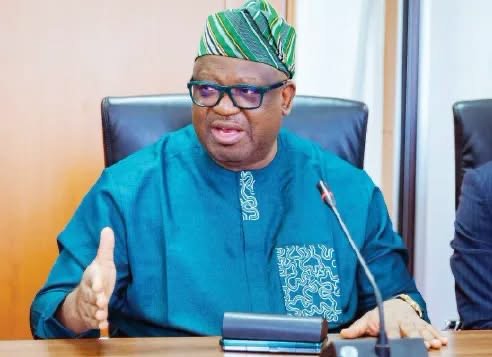
Mutfwang made the allegation on Monday, November 2, 2026, during the formal inauguration of the All Progressives Congress (APC) Campaign Council in Jos, Plateau State, where he defended the economic policies of the Tinubu administration and urged Nigerians, particularly residents of Plateau State, to support the President ahead of the 2027 general elections.
The governor argued that the economic difficulties confronting Nigeria did not begin with the current administration, insisting that Tinubu inherited an economy already weakened by years of fiscal challenges, declining foreign reserves, debt obligations and monetary instability.
According to him, the previous administration had reached a point where it relied on selling crude oil that had not yet been extracted from the ground to secure immediate financial resources.
He maintained that the consequences of those arrangements continue to affect the country’s finances, as the present government must fulfil obligations connected to crude oil previously committed to creditors.
“Part of the problem of the Buhari regime is that they got to a point that they didn’t know what to do, so they sold our future crude. The crude we are yet to dig from the ground has been sold in advance,” Mutfwang said.
He added: “And today we are paying that debt. We are paying that debt. And so we cannot expect things to simply change overnight.”
The allegation has brought renewed attention to Nigeria’s history of crude oil-backed financing, an arrangement through which the country’s national oil company has obtained immediate funding in exchange for commitments to deliver crude oil at agreed periods in the future.
However, the governor’s remarks also raise important questions about the distinction between legitimate oil-backed financing arrangements, the management of public resources and the extent to which previous financial commitments continue to influence Nigeria’s economic recovery.
Mutfwang Says Tinubu Inherited a Weak Economy
Beyond the crude oil allegation, Mutfwang used the APC gathering to defend the economic direction of the Tinubu administration, arguing that the President inherited serious economic problems when he assumed office in May 2023.
He described the condition of the Nigerian economy at the time as being close to collapse, pointing to difficulties involving foreign exchange availability, external debt servicing and the country’s ability to meet international financial obligations.
The governor specifically claimed that Nigeria’s external reserves had fallen to slightly above $3 billion before Tinubu assumed office, compared with more than $40 billion accumulated over previous decades.
He contrasted that figure with what he described as an improvement under the current administration, claiming that Nigeria’s external reserves had risen above $50 billion.
“Where did President Tinubu meet Nigeria in 2023? He met Nigeria, tottering on the brink of collapse, Nigeria that could not service its external debts, Nigeria that would not even allow businesses outside the country to take their proceeds back home,” he said.
Mutfwang also linked Nigeria’s foreign exchange difficulties to the experiences of international airlines operating in the country.
According to him, some international airlines stopped flying to Nigeria because they encountered difficulties accessing foreign currency to repatriate their earnings.
He argued that the situation reflected the scale of the economic problems inherited by the Tinubu administration.
However, the figures and economic assessments presented by the governor remain claims made during a political gathering and should be considered alongside official financial records and independent economic assessments.
Governor Accuses Buhari Government of Printing More Than N30 Trillion
Mutfwang also accused the Buhari administration of relying heavily on monetary expansion to finance government activities, alleging that more than N30 trillion was printed through the Central Bank of Nigeria.
He argued that the alleged monetary expansion contributed to the economic difficulties inherited by the present government.
“When the President took over in 2023, the government that he succeeded had run out of ideas on how to manage the economy, and they resorted to printing money in the Central Bank.
“They printed over N30 trillion, which went down the drain,” he said.
The governor contrasted the situation with what he described as improvements in the operations of the Central Bank under Tinubu.
He claimed that monetary and fiscal adjustments had helped stabilise the country’s financial system and address some of the problems associated with previous government financing practices.
Nevertheless, the allegation concerning N30 trillion requires careful examination of the relevant monetary and fiscal records.
Nigeria’s monetary system involves several instruments, including advances to government, liquidity management operations and other central bank interventions. These mechanisms have different economic implications and should not automatically be treated as equivalent to the physical printing of banknotes.
A proper assessment therefore requires distinguishing between money creation, central bank financing, government borrowing and the actual circulation of currency.
How Nigeria’s Crude Oil-Backed Financing Works
The governor’s allegation about advance crude oil sales touches on a financing arrangement that has featured prominently in Nigeria’s petroleum industry.
Crude oil-backed financing generally involves a company or government-linked institution receiving money upfront in exchange for an agreement to deliver specified quantities of crude oil at a later date.
In Nigeria, the Nigerian National Petroleum Company Limited (NNPC Limited) has entered into several financing arrangements involving future crude oil deliveries.
These transactions have been used to obtain funding for different purposes, including operational requirements, outstanding obligations, investment commitments and foreign exchange-related interventions.
One of the notable arrangements was Project Eagle, which involved forward crude oil sales and financing agreements established before the end of Buhari’s administration.
According to NNPC’s 2023 audited financial statements, an outstanding Pre-Export Finance liability under Project Eagle was refinanced through a forward sale of crude oil valued at approximately $694 million in March 2021.
The financial statements also disclosed that NNPC Exploration and Production Limited had capital commitments of approximately $352.88 million relating to another forward sale agreement with Eagle Export Financing Limited.
Under that arrangement, the company received upfront payment against future crude oil deliveries.
The transactions demonstrate that forward crude oil sales and resource-backed financing were part of Nigeria’s petroleum financing structure during the Buhari administration.
However, it is important to distinguish between the existence of these transactions and the governor’s broader political interpretation of their consequences.
Oil-backed financing is not automatically evidence of financial misconduct. It is a recognised financing mechanism used by oil-producing countries and national petroleum companies to access immediate funding.
The critical issues are the terms of the agreements, interest rates, quantities of crude committed, repayment periods, transparency and the economic value received from the transactions.
Where future production is committed to creditors, the arrangement can reduce the quantity of crude available for other purposes during the repayment period.
It can also create financial pressure when production falls below expectations or when the country faces competing demands for its petroleum revenues.
Project Gazelle and the Tinubu Administration’s Crude Oil Commitments
Nigeria’s crude-backed financing arrangements did not end with the Buhari administration.
In August 2023, shortly after Tinubu assumed office, NNPC secured a $3 billion crude oil-backed financing facility from the African Export-Import Bank (Afreximbank).
The transaction, known as Project Gazelle, was designed to provide immediate foreign exchange support and help address pressure on the naira.
The arrangement involved future crude oil deliveries through a structured financing agreement.
Information subsequently disclosed by NNPC and reported by TheCable indicated that the facility involved commitments covering approximately 164.25 million barrels of crude oil, with deliveries structured at 90,000 barrels per day.
The financing was also intended to support advance payments of future tax and royalty obligations associated with production-sharing contract assets.
The transaction attracted attention because it demonstrated that the Tinubu administration also relied on crude-backed financing to address immediate financial pressures.
However, Project Gazelle was a separate transaction negotiated in 2023 and should not be confused with the earlier agreements established during Buhari’s presidency.
The distinction is important when examining Mutfwang’s claim that the current government is paying debts connected to crude oil sold in advance by the previous administration.
Nigeria’s petroleum financing obligations involve multiple transactions, different beneficiaries and separate repayment arrangements. It would therefore be inaccurate to attribute every outstanding crude-backed commitment to one administration without examining the relevant agreements individually.
Earlier APC Response to Mutfwang’s Allegations Against Buhari
Mutfwang’s latest comments are not the first time he has accused the Buhari administration of selling Nigeria’s economic future.
In March 2024, the Plateau governor made similar allegations, blaming the previous administration for the economic difficulties confronting Nigerians.
At the time, he claimed that the Buhari government had printed and distributed approximately N30 trillion and sold crude oil that had not yet been extracted.
His comments attracted criticism from members of the APC, including the party’s National Director of Publicity, Bala Ibrahim.
According to a report by Pulse Nigeria published on March 7, 2024, Ibrahim rejected the governor’s characterisation of the crude oil transactions.
He argued that advance oil sales were part of established practices in international petroleum markets and that such arrangements were not necessarily evidence that a country had mortgaged its future.
The APC spokesman also argued that Mutfwang needed to understand how crude oil marketing and international oil transactions operated.
His response highlighted an important distinction in the debate: while advance crude oil sales create future delivery obligations, the transactions can also provide immediate financing for governments and petroleum companies.
The disagreement reflects competing political interpretations of Nigeria’s oil-backed financing history, with questions remaining about whether the financial benefits justified the long-term obligations created by the agreements.
Mutfwang Defends Tinubu’s Fuel Subsidy Reforms
The Plateau governor also defended the removal of petrol subsidies under the Tinubu administration, describing the previous subsidy arrangement as a system that created opportunities for financial abuse.
He alleged that the government had borrowed money to settle subsidy claims supported by what he described as fictitious documents.
According to him, the country could not continue borrowing money to pay claims that did not generate corresponding economic value.
“I say it was a fraud because we were borrowing money to pay people who brought fictitious documents. They never brought any wealth. They brought fictitious documents, claimed monies and subsidies,” he said.
He argued that ending the subsidy arrangement was necessary to prevent further financial pressure on government resources.
However, Mutfwang acknowledged that the removal of subsidies had consequences for Nigerians, particularly households and businesses dealing with higher transportation and living costs.
He maintained that although petrol was now more readily available, affordability remained a challenge.
“Today, by the grace of God, we have solved one side of the equation. Today fuel is available. It may not be cheap, but it is available,” he said.
The governor’s comments reflect one of the central tensions surrounding Nigeria’s economic reforms.
While the government has defended subsidy removal as necessary to reduce fiscal pressure and improve the management of public resources, Nigerians continue to experience the consequences through transportation costs, food prices and the cost of running businesses.
The effectiveness of the reform will ultimately depend not only on government savings but also on whether those resources translate into improved public services, infrastructure, employment and living conditions.
Plateau Government Introduces Measures to Cushion Economic Hardship
Mutfwang also used the occasion to highlight measures introduced by his administration to reduce the effects of economic difficulties on residents of Plateau State.
He cited the introduction of metro buses, the revival of the railway system within Jos and reductions in tuition fees for students attending tertiary institutions.
According to the governor, his administration reduced school fees for students in state tertiary institutions by 50 per cent and increased their allowances by approximately 300 per cent.
He also commended the Federal Government’s student financing initiatives, particularly the Nigerian Education Loan Fund (NELFUND), saying Plateau indigenes studying in universities had benefited from the programme.
Mutfwang said some students were receiving monthly financial support of N20,000 and N40,000.
The NELFUND initiative is part of the Federal Government’s broader effort to expand access to higher education through financial assistance to eligible students.
The governor’s remarks suggest that his administration intends to combine state-level interventions with federal programmes to address some of the financial pressures affecting households.
However, the long-term impact of these measures will depend on their implementation, funding sustainability and the number of residents who ultimately benefit.
Mutfwang Links Economic Performance to 2027 Elections
The governor’s comments came during the inauguration of the APC Campaign Council in Jos, making the event both an assessment of the current administration’s performance and a political mobilisation exercise ahead of the 2027 general elections.
Mutfwang urged campaign council members and APC candidates to communicate the achievements of the Tinubu administration to Nigerians.
He argued that the government needed to explain its policies more effectively, particularly because many citizens remained apprehensive about the economic situation.
The governor also called for continued political power rotation between northern and southern Nigeria.
He maintained that after eight years of northern leadership, it was fair for the South to complete another eight-year period.
According to him, respecting political arrangements involving regional power rotation would help maintain political stability.
Mutfwang also expressed confidence that Plateau State would support Tinubu’s re-election bid in 2027.
He declared that the state had already reached an understanding concerning the rotation of governorship power between its senatorial zones.
His remarks placed the economic debate within the wider political calculations surrounding the next general elections.
However, the governor’s position also means that his assessment of the Buhari administration and defence of Tinubu’s policies must be understood within the political context of his public support for the President.
That context does not automatically invalidate his claims, but it reinforces the importance of examining the economic figures and financing arrangements against independently verifiable records.
Why Nigeria’s Advance Crude Oil Sales Matter
Nigeria’s dependence on crude oil remains a major factor in its economic stability.
Petroleum exports provide substantial foreign exchange earnings and government revenue, making the management of future production commitments particularly important.
When crude oil is sold in advance, the country or its national oil company receives financing before the actual delivery of the commodity.
Such arrangements can provide immediate liquidity, particularly when government revenue is under pressure.
However, they also create obligations that must be fulfilled through future crude oil deliveries or other agreed repayment mechanisms.
This means that future oil production may already have been committed to meeting previous financial agreements before the proceeds become available for other government priorities.
For Nigeria, the challenge is particularly significant because crude oil production has faced several difficulties, including oil theft, pipeline vandalism, operational disruptions, investment constraints and production challenges.
When production is lower than expected, the country may struggle to meet both its existing commitments and other financial obligations.
There are also questions about transparency.
Oil-backed financing arrangements should be accompanied by adequate public disclosure of their terms, including the volume of crude committed, financing costs, repayment schedules and the institutions benefiting from the agreements.
Without sufficient disclosure, citizens may find it difficult to determine whether such transactions represent responsible financial management or whether they create disproportionate long-term obligations.
The Nigeria Extractive Industries Transparency Initiative (NEITI) has previously highlighted transparency and accountability concerns surrounding resource-backed financing arrangements.
Its assessments have also pointed to the importance of properly recording oil-related transactions and ensuring that the financial benefits and obligations are adequately reflected in public accounts.
What Happens Next?
Mutfwang’s latest allegation is likely to renew public interest in the financial agreements involving Nigeria’s crude oil resources under successive administrations.
However, establishing the precise amount of debt currently being serviced from previous advance crude oil sales requires a detailed breakdown of the individual transactions.
Such information would help Nigerians understand which agreements were negotiated under Buhari, which were refinanced or extended, how much has already been repaid and what obligations remain outstanding.
NNPC Limited’s audited financial statements, relevant government debt records and reports from NEITI provide important starting points for examining these questions.
The Federal Government and the national oil company also have a responsibility to provide clear explanations of the financial implications of crude-backed financing arrangements.
For the Tinubu administration, the challenge extends beyond defending its economic policies. It must demonstrate that Nigeria’s petroleum resources are being managed transparently and that future production is not being committed without adequate consideration of the country’s long-term financial interests.
For Nigerians, the central issue is whether the country’s oil wealth is generating sustainable economic benefits or whether immediate financing needs continue to place pressure on future revenues.
Mutfwang’s comments have renewed that debate, but the final assessment must rest on verifiable financial records rather than political accusations alone.
Nigeria’s economic recovery will ultimately depend on transparent management of public resources, responsible borrowing, increased productivity and policies that improve the living conditions of citizens.
Weng Global – stories beyond borders
Sources
- Vanguard – Report on Caleb Mutfwang’s November 2, 2026, remarks in Jos.
- Nigerian National Petroleum Company Limited – 2023 Audited Financial Statements.
- TheCable – Explainer on NNPC’s crude-backed financing arrangements.
- Nigeria Extractive Industries Transparency Initiative (NEITI) – Reports on Nigeria’s oil and gas sector.
- Pulse Nigeria – Report on the APC’s March 2024 response to Mutfwang’s allegations.
- Federal Ministry of Information and National Orientation – Official statements on crude oil forward-sale arrangements.