Reported by Simon yusuph,| Journalist at wengglobal
A senior media adviser to President Bola Ahmed Tinubu has criticised Cardinal John Onaiyekan for publicly discussing a private meeting between the President and members of the Catholic Bishops’ Conference of Nigeria (CBCN), arguing that such comments undermined the confidentiality and dignity of the engagement.
In a lengthy opinion article titled “Cardinal Onaiyekan’s Abuse of Clerical Privilege,” Temitope Ajayi, Senior Special Assistant to the President on Media and Publicity, contended that Cardinal Onaiyekan acted inappropriately by granting a television interview in which he offered his interpretation of the closed-door meeting between President Tinubu and the Catholic bishops.
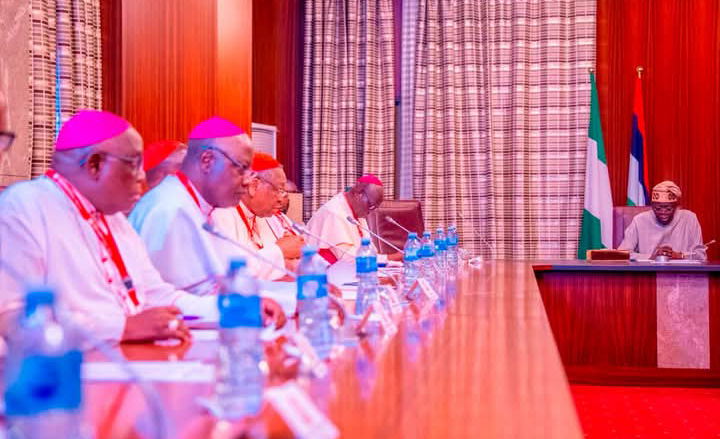
Ajayi’s remarks come days after the Catholic Bishops’ Conference of Nigeria raised concerns about the country’s economic hardship, insecurity, governance challenges and other national issues during an audience with President Tinubu. The President responded to the bishops’ observations during the meeting, defending his administration’s reforms while acknowledging that Nigeria continues to face significant economic and security challenges.
Ajayi Defends Confidentiality of Presidential Meeting
According to Ajayi, the meeting should have remained confidential after both parties had exchanged views.
He argued that the bishops exercised their democratic right by presenting what they considered to be the country’s pressing challenges, while President Tinubu equally exercised his responsibility by responding to each issue raised.
Ajayi maintained that disagreements over policy or national conditions are legitimate in a democratic society, but said it was inappropriate for one participant to publicly narrate a private conversation shortly after the meeting.
He described Cardinal Onaiyekan’s subsequent interview as an “abuse of clerical privilege,” asserting that religious leaders who enjoy privileged access to state officials should exercise restraint when discussing confidential engagements.
Defence of Tinubu’s Economic Policies
The presidential aide also defended the Tinubu administration’s economic reforms, arguing that critics often overlook improvements made since the current administration assumed office.
Ajayi said President Tinubu acknowledged that Nigeria continues to face economic and security difficulties but maintained that government policies have helped stabilise public finances and laid the foundation for long-term recovery.
He pointed to increased fiscal allocations to states, improved salary and pension payments in several states, and broader fiscal reforms as indicators that the administration has made measurable progress despite ongoing hardship.
According to Ajayi, the President’s position during the meeting was that Nigeria had emerged from what he described as a difficult fiscal period and was gradually moving toward recovery.
Mission Schools and Constitutional Responsibilities
Ajayi also addressed one of the issues reportedly raised during the meeting concerning the return of mission schools.
According to the presidential aide, President Tinubu reminded the bishops that ownership and management of schools fall largely under the constitutional responsibilities of state governments rather than the Federal Government.
Ajayi noted that President Tinubu reportedly referenced his own record as former Governor of Lagos State, where mission schools were returned to their original proprietors.
He argued that the issue should therefore be directed to state governments rather than the Presidency.
Security Assessment
On national security, Ajayi disputed suggestions that the President had downplayed insecurity.
He said President Tinubu acknowledged ongoing security threats while highlighting gains recorded by the Armed Forces and intelligence agencies across different theatres of operation.
Ajayi further argued that, as Commander-in-Chief, the President receives classified intelligence and operational briefings unavailable to the general public, enabling him to assess the country’s security situation using information beyond media reports.
While acknowledging that insecurity remains a major concern, he maintained that the overall security picture is more complex than public narratives sometimes suggest.
Criticism of Public Commentary
A significant portion of Ajayi’s article focused on what he described as a common misconception that only public critics are capable of “speaking truth to power.”
He argued that President Tinubu receives daily intelligence reports, policy briefings, media analyses and advice from multiple official and unofficial sources.
According to him, the President regularly reviews newspaper reports, television discussions and intelligence assessments before making policy decisions.
Ajayi therefore rejected suggestions that religious leaders alone possess a unique understanding of the country’s realities.
Wider Debate on Church-State Engagement
The exchange reflects a broader conversation in Nigeria about the relationship between religious institutions and elected governments.
The Catholic Bishops’ Conference of Nigeria has historically spoken on issues including governance, corruption, insecurity, poverty, electoral reforms and social justice, often describing such interventions as part of its moral responsibility.
Successive Nigerian administrations have also defended their policies in response to criticisms from religious organisations, civil society groups, labour unions and other stakeholders.
Political analysts note that such engagements remain an important feature of democratic governance, where government institutions and independent organisations frequently hold differing views on national priorities.
Importance of Respectful Democratic Dialogue
Ajayi concluded his article by arguing that both the Catholic bishops and President Tinubu fulfilled their respective democratic responsibilities during the meeting.
According to him, the bishops presented their concerns, while the President responded to each issue respectfully.
He maintained, however, that preserving the confidentiality of private meetings would strengthen trust between public institutions and religious leaders.
The Catholic Bishops’ Conference of Nigeria has not issued any formal response to Ajayi’s opinion article at the time of publication.
As public debate continues, observers say the episode underscores the importance of constructive engagement between government officials, faith leaders and civil society in addressing Nigeria’s political, economic and security challenges while maintaining mutual respect and democratic accountability.
Sources:
- Opinion article by Temitope Ajayi, Senior Special Assistant to President Bola Tinubu on Media and Publicity
- Catholic Bishops’ Conference of Nigeria (CBCN)
- Arise News interview with Cardinal John Onaiyekan
- Channels Television
- Premium Times
- Punch Newspapers
- The Guardian Nigeria
- News Agency of Nigeria (NAN)