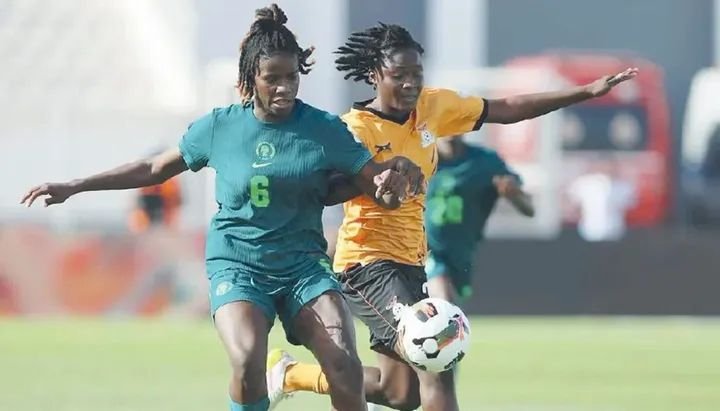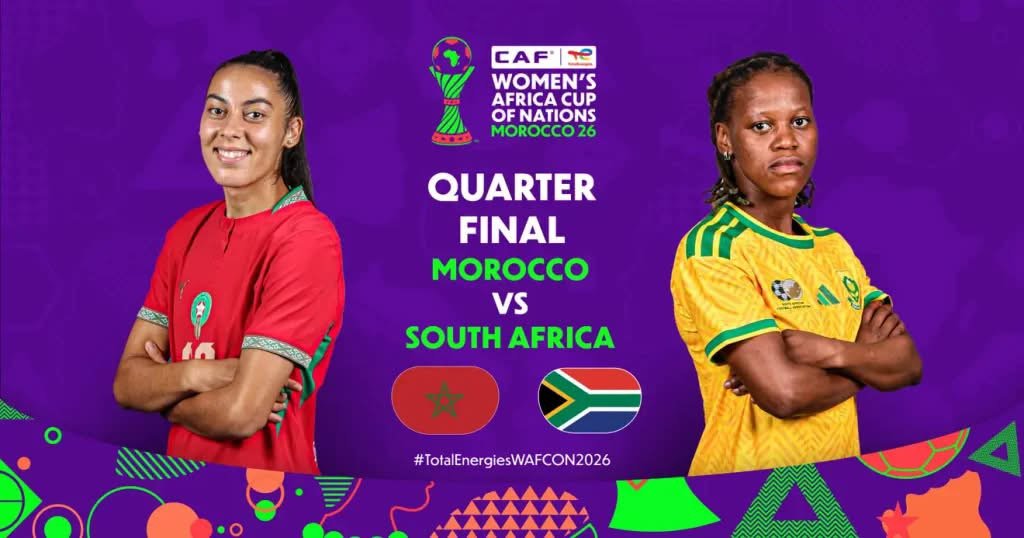
Morocco and South Africa Renew WAFCON Rivalry With 2027 World Cup Ticket at Stake in Rabat Quarter-Final!
Morocco and defending champions South Africa meet in a high-stakes quarter-final of the 2026 Women’s Africa Cup of Nations (WAFCON) on Saturday, with a place in the semi-finals and automatic qualification for the 2027 FIFA Women’s World Cup in Brazil at stake.
The heavyweight encounter is scheduled for 9:00 p.m. local time at the Moulay El Hassan Stadium in Rabat, with the winner advancing to the last four and securing one of Africa’s four direct tickets to next year’s global women’s football tournament. (Confédération Africaine de Football)
The fixture carries additional significance because it is a repeat of the 2022 WAFCON final, when South Africa defeated tournament hosts Morocco 2–1 in Rabat to claim their first continental title.
Four years later, the two sides meet again in Morocco, but this time with considerably more than continental pride at stake. The winner will remain in contention for the WAFCON title and book an immediate place at the 2027 FIFA Women’s World Cup, while the losing side will have to rely on the tournament’s qualification play-offs for another opportunity to reach Brazil. (Confédération Africaine de Football)
A rematch with history behind it
The Morocco-South Africa rivalry has been shaped by the dramatic 2022 final.
South Africa, then appearing in their sixth WAFCON final without a championship, produced a decisive second-half performance to overcome the hosts. Hildah Magaia scored twice before Rosella Ayane pulled one back for Morocco late in the contest.
That victory finally delivered South Africa’s first WAFCON title after five previous final defeats.
The meeting also established a particular psychological dimension to Saturday’s quarter-final. Morocco have since developed into one of Africa’s most competitive women’s national teams, while South Africa have consolidated their position among the continent’s leading sides.
CAF statistics show that the two countries have met only once previously at the WAFCON finals — the 2022 final — making Saturday’s quarter-final their second tournament encounter. (Confédération Africaine de Football)
For Morocco, the match presents an opportunity to reverse the outcome of that final on home soil. For South Africa, it is an opportunity to demonstrate that their continental credentials remain intact under coach Desiree Ellis.
Morocco arrive with a strong defensive record
Morocco enter the knockout phase after an unbeaten group-stage campaign.
The hosts defeated Kenya and Algeria before drawing 0–0 with Senegal in their final Group A match. The result ended Morocco’s run of 14 consecutive WAFCON matches in which they had scored, but it also underlined the strength of their defence.
According to CAF, Morocco completed the group stage without conceding a goal and had gone 271 minutes without allowing an opponent to score heading into the quarter-final. Goalkeeper Khadija Er-Rmichi has also recorded three clean sheets at the tournament and six overall in WAFCON competition. (Confédération Africaine de Football)
That defensive stability could become one of Morocco’s most important assets against a South African side possessing significant attacking quality.
The hosts are also familiar with the pressure of knockout football. Morocco have reached the quarter-finals for a third consecutive edition and have won both of their previous quarter-final ties, defeating Botswana 2–1 in 2022 and Mali 3–1 in 2024.
They have also demonstrated resilience beyond 90 minutes. Morocco won penalty shoot-outs against Nigeria in the 2022 semi-final and Ghana in the 2024 semi-final, showing that the team has experience managing the psychological demands of high-pressure knockout matches. (Confédération Africaine de Football)
South Africa seeking another semi-final appearance
South Africa arrive with a different tournament narrative.
Banyana Banyana suffered a difficult start but recovered strongly enough to reach the knockout phase. Their 1–0 victory over Burkina Faso in their final group match secured their progress and ended a five-match sequence without a victory in open play.
The win also produced South Africa’s first clean sheet since their goalless quarter-final against Senegal at the previous WAFCON.
South Africa have considerable experience at this stage of the competition. They are appearing in the quarter-finals for the third time and are pursuing a 12th semi-final appearance. CAF records show that Banyana Banyana have reached the last four at every WAFCON since their group-stage elimination in 2004. (Confédération Africaine de Football)
That consistency gives Ellis’ side a substantial tournament pedigree, even though their recent knockout record has been less dominant.
South Africa have not won any of their last three WAFCON knockout matches in open play. Their most recent such victory came against Morocco in the 2022 final.
The team will therefore need to combine its experience with greater attacking efficiency if it is to overcome a Moroccan side that has yet to concede at the tournament.
Kgatlana provides South Africa’s attacking threat
One of South Africa’s key attacking figures will be Thembi Kgatlana.
The forward scored the decisive goal in the team’s 1–0 victory over Burkina Faso and has already registered eight goals across her WAFCON career, including two in the current tournament.
CAF statistics show that South Africa have won six of the seven WAFCON matches in which Kgatlana has scored, with the exception being their 2–2 draw against Côte d’Ivoire during the current edition. (Punch Newspapers)
Her pace and movement could pose problems for Morocco, particularly if South Africa can create opportunities in transition.
Morocco, however, have the defensive resources to counter that threat. Er-Rmichi’s form in goal, combined with the hosts’ ability to maintain compact defensive structures, has been central to their unbeaten group campaign.
The battle between South Africa’s attacking movement and Morocco’s defensive organisation could therefore become one of the defining tactical contests of the quarter-final.
Jorge Vilda chasing another final run
Morocco coach Jorge Vilda will also be seeking to guide the hosts back to the final.
Vilda led Morocco to the WAFCON final at the previous edition, where they ultimately lost to Nigeria. He has now taken the team into another knockout phase and will be looking to convert Morocco’s growing continental competitiveness into their first WAFCON championship.
CAF records indicate that Vilda has lost only one of his nine WAFCON matches in charge, making the Spanish coach one of the central figures in Morocco’s recent rise. (Punch Newspapers)
The Moroccan side also has the advantage of playing in front of a home crowd in Rabat.
Home support has been a recurring feature of Morocco’s recent WAFCON campaigns, and the team has progressed to the knockout phase in all three editions it has hosted or participated in as host.
However, the pressure associated with hosting a major tournament can work in both directions. Expectations are high, and Morocco must avoid allowing the significance of the occasion to disrupt their tactical discipline.
World Cup qualification adds another layer
The quarter-final is not simply about reaching the WAFCON semi-finals.
The 2026 tournament is also serving as the primary African qualification pathway for the 2027 FIFA Women’s World Cup in Brazil.
CAF has confirmed that the four teams reaching the WAFCON semi-finals will qualify directly for the World Cup. The four quarter-final losers, meanwhile, will enter the tournament’s World Cup qualifying play-offs, where two additional African teams will eventually secure places at the global finals. (Confédération Africaine de Football)
That structure makes Saturday’s match particularly important.
A victory would immediately eliminate uncertainty for either Morocco or South Africa and guarantee a place at the 2027 World Cup. Defeat would not end the losing team’s qualification hopes, but it would force it through a more complicated play-off route.
For two teams with ambitions of competing at the highest level, the difference is substantial.
A broader test of African women’s football
The Morocco-South Africa contest also reflects the growing competitiveness of women’s football in Africa.
Morocco have emerged as one of the continent’s strongest sides over recent years, reaching the 2022 WAFCON final and the 2024 final. South Africa, meanwhile, have remained a consistent force and won the continental championship in 2022.
Both countries also reached the round of 16 at the 2023 FIFA Women’s World Cup, demonstrating that their ambitions extend beyond continental competition. CAF notes that victory on Saturday would send Morocco to their second World Cup appearance, while South Africa would qualify for their third after appearances in 2019 and 2023. (Confédération Africaine de Football)
Their continued progress has contributed to the increasing visibility and competitiveness of African women’s football.
The expansion of the WAFCON to 16 teams in 2026 has also broadened the tournament’s competitive field. CAF describes the current edition as the largest in the competition’s history, with 16 nations participating across four groups. (Confédération Africaine de Football)
What to expect in Rabat
Morocco will enter the contest with the confidence of an unbeaten group campaign, home advantage and an impressive defensive record.
South Africa will rely on tournament experience, attacking quality and the leadership of a squad accustomed to high-pressure knockout football.
The historical record offers little room for complacency. South Africa have already demonstrated that they can defeat Morocco in a major final on Moroccan soil, while Morocco’s recent progress means Saturday’s contest is unlikely to resemble the 2022 encounter.
The outcome may ultimately be determined by small details: Morocco’s ability to maintain their defensive discipline, South Africa’s efficiency in front of goal, the effectiveness of Kgatlana and the hosts’ capacity to manage the pressure of playing at home.
For both teams, however, the calculation is straightforward.
Win, and the road to the WAFCON title remains open while a 2027 World Cup place is secured.
Lose, and the fight for Brazil continues through the play-offs.
That combination makes Morocco against South Africa one of the defining matches of the 2026 WAFCON — a continental rivalry with a global prize waiting at the end of 90 minutes, and potentially extra time or penalties if neither side can be separated.
Sources
- Confederation of African Football (CAF): Match statistics and official preview for Morocco vs South Africa in the WAFCON 2026 quarter-final. CAF official match preview and statistics
- The Punch: Report on the Morocco-South Africa WAFCON quarter-final and its World Cup qualification implications. The Punch report
- CAF: Official WAFCON 2026 schedule and competition format. CAF WAFCON 2026 schedule
- CAF: Official WAFCON 2026 final-draw procedures and qualification structure. CAF final-draw procedures
- Olympics.com: 2026 Women’s Africa Cup of Nations schedule, results and standings. Olympics.com WAFCON 2026 coverage
- SAnews: South Africa’s WAFCON campaign and route to the 2027 FIFA Women’s World Cup. SAnews WAFCON coverage