Reported by Simon yusuph, | Journalist at wengglobal
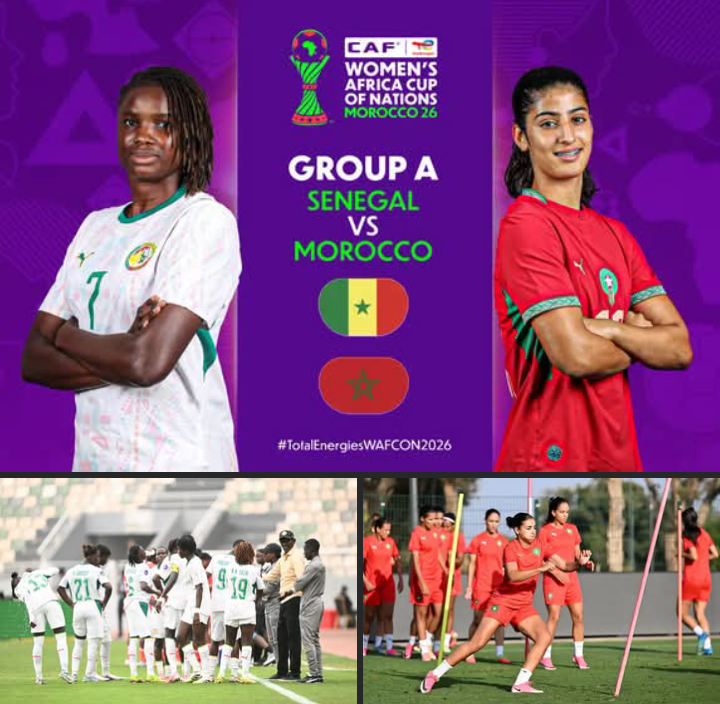
Host nation Morocco will seek to cap an impressive Group A campaign with a flawless record when they face long-time rivals Senegal in one of the most anticipated fixtures of the group stage at the 2026 Women’s Africa Cup of Nations (WAFCON). The encounter is expected to be more than just a battle for points; it represents another chapter in a growing rivalry between two ambitious African football nations eager to establish themselves among the continent’s elite.
With qualification for the knockout stages already taking shape, Morocco enters the contest aiming to maintain momentum before the quarter-finals, while Senegal is determined to secure a positive result that could strengthen its own hopes of progressing. The fixture brings together two teams that have invested significantly in women’s football over recent years, reflecting the broader transformation of the women’s game across Africa.
Morocco’s emergence as one of Africa’s strongest women’s football nations has been one of the continent’s most remarkable sporting stories. Since reaching the final of the 2022 Women’s Africa Cup of Nations and qualifying for the 2023 FIFA Women’s World Cup, the Atlas Lionesses have continued to build a competitive squad capable of challenging for major honours.
Playing before passionate home supporters once again provides Morocco with an important advantage. Backed by modern football infrastructure, increased investment from the Royal Moroccan Football Federation, and growing public support for women’s football, the hosts have demonstrated both tactical discipline and attacking quality throughout the group stage.
A victory over Senegal would not only preserve Morocco’s perfect record but also send a powerful statement to other title contenders ahead of the knockout rounds. Finishing the group stage with maximum points would also reinforce the team’s credentials as genuine favourites to lift the continental trophy on home soil.
For Senegal, the match represents a defining moment in its WAFCON campaign. Although facing one of the tournament favourites presents a formidable challenge, the Lionesses have repeatedly shown resilience against stronger opposition and remain determined to secure qualification for the next phase.
Senegal has steadily improved its standing in African women’s football through increased domestic development programmes and greater exposure in international competitions. The team’s physical style, defensive organisation, and ability to exploit counter-attacking opportunities have made it a difficult opponent for many of Africa’s top sides.
A positive result against Morocco could significantly enhance Senegal’s confidence and provide a major boost ahead of the knockout rounds, should qualification be secured. Even a draw against the hosts would underline the team’s progress and growing competitiveness within African football.
Beyond the immediate stakes of qualification, Morocco and Senegal have developed an increasingly competitive rivalry in recent years. Their meetings have often reflected the changing balance of power in African women’s football, with both countries investing heavily in player development, coaching education, and football infrastructure.
Morocco’s rapid rise has attracted widespread attention across the continent, while Senegal continues to close the gap through consistent improvement and stronger performances in regional and continental competitions. Every encounter between the two nations now carries additional significance, serving as a benchmark for their respective ambitions.
The rivalry also reflects a broader trend across Africa, where investment in women’s football has accelerated following the success of African teams on the global stage. National federations are increasingly recognising the commercial, sporting, and social value of developing competitive women’s programmes.
Morocco’s tactical flexibility has been central to its success throughout the tournament. The Atlas Lionesses have combined disciplined defensive organisation with fluid attacking movement, enabling them to control possession while creating numerous scoring opportunities.
Their midfield has played a particularly influential role, dictating the tempo of matches and linking defence with attack effectively. Meanwhile, the team’s experienced defensive line has limited opponents’ chances, providing a solid foundation for the forwards to express themselves.
Senegal, however, is expected to adopt a pragmatic approach. Rather than engaging Morocco in an open contest, the West African side may prioritise defensive compactness before seeking opportunities through quick transitions and set pieces. Such an approach has troubled technically superior teams in previous tournaments and could once again prove effective.
The tactical contest between Morocco’s possession-based style and Senegal’s disciplined defensive structure is likely to determine the outcome of the match.
This Group A showdown also highlights the remarkable growth of women’s football across Africa. In recent years, the Confederation of African Football (CAF) has expanded investment in women’s competitions, increased prize money, and strengthened youth development initiatives aimed at improving competitiveness across member associations.
Countries including Morocco, Nigeria, South Africa, Zambia, Ghana, Senegal, and others have invested in professional leagues, coaching programmes, and grassroots development, leading to higher standards of play and increased international recognition.
The success of African teams at recent FIFA Women’s World Cup tournaments has further accelerated interest in women’s football, inspiring governments, sponsors, and football federations to provide greater support.
Morocco’s hosting of WAFCON 2026 reflects CAF’s broader vision of promoting women’s football through world-class facilities, improved broadcasting, and enhanced fan engagement. Packed stadiums and growing television audiences underline the increasing popularity of the tournament across Africa and beyond.
For Morocco, maintaining winning momentum could prove crucial in the knockout stages, where confidence often plays a decisive role. A perfect group-stage campaign would reinforce belief within the squad while sending a clear warning to potential quarter-final opponents.
For Senegal, qualification remains the immediate objective, but a strong performance against the hosts would demonstrate that the gap between Africa’s established powers and emerging challengers continues to narrow.
Regardless of the result, the encounter promises high-quality football and another compelling chapter in the evolution of women’s football on the continent. As African nations continue investing in talent development and professional structures, rivalries such as Morocco versus Senegal are becoming defining fixtures capable of attracting global attention.
The outcome of this crucial Group A clash will shape the knockout bracket and may ultimately influence the race for the 2026 Women’s Africa Cup of Nations title. With both teams carrying significant ambitions, supporters can expect an intense, tactically engaging, and emotionally charged contest worthy of one of Africa’s premier sporting events.
Sources:
- Confederation of African Football (CAF)
- FIFA
- Reuters
- BBC Sport
- ESPN Africa
- SuperSport
- CAF Women’s Africa Cup of Nations official communications