Taliban Marks Five Years in Power With Military Parades as Afghanistan Faces Deepening Humanitarian and Rights Crisis!
The Taliban has marked five years since its return to power in Afghanistan with military displays, public celebrations and patriotic ceremonies, presenting its rule as a period of security and independence while critics point to worsening restrictions on women, economic hardship and Afghanistan’s continuing international isolation.
The anniversary falls on August 15, the date Taliban forces seized Kabul in 2021 as United States and NATO forces completed their withdrawal after nearly two decades of military involvement in Afghanistan. The collapse of the internationally backed government and the Taliban’s rapid takeover brought an abrupt end to the Western-backed political order and triggered a chaotic evacuation from Kabul airport.
Five years later, the Taliban authorities are firmly in control of the country, but their administration remains diplomatically isolated and faces persistent criticism over its treatment of women and girls, restrictions on civil liberties and the country’s severe humanitarian needs.
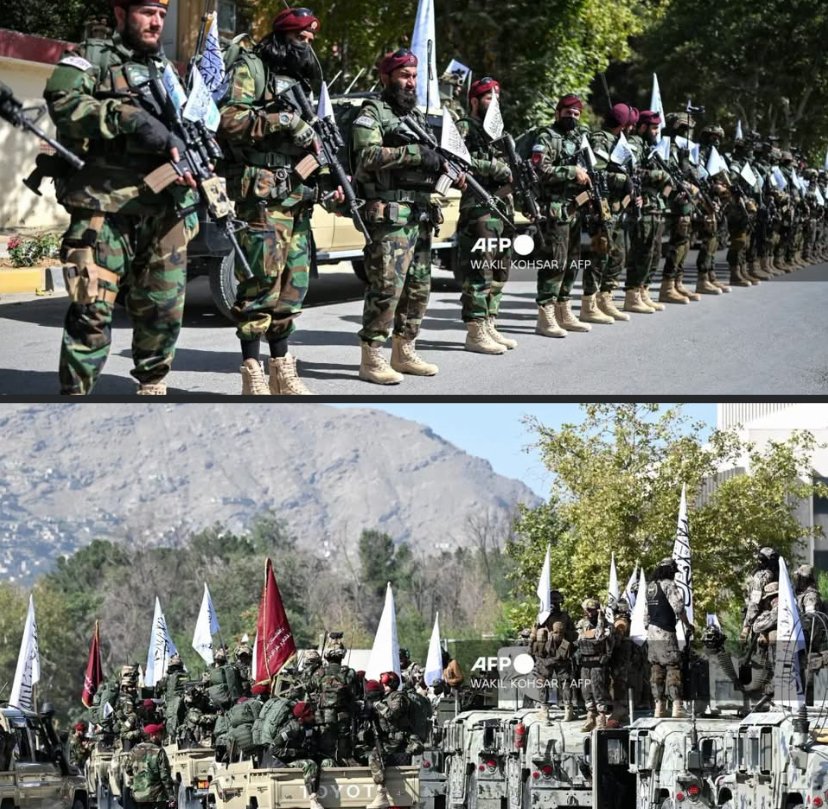
Reuters reported on Saturday that Taliban authorities staged celebrations in Kabul portraying their five-year rule as a victory over Western influence. Military vehicles and displays formed part of the commemorations, while Taliban officials presented the anniversary as evidence of the government’s ability to maintain control and stability. (Reuters)
Afghan government spokesman Zabihullah Mujahid described the anniversary in celebratory terms, saying the day would be remembered in Afghanistan’s history. Public displays in Kabul included Taliban flags, while supporters travelled through the capital on motorcycles and in vehicles decorated for the occasion. (Vanguard News)
From insurgency to government
The Taliban’s return to power followed a rapid military offensive in August 2021 that saw provincial capitals fall in quick succession. On August 15, Taliban fighters entered Kabul after President Ashraf Ghani fled the country.
The takeover ended the Islamic Republic of Afghanistan, which had been heavily dependent on international military, political and financial support.
The final weeks of the US-led withdrawal were marked by scenes of thousands of Afghans attempting to escape through Kabul’s Hamid Karzai International Airport. The United States and its allies evacuated tens of thousands of people before completing the military withdrawal on August 31, 2021.
The Taliban subsequently established what it calls the Islamic Emirate of Afghanistan.
The group has since consolidated control over most of the country, significantly reducing the level of conventional warfare that characterised the previous decades. The Associated Press reported that some residents in Kabul say they now feel safer because large-scale fighting has declined, although they continue to complain about unemployment, economic difficulties and limited educational opportunities. (AP News)
That security improvement is one of the central achievements the Taliban points to in defending its record.
However, reduced battlefield conflict has not translated into broad political inclusion or international acceptance.
Women’s rights remain at the centre of criticism
The most persistent international criticism of Taliban rule concerns restrictions imposed on women and girls.
Afghan girls have been barred from secondary education beyond the sixth grade, while women face extensive restrictions on employment, movement and participation in public life.
The United Nations and rights organisations have repeatedly described the situation as one of the world’s most severe women’s rights crises.
Reuters reported on Friday that the United Nations was urging donors to maintain support for programmes assisting Afghan women, warning that funding shortages were putting women’s organisations at risk of closure. The UN humanitarian appeal for Afghanistan was reported to be only about one-quarter funded. (Reuters)
The restrictions have also become a major obstacle to the Taliban’s efforts to secure wider international recognition.
The Taliban argues that its policies are based on its interpretation of Islamic law and Afghan cultural values. Critics, however, say the restrictions systematically exclude women from education, employment and public participation.
The Associated Press reported that more than 2.4 million Afghan girls are excluded from education because of the restrictions, while humanitarian needs continue to grow amid insufficient international assistance. (AP News)
Humanitarian crisis shadows anniversary
The anniversary celebrations are taking place against a difficult economic and humanitarian backdrop.
Afghanistan remains heavily dependent on international humanitarian assistance, while years of economic disruption, drought, natural disasters and displacement have placed enormous pressure on households.
Aid agencies have repeatedly warned that funding shortages could make it more difficult to provide food, healthcare and other essential services.
Reuters reported that humanitarian needs have increased as Afghanistan faces natural disasters, economic hardship and displacement, with aid groups warning of a worsening crisis. (Reuters)
For ordinary Afghans, therefore, the meaning of five years of Taliban rule varies significantly.
Some residents point to improved security and the absence of the widespread fighting that devastated communities under the previous conflict. Others say security alone cannot address unemployment, poverty, restrictions on education or the limited opportunities available to women and young people.
The contrast between the government’s celebration and the daily difficulties faced by many Afghans has consequently become a defining feature of the anniversary.
International isolation gradually changing
Although the Taliban remains largely unrecognised internationally, its diplomatic position has changed over the past five years.
Russia has formally recognised the Taliban administration, while several other countries have maintained diplomatic contacts with Kabul without extending full recognition.
China, India, Iran, Turkey and Central Asian states have increased engagement with Afghanistan for reasons ranging from trade and regional security to migration and counterterrorism.
The Guardian reported on Saturday that international engagement with the Taliban is increasing despite continued concerns over its human rights record. The newspaper noted that countries including Russia, China, India, Iran and several Central Asian states have pursued contacts with the authorities in Kabul for strategic and regional reasons. (The Guardian)
The development illustrates a growing tension in international policy towards Afghanistan.
While governments and international organisations continue to criticise the Taliban’s treatment of women and other human rights concerns, neighbouring countries have practical interests in maintaining working relationships with the authorities controlling Afghanistan.
These interests include border security, terrorism, trade routes, migration and regional stability.
The Taliban has used this expanding diplomatic engagement to argue that its government is gradually overcoming the isolation that followed its 2021 takeover.
Security remains an unfinished issue
Despite the Taliban’s claim to have brought greater security to Afghanistan, violence and targeted attacks have not completely disappeared.
The Associated Press reported that, in the days leading up to the fifth anniversary, two Taliban officials in northeastern Badakhshan province were killed in separate incidents. The attacks highlighted continuing security concerns even as the Taliban maintains control over the country. (AP News)
The presence of Islamic State-Khorasan and other militant threats remains another challenge for Taliban authorities.
At the same time, Afghanistan’s relations with neighbouring Pakistan have deteriorated significantly, with cross-border tensions adding another layer of uncertainty to the country’s security environment.
The Taliban therefore faces the difficult task of maintaining internal stability while managing relations with neighbouring states and preventing Afghanistan from becoming a base for militant organisations.
A changing relationship with the outside world
Five years after the fall of Kabul, the international community’s approach to the Taliban has also evolved.
The immediate response in 2021 was dominated by evacuation, sanctions, diplomatic condemnation and demands for an inclusive government and respect for human rights.
Today, there is greater emphasis on pragmatic engagement.
The Guardian reported that regional powers and Western governments are increasingly engaging with Taliban representatives over issues such as migration, security and economic interests, even though concerns about women’s rights remain unresolved. (The Guardian)
This shift does not necessarily represent full acceptance of Taliban rule.
Instead, it reflects the reality that the Taliban controls Afghanistan and that international actors must deal with the authorities on practical matters affecting regional and global security.
The challenge for foreign governments is finding a balance between engagement and pressure: maintaining channels that can address humanitarian and security concerns without weakening demands for fundamental rights.
The legacy of five years
The fifth anniversary of Taliban rule therefore presents two sharply different narratives.
For Taliban officials and supporters, August 15 represents the end of foreign military occupation and the establishment of what they describe as an independent Islamic government.
For many critics, activists and women affected by the restrictions, the same date represents the beginning of a period of severe limitations on fundamental freedoms.
Between these competing narratives are millions of Afghans whose primary concerns are more immediate: security, food, employment, education, healthcare and the ability to build a stable future.
The Associated Press found that while some Kabul residents acknowledge improvements in security, many are urging the authorities to create jobs and restore educational opportunities, particularly for girls. (AP News)
That contrast may ultimately define the Taliban’s fifth year in power.
The government has demonstrated that it can maintain territorial control and reduce the scale of conventional conflict. It has also expanded diplomatic contacts and sought greater economic engagement with neighbouring countries.
But control is not the same as broad legitimacy, and stability cannot be measured solely by the absence of large-scale warfare.
For Afghanistan to move beyond its prolonged crisis, questions surrounding women’s rights, education, economic opportunity, humanitarian assistance, political inclusion and international recognition will remain central.
As the Taliban celebrates five years in power, the country’s future will depend not only on how effectively its rulers maintain control, but also on whether they can address the fundamental social, economic and human rights concerns that continue to shape the lives of millions of Afghans.
For wengglobal, the anniversary is best understood through that broader context: five years of Taliban consolidation, reduced conventional conflict and expanding regional engagement, alongside unresolved questions about rights, governance, humanitarian conditions and Afghanistan’s place in the international community.
Sources
- Reuters — Taliban mark five years in power as aid groups warn of crisis. (Reuters)
- Associated Press (AP) — Afghanistan marks 5 years under the Taliban with safer streets but pleas for jobs and education. (AP News)
- The Guardian — Concerns grow over increased global ties with Taliban in Afghanistan. (The Guardian)
- Associated Press (AP) — A second Taliban official is killed in attack in Afghanistan, as the takeover anniversary nears. (AP News)
- Al Jazeera — Taliban marks fourth anniversary of return to power with internal threats. (Al Jazeera)
- The Guardian — Women banned from celebrations as Taliban marks fourth anniversary of Afghanistan takeover. (The Guardian)