Gbagada Expressway Crash Triggers Lagos Traffic Gridlock as Two Trucks and Car Collide
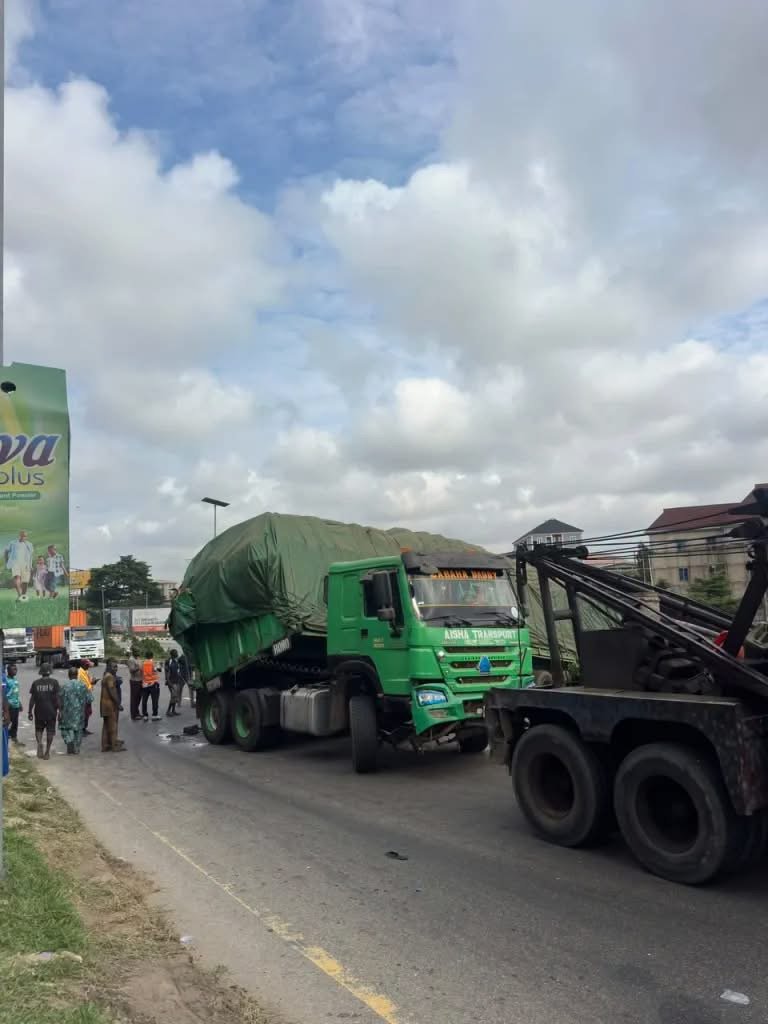
Motorists travelling through the Gbagada axis of Lagos were confronted with significant traffic disruption following a multiple-vehicle collision involving two articulated trucks and a private car along the busy expressway.
The incident, reported on June 29, 2026, occurred at the TREM inward Gbagada section of the Lagos Expressway and prompted an immediate response from the Lagos State Traffic Management Authority (LASTMA), which mobilised its rescue and recovery personnel to the scene.
The crash brought renewed attention to the vulnerability of major Lagos transport corridors to prolonged traffic disruption whenever heavy-duty vehicles are involved in road accidents. With the Gbagada corridor serving as an important connection between several densely populated parts of Lagos, even a single obstruction can rapidly produce extensive delays for commuters and motorists.
According to LASTMA, the collision involved two articulated trucks carrying cargo and a private vehicle. The agency said emergency responders were deployed after the accident was reported, while a tow truck was mobilised to facilitate the removal of the damaged vehicles.
LASTMA’s Rescue and Recovery Unit was also deployed to assist with vehicle evacuation and traffic management around the crash location.
The agency advised motorists approaching the affected area to exercise caution and prepare for delays while recovery operations were underway.
The incident was first reported by several Nigerian news organisations, including Punch Newspapers and Blueprint Newspapers, which cited information released by LASTMA concerning the collision and the subsequent recovery operation. (Punch Newspapers)
Accident disrupts movement on busy Gbagada corridor
The Gbagada Expressway is one of the important road corridors within Lagos’ wider metropolitan transport network. Its links to surrounding residential, commercial and commuter routes mean that accidents on the corridor can quickly affect traffic beyond the immediate crash scene.
In this case, the presence of two articulated trucks, in addition to a private car, created a substantial obstruction that required specialised recovery equipment and coordinated traffic management.
Unlike minor vehicle incidents that can sometimes be moved to the roadside within minutes, crashes involving articulated trucks can take considerably longer to resolve because of the size, weight and cargo configuration of the vehicles.
The delay involved in securing damaged trucks, assessing the road environment and positioning recovery equipment can compound congestion, particularly during periods of heavy traffic.
Reports on the incident indicated that the recovery exercise was ongoing when the initial traffic updates were issued. LASTMA’s intervention was therefore focused not only on removing the vehicles but also on managing traffic around the affected section and reducing the likelihood of further collisions. (The Meteor Digital Newspaper)
No immediate casualty figure established
While reports confirmed the involvement of two trucks and a private car, the initial accounts did not establish a confirmed death or injury toll arising from the June 29 collision.
That distinction is important, particularly in the circulation of accident videos and social-media reports, where images of badly damaged vehicles can sometimes lead to unverified claims about casualties.
Wengglobal therefore understands the confirmed information to be that a multiple-vehicle crash occurred and that LASTMA commenced recovery and traffic-management operations. No additional casualty figures should be attributed to the incident without confirmation from the relevant authorities.
The circumstances that led to the collision were also not publicly established in the reports reviewed. Consequently, claims about speeding, brake failure, reckless driving, mechanical defects or other possible causes would be speculative unless supported by an official investigation.
LASTMA response underscores importance of rapid recovery
The response by LASTMA highlights the critical role of traffic-management agencies in Lagos, where road capacity is frequently tested by high vehicle volumes.
Following a major crash, emergency response has two immediate priorities: protecting people at the scene and restoring movement on the affected road.
The deployment of a tow truck and LASTMA’s Rescue and Recovery Unit reflected an effort to achieve both objectives. Clearing damaged vehicles from strategic sections of the expressway can prevent an initial accident from developing into a wider transport crisis.
Traffic authorities also face the challenge of protecting accident scenes from secondary collisions. Motorists approaching an obstruction may have limited visibility or insufficient time to react, particularly when traffic is already slowing sharply.
For that reason, motorists are generally expected to reduce speed and follow directions from traffic officials when approaching accident scenes.
Gbagada has witnessed previous serious crashes
The latest collision is not an isolated road-safety concern in the Gbagada area.
In March 2026, a separate fatal crash occurred at New Castle Bus Stop inward Gbagada along the Oworonsoki–Apapa Expressway. In that incident, a commercial bus reportedly veered off the road and struck a roadside culvert. A female passenger was ejected onto the expressway and was subsequently hit by an approaching articulated trailer. Six other occupants of the bus sustained serious injuries. The Guardian, Punch Newspapers and other Nigerian outlets reported the incident based on information from LASTMA. (Guardian NG)
The earlier tragedy illustrates the dangers associated with high-speed traffic and heavy-duty vehicles operating along heavily populated urban corridors. It also demonstrates why accident scenes require rapid intervention to prevent secondary crashes.
There have likewise been previous incidents in which truck-related accidents caused severe congestion around the Gbagada corridor. In December 2024, Vanguard reported that an overturned truck blocked a substantial portion of the Gbagada-Oworonshoki Expressway, forcing traffic-management personnel and other responders to work on clearing the obstruction. (Vanguard News)
These recurring incidents point to the broader road-safety challenge confronting Lagos, where enormous traffic volumes, heavy commercial transport activity and limited road capacity can combine to magnify the consequences of individual crashes.
Need for stronger road-safety discipline
Beyond emergency response, repeated accidents involving articulated vehicles raise questions about preventive road safety.
Heavy-duty truck operators and other commercial drivers must maintain strict compliance with road-safety requirements, including appropriate speed, vehicle maintenance, safe following distances and responsible manoeuvring.
At the same time, private motorists must remain alert when sharing roads with articulated vehicles. Trucks have substantial blind spots, require greater stopping distances and can be difficult to manoeuvre in congested traffic.
The responsibility for safer roads, however, does not rest solely with drivers. Effective enforcement, regular vehicle inspections, road engineering, adequate lighting and clear road markings are all important components of a functioning road-safety system.
Lagos’ traffic-management authorities have increasingly had to combine enforcement with emergency recovery operations because disruptions on major corridors can have consequences far beyond the location of an accident.
The Gbagada incident once again demonstrates how quickly a road crash involving heavy vehicles can interfere with the movement of thousands of people.
Wengglobal’s assessment
For commuters, the immediate priority following such incidents is access to reliable traffic information, safe alternative routes and timely clearance of obstructions.
For authorities, the longer-term priority should be reducing the frequency and severity of crashes through preventive enforcement, improved road design, safer heavy-duty vehicle operations and rapid-response capacity.
The June 29 Gbagada collision did not merely represent a confrontation between vehicles; it also demonstrated the wider economic and social consequences of disruptions on Lagos’ major transport corridors.
As Nigeria’s commercial capital continues to experience intense urban mobility pressures, effective accident response will remain essential. But sustained road safety will ultimately depend on preventing avoidable crashes before they occur.
For motorists using the Gbagada corridor and other major Lagos expressways, the incident is a reminder that caution, patience and adherence to traffic regulations remain critical, particularly around articulated trucks and other heavy vehicles.
Wengglobal will continue to distinguish verified information from unconfirmed claims and provide context around major incidents affecting commuters, businesses and communities across Nigeria.
Sources
- Punch Newspapers — “Two trucks, car collide on Lagos road”
- Blueprint Newspapers — “Two trucks, car collide on Lagos expressway”
- The Guardian Nigeria — “LASTMA responds swiftly to fatal Gbagada road accident”
- The Guardian Nigeria — “Woman killed, six injured as bus crashes in Lagos”
- Vanguard — “Gridlock as truck falls, blocks Gbagada Expressway in Lagos”