Reported by Weng Patrick Atokor | Journalist at Weng Global
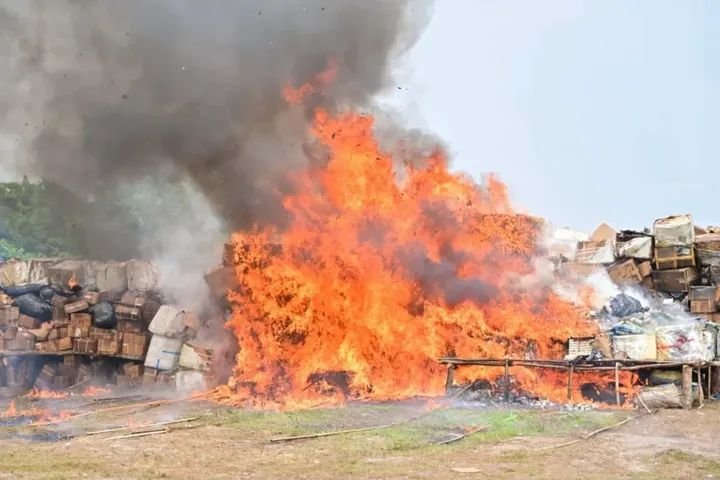
The National Drug Law Enforcement Agency (NDLEA) has destroyed 329,865.585 kilogrammes of assorted illicit drugs and psychotropic substances valued at an estimated N301.058 billion, in a major operation carried out in Lagos.
The court-ordered destruction exercise took place on Monday at Navy Town, Ojo, Lagos, marking one of the agency’s largest publicly announced destruction exercises involving narcotics seized across different commands in the state.
According to the NDLEA, the drugs were destroyed following orders of the Federal High Court, Lagos Judicial Division. The exercise covered illicit substances connected to concluded and uncontested cases, as well as abandoned seizures.
The massive quantity of drugs destroyed highlights the scale of the illegal narcotics trade confronting Nigeria, particularly Lagos, which serves as a major commercial centre and an important entry and exit point for international cargo and passengers.
NDLEA destroys nearly 330,000kg of drugs
The NDLEA said 246,864.535kg of the destroyed drugs were seized by its Lagos Strategic Command between April 2025 and May 2026.
An additional 83,001.05kg came from several other commands and operational units working within Lagos.
These included the Murtala Muhammed International Airport Command, Tin Can and Apapa Strategic Commands, the Marine Command and a Special Operations Unit.
The figures demonstrate the breadth of the anti-narcotics operation across Lagos, from airports and seaports to other locations targeted by NDLEA intelligence and enforcement activities.
The total street value of the destroyed substances was put at N301,058,076,000.
The destruction therefore represents not only a significant enforcement achievement but also the removal of a huge quantity of narcotics that authorities say could otherwise have reached communities and markets across Nigeria and beyond.
Cocaine, heroin, cannabis and opioids destroyed
The substances destroyed included some of the most dangerous and commonly trafficked illicit drugs.
They comprised cocaine, heroin, methamphetamine and different strains of cannabis, including Canadian Loud and skunk.
Other substances included ephedrine, tramadol, codeine syrup, other opioids and khat leaves.
The diversity of substances demonstrates that Nigeria’s drug problem extends beyond a single category of narcotics. The country continues to confront trafficking and abuse involving both traditional illicit drugs and pharmaceutical substances that are diverted into illegal markets.
The presence of opioids such as tramadol and codeine syrup is particularly significant because the misuse of pharmaceutical drugs has become part of the wider substance-abuse challenge facing many communities.
Marwa warns drug traffickers
NDLEA Chairman and Chief Executive Officer, Brigadier General Mohammed Buba Marwa (retd.), used the exercise to send a warning to drug barons, traffickers and dealers.
Marwa said the agency would continue its campaign against criminal networks involved in the production, movement and distribution of illicit substances.
The NDLEA chairman has repeatedly maintained that the agency’s strategy is focused not only on intercepting drugs but also on dismantling the networks and financial structures that sustain the illegal trade.
The latest destruction exercise reinforces that approach, as the drugs involved had already been removed from circulation through seizures and subsequent legal processes.
The Guardian reported that Marwa warned drug barons, traffickers and dealers that their ability to operate with impunity would not continue.
Lagos remains a major frontline
Lagos occupies a strategic position in Nigeria’s drug-control efforts because of its international airport, major seaports, extensive road network and large population.
The state hosts the country’s busiest commercial gateways, making it an attractive target for international drug trafficking networks seeking to move narcotics into Nigeria or use the country as a transit point.
Recent NDLEA operations demonstrate the scale and sophistication of the challenge.
In July, the agency announced the interception of 6,778.5kg of Canadian Loud at the Apapa seaport in Lagos. The substance was intercepted during a joint examination involving NDLEA operatives, the Nigeria Customs Service and other security agencies.
The agency has also reported cocaine interceptions at Lagos airport and other points, underlining the continuing attempts by traffickers to exploit legitimate transportation and commercial channels.
In another July operation, NDLEA operatives intercepted cocaine concealed in cartons containing food items at the export shed of Lagos airport.
Enforcement goes beyond seizures
While the destruction of seized narcotics removes drugs from circulation, experts and law-enforcement agencies recognise that seizures alone cannot solve Nigeria’s drug problem.
Drug trafficking is supported by networks that involve financing, transportation, concealment, distribution and recruitment.
For this reason, the NDLEA has increasingly combined interdiction operations with investigations, arrests, prosecutions and efforts to identify major trafficking networks.
In June, the agency announced the conviction of 12 defendants linked to the trafficking of 315kg of cocaine. The case resulted in convictions and financial restitution orders, demonstrating the agency’s focus on pursuing both individuals and assets associated with trafficking.
The agency has also prosecuted major trafficking cases in Lagos, including cases involving international suspects and large-scale cocaine importation.
The human cost of drug abuse
Beyond the financial value attached to seized narcotics, the NDLEA has repeatedly stressed that the real cost of drug trafficking is measured in human lives and social consequences.
Illicit drug use can contribute to addiction, family breakdown, violence, health problems, loss of productivity and other forms of social harm.
For young people in particular, exposure to drug trafficking and substance abuse can create long-term consequences affecting education, employment and relationships.
The destruction of the 329,865.585kg therefore represents more than the disposal of seized material. It is also intended to prevent the substances from being recycled into criminal markets.
The Federal Government has said its broader response to the drug problem includes prevention, treatment, rehabilitation and the dismantling of trafficking networks.
At the National Drug Use Summit in July, the government reaffirmed its commitment to preventing illicit drug use, disrupting trafficking networks and expanding access to treatment and rehabilitation.
Strengthening inter-agency cooperation
The scale of the Lagos operation also underscores the importance of cooperation between law-enforcement and security agencies.
Drug trafficking increasingly operates across borders and jurisdictions, making intelligence sharing and coordinated enforcement essential.
The NDLEA and Nigeria Customs Service agreed earlier this year to strengthen cooperation against transnational organised crime and drug trafficking.
The framework was designed to improve coordination between the two agencies and strengthen Nigeria’s ability to intercept illicit substances entering or leaving the country.
Such cooperation is particularly important in Lagos because trafficking networks may attempt to exploit airports, seaports, courier services, roads and other transportation channels.
A warning to trafficking networks
The destruction of drugs worth more than N301 billion sends a strong message about the scale of the NDLEA’s current enforcement activities.
However, the operation also demonstrates the enormous financial incentives available to criminal networks involved in the illicit drug trade.
The agency’s challenge will therefore extend beyond destroying seized substances. It will need to continue identifying the people financing trafficking operations, tracing criminal proceeds, disrupting supply chains and preventing new consignments from reaching Nigerian communities.
Recent NDLEA operations suggest that the agency is increasingly targeting the wider networks behind drug trafficking rather than focusing exclusively on individual couriers.
In May, President Bola Ahmed Tinubu commended the agency after it announced the dismantling of a Nigerian-Mexican drug syndicate and the seizure of chemicals and illicit drugs valued at more than $360 million.
What the destruction means for Nigeria
The Lagos destruction exercise is a significant development in Nigeria’s continuing fight against drug trafficking and substance abuse.
With 329,865.585kg of illicit drugs removed from circulation and an estimated street value of N301.058 billion, the operation represents a substantial blow to the criminal networks connected to the seized consignments.
But the long-term success of the campaign will depend on what happens beyond the destruction ground.
Sustained intelligence gathering, border control, prosecution of traffickers, financial investigations, public education, prevention programmes and access to treatment will remain critical.
For communities, the objective is ultimately not simply to see seized drugs destroyed but to reduce the availability and demand for dangerous substances.
As the NDLEA continues its operations across Nigeria, the agency faces the challenge of maintaining pressure on trafficking networks while working with other government institutions and communities to address the factors that drive drug abuse.
The destruction of the Lagos consignments is therefore both an enforcement milestone and a reminder of the continuing scale of Nigeria’s narcotics challenge.
With more than N301 billion worth of illicit drugs permanently removed from circulation, authorities are seeking to ensure that the substances do not return to the streets—and that the criminal networks responsible for moving them face increasing pressure from law enforcement.