Reported by Weng Patrick Atokor l Journalist at Weng Global
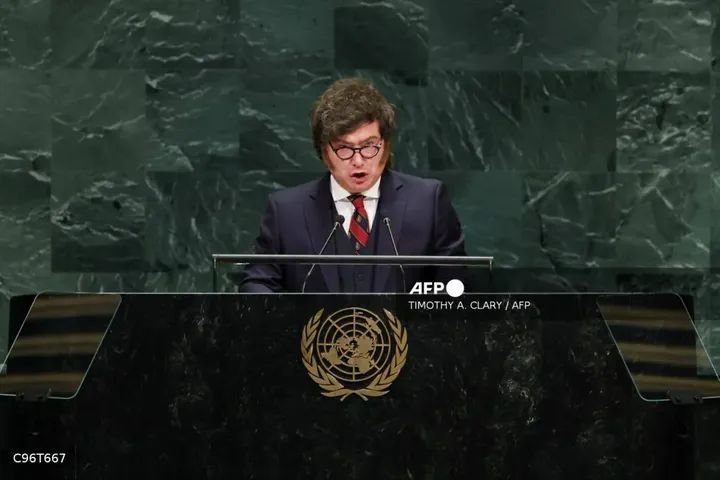
Argentine President Javier Milei has sharply criticised the United Nations over its handling of Argentina’s long-running sovereignty dispute with the United Kingdom over the Falkland Islands, calling the organisation “useless” during an address to the UN General Assembly in New York on September 23, 2026.
Milei said the Falkland Islands, known in Argentina as the Malvinas, remain a national cause and accused the UN of failing to ensure that previous resolutions concerning the disputed territory are respected.
His remarks came as tensions between Argentina and the UK have increased over offshore oil exploration near the islands.
Milei Accuses UN of Failing to Act
Addressing the 81st UN General Assembly, Milei argued that the international organisation had failed to effectively address Argentina’s sovereignty claim.
He specifically referred to a 1976 UN General Assembly resolution calling on Argentina and the UK to refrain from unilateral actions that could affect the disputed territory while the sovereignty question remained unresolved.
Milei questioned the effectiveness of such resolutions when, in his view, they are not followed by consequences.
He also accused the UN of “looking the other way” regarding developments around the Falkland Islands.
In a broader criticism of the organisation, the Argentine president described the UN as a “useless organisation” and accused its bureaucracy of failing to fulfil its responsibilities on international security and human rights.
Oil Exploration Raises Fresh Tensions
A major factor behind the latest dispute is the Sea Lion offshore oil project in waters north of the Falkland Islands.
The project involves UK-based Rockhopper Exploration and Israel-based Navitas Petroleum. The companies operate under licences approved by Falkland Islands authorities, while Argentina considers the activity unlawful because it claims sovereignty over the territory and surrounding resources.
Argentina has already begun sanctions proceedings against more than 60 companies and individuals linked to offshore drilling activities near the islands.
The government has also submitted legislation intended to strengthen penalties against companies involved in natural-resource exploitation in areas Argentina considers part of its maritime territory.
The developments have added an economic dimension to a sovereignty dispute that has remained unresolved for decades.
Britain Maintains Its Position
The United Kingdom continues to administer the Falkland Islands as a British overseas territory and rejects Argentina’s sovereignty claim.
British officials have also defended the right of the islanders to determine their own political future.
The position was reinforced during the diplomatic activity surrounding this week’s UN General Assembly. British Prime Minister Andy Burnham said the UK would stand firm against threats and defend the Falkland Islanders’ right to remain British.
The Falkland Islands held a referendum on their political status in 2013. According to the Associated Press, 99.8% of participating voters supported remaining a British overseas territory, with only three votes against.
Argentina disputes the relevance of that vote to the sovereignty question, with Milei arguing that the principle of self-determination should not apply in the circumstances of the islands.
A Dispute Rooted in the 1982 War
The sovereignty dispute has a long history and became the subject of armed conflict in 1982, when Argentina invaded the islands.
Britain subsequently launched a military operation to retake the territory. The conflict lasted 74 days and ended with the surrender of Argentine forces.
The war resulted in the deaths of 649 Argentine military personnel, 255 British military personnel and three Falkland Islanders, according to figures cited by The Guardian.
The dispute remained unresolved after the conflict, with Argentina continuing to claim sovereignty and Britain maintaining control of the islands.
The United Nations has continued to support a peaceful resolution through negotiations between Argentina and the UK.
Argentina Says It Will Not Wait Indefinitely
Milei’s latest speech marked a tougher public position from Buenos Aires.
He said Argentina would not simply wait for the UN and international community to enforce existing commitments, arguing that his government had decided to take measures of its own in response to activities it considers unlawful.
That position has already been reflected in Argentina’s sanctions against entities associated with the offshore oil project and proposed changes to domestic legislation.
However, Milei also called for a peaceful solution to the sovereignty dispute, indicating that Argentina’s current approach combines diplomatic pressure with economic and legal measures.
Wider International Attention
The Falklands dispute has attracted renewed international attention partly because of recent comments from US President Donald Trump.
Trump said in August that the United States was reviewing its previously neutral position on the dispute. The development has added another layer to relations involving Argentina, Britain and the United States.
Milei has maintained close relations with Washington, while Britain has continued to insist that the wishes of the Falkland Islanders must remain central to the territory’s future.
The issue therefore extends beyond the immediate disagreement over offshore oil. It involves competing claims over sovereignty, international law, self-determination and control of potentially valuable natural resources.
What Happens Next?
The immediate focus is likely to remain on Argentina’s sanctions and proposed legislation, as well as the progress of the Sea Lion oil project.
Argentina has signalled that it intends to continue challenging activities it considers violations of its territorial claims. Britain and the Falkland Islands authorities, meanwhile, maintain their position that the islands have the right to develop their natural resources.
The UN continues to call for a peaceful settlement of the sovereignty dispute.
For now, Milei’s intervention at the General Assembly has placed the Falklands dispute firmly back in the international spotlight while exposing wider questions about the UN’s ability to enforce its resolutions.
Weng Global – Stories beyond borders
Sources
- Associated Press — Milei renews Argentina’s Falklands claim at the UN and calls for a peaceful solution.
- Al Jazeera — Milei’s UN speech and Argentina’s dispute with the UK over the Falkland Islands.
- The Guardian — Argentina’s criticism of the UN and the Falklands sovereignty dispute.
- Reuters — Argentina’s proposed legislation to strengthen sanctions over Falklands-related activities.