Reported by Simon Daniel Yusuph l Journalist at Weng Global
Lionel Messi brought his 21-year international career with Argentina to an emotional close on Tuesday, October 6, 2026, scoring a penalty and providing two assists as Argentina defeated Benin 3-0 at the Estadio Monumental in Buenos Aires.
The farewell was about far more than the result. In front of more than 85,000 supporters, Messi became visibly emotional as he reflected on his extraordinary journey with the national team, remembering his late father, Jorge Messi, and acknowledging the enduring influence of Argentine football legend Diego Maradona.
Messi’s final appearance ended a remarkable chapter that began in 2005 and included the 2022 FIFA World Cup, two Copa América titles and the transformation of a player once heavily criticised by sections of the Argentine public into one of the country’s most revered sporting figures.
MAIN DEVELOPMENT
Argentina defeated Benin through goals from Nicolás Otamendi, Nico Paz and Messi, with the captain directly involved in all three.
Otamendi opened the scoring in the 48th minute after Messi supplied the assist from a corner. Messi then created Argentina’s second goal for Nico Paz in the 61st minute before completing the scoring himself from the penalty spot 10 minutes later.
The goal was Messi’s 126th for Argentina and his final one in the national-team shirt. He also finished the match with two assists, underlining the influence he maintained even at the end of an international career that lasted more than two decades.
The Argentine Football Association confirmed that the match at the Monumental was Messi’s final appearance in front of an Argentine home crowd. The occasion was organised as a farewell celebration for the captain, with the stadium packed for a night dedicated to his service to the national team.
The result also extended Argentina’s winning run in international friendlies to 22 matches, according to the Argentine Football Association.
But the statistics were secondary to the emotion surrounding the occasion.
MESSI REMEMBERS HIS LATE FATHER
One of the most poignant moments came after the final whistle when Messi addressed the supporters.
The Argentine captain became emotional while speaking about the people who had helped him throughout his career, with his late father, Jorge Messi, foremost in his thoughts.
Jorge Messi died in August 2026, only weeks before his son’s final appearance for Argentina. His absence therefore gave the farewell an additional personal dimension for Messi and his family.
Messi acknowledged his father while reflecting on what it had meant to represent Argentina for more than 20 years. The moment was particularly significant because Jorge had been a central figure in Messi’s development from a young player in Rosario into an international football star.
Reports from the farewell ceremony said Messi’s first thoughts after the match were about his father. MLS Soccer, reporting on his speech, said the Argentine captain began by referring to his father before thanking supporters and reflecting on his career.
The tribute made the occasion more personal than a conventional retirement ceremony. Messi was not simply closing a chapter in his sporting career; he was doing so while processing the recent loss of one of the people who had been closest to his journey.
MARADONA’S SHADOW AND MESSI’S LEGACY
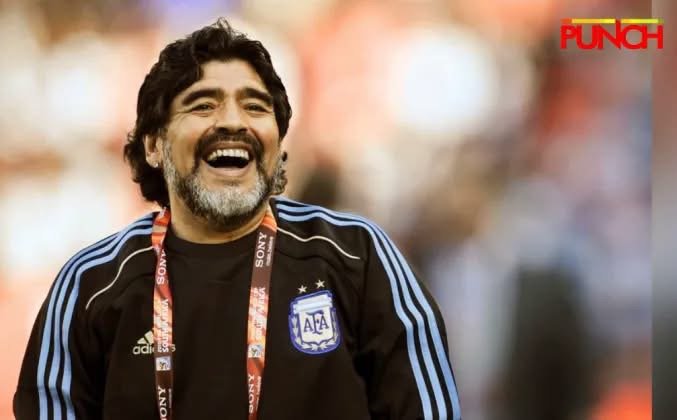
Messi also paid tribute to Diego Maradona, whose name has been inseparable from discussions about Argentine football and Messi’s own place in the country’s sporting history.
For much of Messi’s career, comparisons with Maradona were unavoidable. Maradona had led Argentina to World Cup glory in 1986 and was regarded as the country’s defining football icon before Messi’s generation emerged.
When Messi made his senior Argentina debut in 2005, he entered a football culture in which Maradona’s influence was immense. FIFA has noted that both players made their Argentina debuts against Hungary, with Messi’s first appearance ending prematurely after he was sent off.
Messi spent years being measured against Maradona, particularly because Argentina’s national team success initially failed to match his achievements at club level.
That changed dramatically during the final years of his international career.
Messi helped Argentina win the Copa América in 2021, the Finalissima in 2022 and, most significantly, the FIFA World Cup in Qatar later that year. The World Cup triumph placed him alongside the greatest figures in Argentine football and removed the most persistent criticism surrounding his international career.
FIFA’s retrospective on Messi’s Argentina career described the 21-year journey as one marked by extraordinary performances and major titles, culminating in an emotional farewell at the Monumental.
The connection between Maradona and Messi is therefore not simply about comparing statistics or playing styles. It reflects two generations of Argentine football and two players who carried enormous expectations from supporters.
By the time Messi walked off the field for the final time, the debate over whether he had lived up to Maradona’s legacy had become less important to many Argentines. Messi had established a legacy of his own.
A CAREER THAT CHANGED ARGENTINA’S RELATIONSHIP WITH MESSI
Messi’s relationship with Argentina was not always as celebratory as it was on Tuesday night.
His early years with the senior national team were accompanied by enormous expectations. Despite his success with Barcelona and his growing reputation as one of the world’s finest players, Argentina repeatedly fell short in major tournaments.
He lost the 2014 World Cup final to Germany and suffered defeats in the Copa América finals in 2007, 2015 and 2016.
The disappointment became so intense that Messi announced his international retirement in 2016 after Argentina lost the Copa América Centenario final to Chile.
He later reversed that decision and returned to the national team.
The turning point came under coach Lionel Scaloni.
Argentina’s success at the 2021 Copa América gave Messi his first major senior international title with the country. The victory was followed by the Finalissima triumph against Italy in 2022 and then the World Cup victory in Qatar.
The 2022 World Cup was especially important because it fulfilled the achievement that had eluded Messi throughout the majority of his career.
Argentina’s triumph also changed the tone of the country’s relationship with its captain. The player who had once been questioned for not reproducing his Barcelona form with Argentina was now celebrated as the leader who had finally delivered the World Cup.
THE NUMBERS BEHIND THE FAREWELL
Messi finished his Argentina career with records that underline the scale of his contribution.
He made 208 appearances for Argentina, more than any other player, and scored 126 goals, also a national record. His final international goal came from the penalty spot against Benin.
His career also included four major senior international titles: the 2021 Copa América, the 2022 Finalissima, the 2022 FIFA World Cup and the 2024 Copa América.
The numbers, however, tell only part of the story.
Messi became the central figure of Argentina’s most successful period in decades. His influence extended beyond scoring goals, with his passing, chance creation, leadership and ability to control matches making him indispensable to successive Argentina teams.
His final game against Benin was a fitting demonstration of that influence.
At 39, Messi scored and created two goals, directly contributing to every Argentina goal in the 3-0 victory.
AN EMOTIONAL NIGHT AT THE MONUMENTAL
The atmosphere at the Estadio Monumental reflected the significance of the occasion.
More than 85,000 supporters attended the farewell, while members of Argentina’s World Cup-winning generation and their families were present to celebrate Messi.
The farewell included tributes, celebrations and a special presentation honouring his contribution to the national team. FIFA described the occasion as an emotional conclusion to one of the most extraordinary international careers in football history.
The stadium’s reaction also demonstrated how dramatically Messi’s standing had changed.
For years, some Argentine supporters questioned whether the Barcelona superstar could reproduce his club success internationally. By the time of his final match, the same national team shirt had become inseparable from his identity.
The farewell therefore represented not only the retirement of a footballer but the conclusion of a complicated relationship between a country and one of its greatest sporting figures.
REACTIONS
The reaction to Messi’s retirement has extended beyond Argentina.
Cristiano Ronaldo, Messi’s longtime rival during their years competing at the highest level of European football, paid tribute to the Argentine following his farewell.
Reuters reported that Ronaldo praised Messi after the Argentine announced the end of his international career. The Portuguese forward’s response reflected the respect Messi’s career has earned even among players who spent much of their careers competing against him.
Argentina coach Lionel Scaloni has also repeatedly highlighted Messi’s importance to the national team.
The farewell was attended by former teammates and members of the squad that helped Argentina win the 2022 World Cup, creating a symbolic connection between the generation that achieved international glory and the younger players now expected to carry the team forward.
WHY IT MATTERS
Messi’s departure marks the end of one of the defining eras in international football.
For Argentina, the challenge now is not simply replacing a prolific goalscorer. The national team must move forward without the player around whom much of its footballing identity has revolved for more than a decade.
Messi’s departure also closes a generational chapter in South American football.
Argentina’s rivalry with Brazil, the continuing influence of Maradona’s legacy and the emergence of new talents have all shaped the continent’s football culture. Messi’s career connected several generations, from the era of Maradona to the current generation of players who grew up watching Messi himself.
His story is also significant beyond Argentina.
For millions of football supporters around the world, Messi represented an era defined by technical excellence, sustained consistency and an extraordinary ability to influence matches.
His international career included difficult defeats and periods of criticism, but it ultimately ended with the major titles that had once seemed beyond reach.
WHAT HAPPENS NEXT
Messi’s retirement from Argentina does not necessarily mean an immediate end to his professional club career.
He remains a player for Inter Miami, where his contract currently runs through 2028. His decision to end his international career therefore allows him to focus entirely on club football, although his long-term playing future remains a separate question.
For Argentina, attention will now shift towards the next generation.
Players such as Nico Paz and other emerging talents will face increased expectations as the national team begins life without its longtime captain and No. 10.
Argentina’s football authorities and coaching staff will also have to manage the transition carefully. Replacing Messi as a player is impossible in practical terms, but developing a team capable of competing without him is now the next stage of the country’s football project.
The 3-0 victory over Benin provided an emotional ending to Messi’s international career. It also offered a glimpse of Argentina’s future, with Paz among the younger players scoring during a match dominated by the symbolism of Messi’s farewell.
A FINAL CHAPTER, NOT AN ERA FORGOTTEN
Messi leaves Argentina with an international legacy that combines extraordinary individual records with the trophies his country had waited years to win.
He arrived on the senior international stage as a teenager in 2005, when expectations surrounding him were already enormous. Twenty-one years later, he walked away as Argentina’s record appearance-maker and leading scorer, a World Cup winner and a player whose name is now permanently embedded in the country’s football history.
His final night against Benin was therefore fitting.
There was a victory, a goal, two assists, an enormous crowd and an emotional farewell. There were also memories of the people who shaped his journey, including his late father, Jorge, and the legendary Maradona, whose shadow had followed Messi throughout much of his career.
Messi’s final message to Argentina was ultimately one of gratitude.
The footballer who spent years trying to give his country the success it demanded eventually gave it the greatest prize in international football. He now leaves the national team with his legacy firmly established.
Argentina will move on, as every national team eventually must.
But the blue-and-white shirt will forever be associated with the generation led by Lionel Messi.
Weng Global – stories beyond borders
Sources
- Argentine Football Association (AFA)
- FIFA
- Reuters
- Associated Press
- Inter Miami CF
- MLS Soccer
- The Guardian
- Channels Television