Reported by Weng Patrick Atokor | Journalist at Weng Global
The HerStory of Nigeria project is helping to reshape how young Nigerians understand the country’s history by placing the achievements and contributions of women at the centre of national conversations. Through educational programmes, storytelling, mentorship and historical documentation, the initiative is inspiring schoolgirls to see themselves as future leaders, innovators and changemakers capable of driving Nigeria’s development.
For decades, the stories of countless Nigerian women who played significant roles in politics, education, science, business, arts, activism and community development have remained underrepresented in school curricula and public discourse. The HerStory of Nigeria initiative seeks to address this gap by documenting these achievements and ensuring that younger generations, particularly girls, learn from the lives of women who helped shape the nation’s history.
Organisers of the project believe that preserving women’s history is not merely about celebrating past accomplishments but about building confidence among young girls to actively participate in nation-building. By highlighting female role models from different ethnic, religious and professional backgrounds, the initiative demonstrates that leadership and excellence are achievable regardless of gender.
According to the project’s coordinators, understanding history enables young people to appreciate the sacrifices and resilience of previous generations while encouraging them to become responsible citizens committed to Nigeria’s progress.
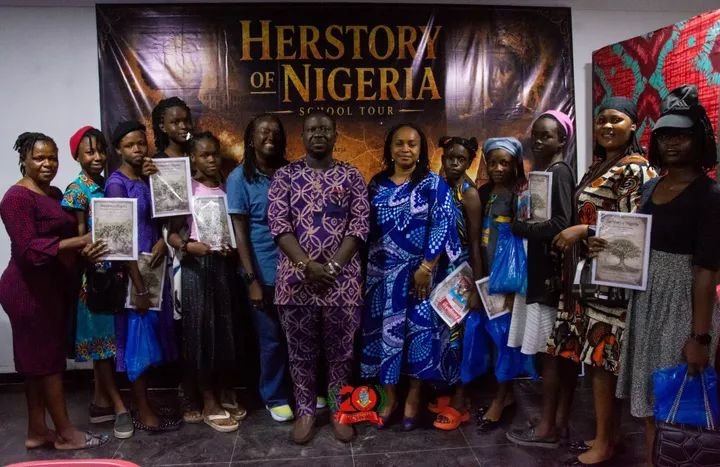
The programme engages secondary school students through interactive history sessions, exhibitions, leadership workshops, debates and storytelling activities. These engagements encourage participants to critically examine Nigeria’s history while recognising the often-overlooked roles played by women in shaping communities, institutions and national policies.
Educators involved in the initiative say many students are surprised to discover the contributions of Nigerian women in the struggle for independence, democratic governance, healthcare, education, literature, entrepreneurship and social justice.
By bringing these stories into classrooms, organisers hope to inspire girls to pursue careers in public service, science, technology, education, journalism, medicine and business with greater confidence.
The project also promotes mentorship by connecting schoolgirls with accomplished Nigerian women from various sectors. These interactions provide opportunities for students to ask questions, receive career guidance and learn firsthand about overcoming obstacles in professional and personal life.
Mentors consistently encourage participants to embrace education, integrity, resilience and innovation as essential qualities for future leaders.
Education experts have praised initiatives like HerStory of Nigeria for complementing formal education by exposing students to diverse perspectives often absent from conventional textbooks.
They argue that history becomes more meaningful when learners can relate to individuals who resemble them and share similar cultural backgrounds.
Beyond inspiring girls, the project also encourages boys to appreciate the contributions of women, promoting mutual respect and gender inclusion within schools and communities.
Organisers maintain that achieving sustainable national development requires the active participation of both women and men, making inclusive historical education an important investment in Nigeria’s future.
Workshops organised under the initiative often include discussions on leadership, civic responsibility, entrepreneurship, digital literacy, environmental sustainability and community development. These themes are designed to help students understand how historical lessons can influence present-day decision-making.
Participants are encouraged to identify problems affecting their communities and develop practical solutions through innovation, teamwork and volunteerism.
Many schools participating in the programme have reported increased enthusiasm among students for history, leadership clubs and community service projects.
Teachers say students have become more engaged in classroom discussions after learning about pioneering Nigerian women whose achievements were previously unfamiliar to them.
The initiative also utilises digital platforms to preserve and share historical materials, ensuring wider access for schools, researchers and members of the public across Nigeria and beyond.
Through documentaries, podcasts, online archives and educational resources, HerStory of Nigeria seeks to make women’s history more accessible to future generations.
Supporters believe technology provides an effective way to preserve historical records while encouraging broader public participation in documenting local histories.
The project aligns with global efforts to promote gender equality, quality education and inclusive development as outlined in the United Nations Sustainable Development Goals (SDGs).
Advocates argue that empowering girls through education and positive role models contributes directly to stronger institutions, economic growth and social cohesion.
Experts note that countries achieve greater development when girls are given equal opportunities to learn, lead and contribute meaningfully to society.
Several stakeholders have called on governments, educational authorities and private organisations to support initiatives that preserve Nigeria’s cultural and historical heritage while promoting inclusive education.
They emphasise that integrating women’s history into school curricula can enrich students’ understanding of Nigeria’s development and encourage balanced historical narratives.
Community leaders involved in the programme stress that preserving history is a shared responsibility requiring collaboration among historians, educators, cultural institutions, civil society organisations and government agencies.
They argue that documenting women’s contributions ensures future generations inherit a more complete understanding of Nigeria’s journey.
Parents have also welcomed the initiative, saying it motivates their daughters to pursue ambitious educational and career goals while strengthening their appreciation of Nigerian heritage.
Some participants described the programme as transformative, noting that learning about accomplished Nigerian women gave them renewed confidence in their own abilities and aspirations.
As Nigeria continues to invest in education, youth empowerment and national development, initiatives such as HerStory of Nigeria demonstrate how history can become a powerful tool for inspiring future generations.
By celebrating the achievements of women who broke barriers across different sectors, the project is helping young Nigerians recognise that leadership, innovation and service are not limited by gender but driven by vision, determination and opportunity.
Ultimately, organisers hope the initiative will contribute to building a generation of informed, confident and socially responsible citizens committed to advancing Nigeria’s development through knowledge, inclusion and active civic participation.
Sources
- Women Radio 91.7 FM
- The Guardian Nigeria
- UNESCO
- UN Women