Reported by Weng Patrick Atokor l Journalist at Weng Global
The President of the Community Court of Justice of the Economic Community of West African States (ECOWAS), Justice Ricardo Cláudio Monteiro Gonçalves, has urged journalists across the region to use their platforms to promote compliance with judgments delivered by the regional court.
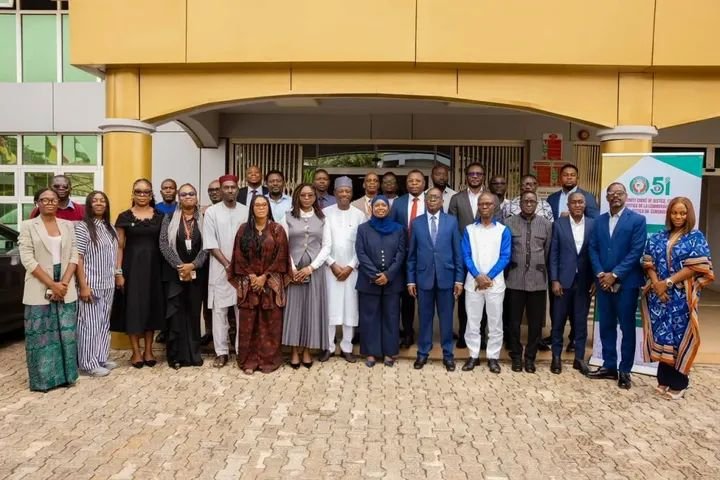
Gonçalves made the call on Wednesday, September 16, 2026, in Abuja, where the ECOWAS Court opened a three-day training programme for journalists covering its activities.
The President, who was represented at the opening ceremony by the Court’s Vice President, Justice Sengu Mohamed Koroma, said journalists had an important role in increasing public awareness of the Court’s decisions and encouraging member states to fulfil their obligations under ECOWAS treaties.
He specifically urged journalists to engage governments on the need to implement judgments of the regional court.
“Let me also urge you to use your media platforms to engage Member States on the need to faithfully implement the decisions of the Court in accordance with their treaty obligations,” Gonçalves said, according to the report of the opening ceremony.
Court raises concern over judgment enforcement
The ECOWAS Court President also drew attention to the gap between judgments delivered by the Court and their implementation by member states.
According to Gonçalves, responsibility for enforcing the Court’s judgments rests with member states, but the current level of compliance is below expectation.
The issue is significant because the ECOWAS Court is a regional judicial institution whose decisions are final and binding under the legal framework governing the Court. Its official materials state that member states and ECOWAS institutions are required to take measures necessary to execute the Court’s decisions.
The enforcement question has therefore become an important part of discussions about the effectiveness of regional judicial institutions and access to justice in West Africa.
In June 2026, for example, the ECOWAS Court ordered the Federal Republic of Nigeria to pay ₦10 million in compensation to journalist Jide Oyekunle over rights violations arising from his coverage of a protest in Abuja in August 2024. The Court said the Nigerian government was required to report on measures taken to implement the judgment within three months.
Journalists urged to understand court procedures
Beyond judgment enforcement, Gonçalves stressed the need for journalists to have a strong understanding of the Court’s mandate, jurisdiction, structure and procedures.
He said gaps in public understanding of the ECOWAS Court were partly connected to inadequate media coverage and limited knowledge of its judicial processes.
The training was consequently designed to strengthen journalists’ ability to report court proceedings and decisions accurately, responsibly and in language that ordinary citizens can understand.
The programme, which runs from September 16 to 18 at the Court’s headquarters in Abuja, brings together journalists from 12 ECOWAS member states. The participating countries include Benin, Cabo Verde, Côte d’Ivoire, Ghana, Guinea-Bissau, Guinea, Liberia, Sierra Leone, Senegal, The Gambia, Togo and Nigeria.
Participants are expected to receive practical guidance on the Court’s mandate, jurisdiction, procedures and legal terminology, alongside techniques for accurately presenting judicial proceedings.
Court warns against confusing allegations with judgments
A central message from the training is the need for journalists to clearly distinguish between what parties argue in court and what the Court itself establishes in its judgment.
Gonçalves urged reporters to avoid bias, sensationalism, misinformation and disinformation when covering judicial proceedings.
The distinction is particularly important in court reporting because submissions made by applicants, respondents or their lawyers do not automatically constitute findings of fact by the Court.
Journalists are therefore expected to identify the source and status of information — whether it is an allegation, legal argument, evidence presented by a party, judicial finding or final decision.
The Court has also emphasised the importance of using official Court sources and accurately reporting its reasoning and decisions. The training programme is intended to strengthen those skills among journalists covering the regional institution.
Three-day programme focuses on judicial reporting
The training is expected to involve officials from the Court’s Registry and Research Departments, alongside experts in journalism and judicial reporting.
According to information on the programme, participants will also have an opportunity to observe and report on scheduled Court proceedings on September 18.
That practical component is intended to allow journalists to apply the knowledge gained during the training to real-time judicial reporting.
The programme is part of the Court’s broader efforts to improve communication with stakeholders and increase public understanding of its work.
It is also aligned with the ECOWAS Court Strategic Plan 2026–2030, including its focus on transparency, stakeholder engagement and accountability.
Court seeks stronger media network across West Africa
The Head of Public Information and External Relations of the Community Court of Justice, ECOWAS, Elohor Ovadje, said the training was expected to improve journalists’ knowledge of the Court and the quality of reports about its proceedings.
She said the initiative would also encourage fairness and objectivity in media coverage while improving public awareness of the Court’s mandate, jurisdiction and jurisprudence.
Another expected outcome is the creation of a network of journalists specialising in judicial reporting across the ECOWAS region.
Such a network could provide a more consistent media presence around the activities of the regional court and improve communication between journalists and judicial officials.
The organisers also expect the initiative to strengthen cooperation between the Court and media organisations and increase public interest in the institution’s work.
Why the training matters
For citizens, judicial decisions can have consequences that extend beyond the courtroom. They can affect human rights, government obligations, access to justice and the responsibilities of public institutions.
However, court judgments can be difficult for non-specialists to understand because they often contain technical legal language and detailed procedural reasoning.
Journalists therefore serve as an important link between judicial institutions and the public.
Accurate reporting can help citizens understand not only what a court decided but also why it reached that decision, which parties were involved, what legal questions were considered and what obligations may follow.
That role becomes particularly important for a regional institution such as the ECOWAS Court, whose decisions can have implications across national borders.
The Court’s official materials describe it as a regional judicial institution with responsibility for interpreting and applying ECOWAS legal instruments, while also exercising a human-rights mandate.
What happens next
The three-day training continues through September 18, with participants expected to receive further instruction in judicial reporting and take part in practical coverage of Court proceedings.
The organisers are also working towards establishing a regional network of journalists who can regularly cover the ECOWAS Court.
For the Court, the broader objective is to improve public understanding of its mandate and decisions while encouraging more accurate reporting of regional justice.
For journalists, the programme places particular emphasis on verification, legal accuracy, impartiality and the distinction between claims made by parties and findings reached by the Court.
The outcome could provide a stronger foundation for specialised judicial reporting across West Africa, particularly as the region continues to rely on regional legal institutions to address questions involving human rights, governance and the rule of law.
Weng Global – Stories beyond borders
Sources
- Community Court of Justice, ECOWAS — official information on the Court’s judgments, enforcement framework and mandate.
- Punch — report on the September 16, 2026 opening of the ECOWAS Court journalists’ training in Abuja.
- Vanguard — report on the September 16–18, 2026 judicial-reporting training programme and participating ECOWAS member states.
- Community Court of Justice, ECOWAS — June 2026 judgment awarding ₦10 million compensation to Nigerian journalist Jide Oyekunle.