Reported by Weng Patrick Atokor | Journalist at Weng Global
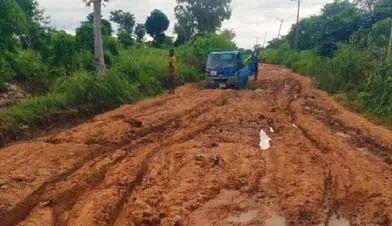
Residents of Obeagu, an agrarian community in Ishielu Local Government Area of Ebonyi State, are facing worsening hardship as deteriorating access roads continue to isolate the community from neighbouring areas, markets and essential services.
Obeagu, located near the boundary between Ebonyi and Enugu states, is surrounded by fertile farmland and depends heavily on agriculture. However, residents say the poor condition of the roads has turned what should be routine journeys into difficult and sometimes dangerous trips.
A recent report by The PUNCH described the community’s access roads as being in a state of collapse, with deep muddy channels and severely damaged stretches making movement particularly difficult during the rainy season.
For residents, the road crisis is more than an inconvenience. It affects their ability to earn a living, access healthcare, attend school and transport goods and people in emergencies.
Farmers struggle to move produce
Agriculture remains central to life in Obeagu. Many households depend on farming for food and income, but poor transportation infrastructure makes it difficult for farmers to move their produce from farms to markets.
When roads become impassable, farmers face the risk of their crops remaining in the community or being transported at significantly higher costs.
The problem can also reduce the price farmers receive for their produce. Traders and transporters who are willing to enter difficult areas may demand higher charges because of the risk of vehicle damage, longer travel times and difficult road conditions.
This creates a cycle in which farmers produce food but struggle to access profitable markets.
Reports on the community have previously highlighted the devastating consequences of the road crisis, including claims that food can rot before it reaches consumers because of transportation difficulties.
Healthcare access remains a major concern
The condition of the roads also has serious implications for healthcare.
Residents requiring urgent medical attention can face difficulties getting out of the community, particularly when heavy rainfall turns already damaged roads into muddy and flooded routes.
Previous reporting has documented concerns involving pregnant women, sick residents and healthcare workers in Obeagu. Vanguard reported in 2024 that residents had difficulty accessing medical facilities because of the lack of reliable roads, while children also had to travel long distances to attend school.
A 2025 report by SaharaReporters similarly said vehicles were unable to access the community for a period, forcing residents to depend heavily on motorcycles and walking. The report also cited concerns about teachers and health workers struggling to reach their places of work.
For a rural community, reliable roads are therefore not simply an infrastructure issue. They are directly connected to survival and access to basic public services.
Education affected by isolation
Children in Obeagu are also among those bearing the consequences.
Where roads are poor, school attendance can become more difficult, particularly during periods of heavy rainfall. Children who have to trek long distances may arrive late, miss lessons or remain at home when the journey becomes too dangerous.
The problem can also affect teachers and other education workers who have to travel into the community.
Over time, poor accessibility can deepen educational inequality between rural communities and better-connected urban areas.
Transport becomes expensive and dangerous
Residents also face increased transportation costs.
SaharaReporters reported in 2025 that commercial motorcyclists charged as much as N2,000 for journeys between the community and the Egedegede Obeagu junction on days when the road was accessible.
For low-income farming households, such transportation costs can consume a significant portion of daily earnings.
Motorcycles may provide the only practical means of movement in some sections, but relying on motorcycles and walking on badly damaged roads also exposes residents to additional risks.
The situation becomes particularly difficult for elderly residents, children, pregnant women and people carrying farm produce.
Road development plans and unanswered questions
The road crisis exists alongside evidence that road infrastructure remains part of broader development planning in Ishielu.
The 2026 Ishielu Local Government budget includes allocations for the grading and lateriting of several roads, as well as other infrastructure projects. The budget document also lists Obeagu among communities with a capital expenditure allocation.
There is also a federal project listed as the construction of the Obeagu-Egedegede-Nkalaha-Nigercem-Nkalagu Road in Ishielu. However, the Eyemark project tracker lists the project as not started, with zero per cent completion in its latest available update.
These records underline the gap that can exist between infrastructure plans and the conditions residents experience on the ground.
For Obeagu residents, the priority is not simply the announcement of another project. They need roads that remain usable throughout the year.
A wider development challenge
The Obeagu situation reflects a broader challenge facing many rural communities across Nigeria: infrastructure deficits can undermine the economic potential of areas that are otherwise rich in agricultural resources.
A road connects farmers to markets, patients to hospitals, children to schools and communities to government.
When that connection breaks down, the consequences spread across nearly every aspect of community life.
For Ebonyi, where agriculture remains important to rural livelihoods, improving access roads could help strengthen local commerce and reduce the cost of transporting farm produce.
But road construction alone is not enough. Proper drainage, durable materials, regular maintenance and effective monitoring are essential if rural roads are to survive heavy rainfall and sustained use.
Residents await action
For the people of Obeagu, the immediate demand is straightforward: a reliable road network that allows them to move freely and participate fully in the economic and social life of Ebonyi State.
The community’s repeated appearance in reports about poor roads suggests that the problem has persisted for years rather than being a temporary disruption. A 2024 PUNCH report described Obeagu as having more than 10,000 residents and highlighted its lack of basic infrastructure, including reliable road access and healthcare facilities.
The continuing complaints therefore place pressure on relevant authorities to move beyond temporary interventions and deliver sustainable infrastructure.
As residents continue to farm, attend school, seek medical care and conduct business, the condition of the road remains a daily reminder of the consequences of isolation.
For Obeagu, fixing the road is not merely about improving transportation. It is about reconnecting a community to markets, public services and opportunities—and ensuring that its agricultural potential is not undermined by the very infrastructure meant to support development.
Sources
- The PUNCH – Deteriorating roads leave Ebonyi community isolated
- SaharaReporters – Ebonyi community cries out over dilapidated access road
- SaharaReporters – Collapsed road isolates Obeagu community
- Vanguard – Ebonyi community cut off by lack of access roads
- Ebonyi State 2026 Ishielu Budget Document
- Eyemark – Obeagu-Egedegede-Nkalaha-Nkalagu Road project