Reported by Simon yusuph, the editor-in-chief at wengglobal
Nigerian Army Intercepts Major Arms Trafficking Syndicate in Kaduna, Seizes Assault Rifles
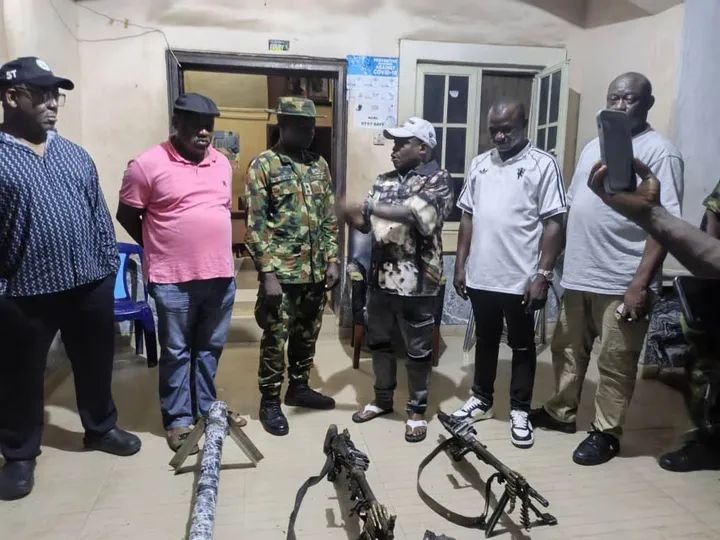
The Nigerian Army has recorded another significant breakthrough in its ongoing campaign against illegal arms trafficking and violent criminal networks after troops intercepted a suspected arms trafficking syndicate in Kaduna State, recovering a cache of sophisticated firearms believed to have been destined for criminal groups operating across parts of northern Nigeria.
Military authorities disclosed that the operation led to the seizure of several assault rifles, submachine guns, and other weapons, dealing what security officials described as a major setback to the illegal proliferation of firearms that has continued to fuel terrorism, banditry, kidnapping, and other violent crimes across the country.
The interception forms part of the Armed Forces of Nigeria’s intensified intelligence-driven operations aimed at disrupting the supply chains that sustain armed groups responsible for insecurity in several states.
Although authorities are yet to release the full identities of those involved or disclose the exact destination of the recovered weapons due to ongoing investigations, military officials said the successful operation followed actionable intelligence and careful surveillance by security operatives.
Intelligence-Led Operation
According to military sources, troops monitored suspicious movements linked to an organised trafficking network before launching the operation that resulted in the recovery of multiple firearms.
Among the weapons reportedly recovered were high-powered rifles and submachine guns capable of causing extensive casualties if they had reached criminal elements.
Security analysts say cutting off the supply of illegal weapons is one of the most effective strategies for reducing violent attacks, particularly in regions battling insurgency, armed banditry, and communal violence.
The latest seizure highlights the growing importance of intelligence gathering, inter-agency cooperation, and rapid military response in Nigeria’s broader counter-terrorism strategy.
Illegal Arms Remain a Major Security Challenge
Nigeria continues to face challenges arising from the proliferation of illicit firearms across several regions.
Security experts have repeatedly warned that illegal weapons fuel numerous criminal activities, including:
- Terrorism
- Armed banditry
- Kidnapping for ransom
- Armed robbery
- Communal clashes
- Farmer-herder conflicts
The Federal Government has consistently maintained that dismantling illegal arms trafficking networks remains central to restoring lasting peace and stability.
Military operations have increasingly focused not only on confronting armed groups in the field but also disrupting logistics networks responsible for supplying weapons and ammunition.
Analysts believe every successful interception weakens criminal organisations by reducing their operational capability and increasing the risks associated with transporting illicit arms.
Renewed Military Pressure
The Kaduna operation comes amid intensified nationwide military offensives targeting terrorists, bandits, kidnappers, and arms smugglers.
In recent months, the Armed Forces have reported several successful operations leading to the arrest of suspected gunrunners, destruction of terrorist camps, recovery of arms and ammunition, and rescue of kidnapped victims.
Security observers note that preventing illegal weapons from reaching criminal groups may ultimately prove more effective than recovering them after violent attacks have occurred.
The military has urged citizens to continue providing credible intelligence to security agencies, stressing that public cooperation remains essential in identifying suspicious movements and preventing criminal activities.
Authorities also reiterated their commitment to working with other security agencies to dismantle arms trafficking networks operating within and across Nigeria’s borders.
FBI Designates England vs Argentina World Cup Semi-Final as Highest-Risk Fixture
Meanwhile, global security agencies are intensifying preparations ahead of one of the most anticipated matches of the FIFA World Cup after the United States Federal Bureau of Investigation (FBI) reportedly classified the England versus Argentina semi-final as the tournament’s highest-risk fixture.
The designation reflects longstanding concerns over the historic sporting rivalry between supporters of both nations and the possibility of crowd-related disturbances before, during, and after the match.
Security planners have identified the fixture as requiring extraordinary preventive measures despite there being no confirmed credible threat against the event.
Historic Rivalry Drives Security Planning
England and Argentina share one of international football’s most famous rivalries, shaped by decades of fiercely contested matches and historical tensions.
Several previous encounters between supporters have prompted authorities to classify meetings between the two teams as requiring enhanced security arrangements.
Law enforcement agencies are expected to deploy additional personnel around stadiums, transport hubs, fan zones, hotels, and other public gathering points to minimise security risks.
Authorities have stressed that the measures are precautionary and intended to ensure the safety of players, officials, supporters, journalists, and visitors attending the tournament.
Enhanced Security Measures
Security officials are expected to implement several additional measures, including:
- Increased police deployment.
- Enhanced surveillance around stadiums.
- Expanded intelligence-sharing among international agencies.
- Stricter entry screening procedures.
- Greater monitoring of supporter movements.
- Rapid-response emergency teams positioned across host cities.
The FBI’s assessment reflects standard international security planning for major sporting events, particularly fixtures expected to attract large global audiences and emotionally charged fan participation.
Tournament organisers have repeatedly emphasised that security preparations remain comprehensive and that spectators should cooperate fully with law enforcement personnel.
Global Sporting Events Face Growing Security Demands
Modern international sporting competitions increasingly require extensive coordination between domestic and international security agencies.
Large-scale events such as the FIFA World Cup involve millions of visitors, making crowd management, cyber security, counter-terrorism preparedness, emergency medical response, and public safety critical operational priorities.
Experts note that security planning now extends far beyond stadium protection to include transport infrastructure, accommodation facilities, public celebrations, digital threats, and cross-border intelligence cooperation.
Authorities continue to encourage supporters to enjoy the tournament responsibly while complying with security procedures designed to protect everyone attending the event.
Balancing Security and Celebration
Despite the heightened security classification, organisers have expressed confidence in their preparations, noting that extensive planning has been undertaken months before the tournament.
Football remains one of the world’s most celebrated sporting events, bringing together supporters from every continent in a spirit of competition and unity.
Security officials maintain that proactive risk assessments are standard practice and should not be interpreted as evidence of an imminent threat.
Instead, such classifications enable authorities to allocate resources efficiently and ensure rapid responses should any incident arise.
Wider Implications
Both developments—the Nigerian Army’s successful interception of an alleged arms trafficking syndicate and the FBI’s heightened security classification for the England versus Argentina World Cup semi-final—underscore the evolving nature of modern security challenges.
While Nigeria continues efforts to curb the illegal flow of weapons that sustain violent crime, international security agencies are increasingly relying on intelligence-led strategies to protect large public events from potential disruptions.
Experts argue that sustained investment in intelligence gathering, technological surveillance, cross-border cooperation, and public engagement will remain essential in addressing security threats at both national and international levels.
For Nigeria, disrupting illegal arms supply networks represents a critical component of broader efforts to restore stability in regions affected by insecurity. Internationally, comprehensive event security planning reflects the growing complexity of safeguarding major global sporting competitions.
As investigations into the Kaduna arms seizure continue and World Cup security preparations intensify, authorities in both contexts have reiterated their commitment to protecting lives, preserving public order, and strengthening collaboration with relevant stakeholders.
Sources
- Nigerian Army official statements.
- Defence Headquarters (Nigeria).
- Reuters.
- Associated Press (AP).
- BBC News.
- Sky News.
- ESPN.
- FIFA.
- Federal Bureau of Investigation (FBI).