Reported by Simon Daniel Yusuph l Journalist at Weng Global
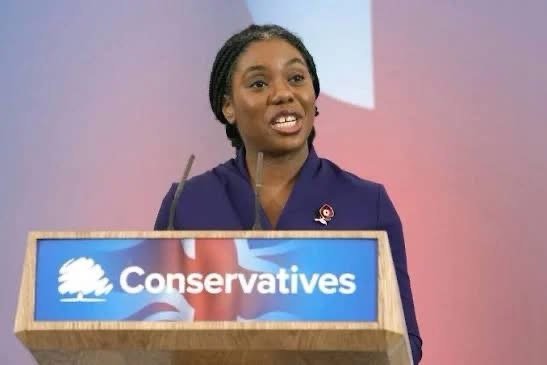
Conservative Party leader Kemi Badenoch has defended the British and English identity of her mixed-race children while criticising Reform UK politicians for questioning who can legitimately be considered English.
Badenoch made the remarks during her keynote speech at the Conservative Party conference in Birmingham on Wednesday, October 7, 2026, as she sought to draw a clear political distinction between the Conservatives and Reform UK on questions of race, national identity and the future direction of Britain.
Her intervention came amid a renewed debate over Englishness after former Conservative Home Secretary Suella Braverman, who has since joined Reform UK, argued that English identity is connected to ethnicity and ancestry. Braverman’s position has prompted criticism from Badenoch and others who argue that such definitions risk excluding people from minority ethnic backgrounds who were born or raised in England.
Main Development
Badenoch used her conference address to criticise Reform UK and its politicians over what she described as attempts to question the identity of people from ethnic minority backgrounds.
She specifically referred to the debate surrounding her own children, who are of mixed Black and white heritage.
Badenoch told Conservative Party members that she did not want Britain to become a country where politicians questioned whether people, including her children, could be regarded as English.
She also referred to Black footballers representing England, arguing that the country had previously been more comfortable with the idea that people from different ethnic backgrounds could be fully English.
Her comments were among the more personal elements of a speech that otherwise focused heavily on Conservative economic policy, welfare reform, taxation, defence and the party’s attempt to recover politically following its defeat at the 2024 general election.
Badenoch said Reform MPs were openly questioning people’s identities and presented the Conservatives as an alternative focused on bringing people together rather than dividing them.
The Conservative leader’s remarks were widely understood as a direct political challenge to Reform UK, which has emerged as a major competitor to the Conservatives on the political right.
The Englishness Debate
The dispute was intensified by comments from Suella Braverman, a former Conservative Home Secretary who defected to Reform UK.
Braverman has argued that Englishness is an ethnic identity and has said that, although she is British and was born in England, she does not regard herself as English because of her family’s ancestry.
During a BBC Question Time appearance, Braverman reportedly suggested that people from non-white backgrounds could be British without necessarily being English. The position triggered criticism and renewed a longstanding debate in Britain about the relationship between nationality, citizenship, ethnicity and cultural identity.
Braverman has previously described herself as British Asian and argued that defining Englishness simply through birthplace or residence would ignore the historical and ethnic dimensions of English identity.
Her argument has therefore gone beyond a question of legal citizenship. It raises a broader political and cultural question over whether English identity should be understood primarily through ancestry and ethnicity, or whether it can encompass people of different racial and family backgrounds who are citizens and members of English society.
Badenoch has taken the latter position in relation to her children and other people from minority ethnic communities.
She said identity was personal and warned against politicians effectively deciding for other people whether they belonged to the national community.
Badenoch’s Personal Connection to the Debate
The dispute carries particular significance for Badenoch because of her own background.
Badenoch was born in London to Nigerian parents and spent much of her childhood in Nigeria and the United States before returning to Britain as a teenager.
Her Nigerian heritage has remained an important part of public discussion about her political identity, although Badenoch has previously said that she now regards Britain as home and identifies primarily with her life and family in the United Kingdom.
In 2025, she said that while she was Nigerian by ancestry and had strong family connections to the country, her immediate identity was centred on her husband, children and life in Britain.
That background gives the latest dispute an additional dimension. Badenoch is herself the daughter of Nigerian parents and the first Black woman to lead the Conservative Party, yet she has built her political career around a strongly British conservative identity.
Her defence of her children’s Britishness therefore intersects with a broader question facing modern Britain: how a country with increasingly diverse communities defines national belonging.
Conservative Party Draws a Line Against Reform UK
The dispute also forms part of Badenoch’s wider attempt to establish a clear political boundary between the Conservative Party and Reform UK.
Reform, led by Nigel Farage, has increasingly competed with the Conservatives for voters on issues including immigration, national identity, taxation and government spending.
The Conservatives suffered a historic defeat in the 2024 general election, leaving the party with 121 seats in Parliament. Reform has subsequently become a significant force on the British political right, increasing pressure on Badenoch to demonstrate that the Conservatives remain capable of attracting voters who have moved away from the party.
At the Conservative conference in Birmingham, Badenoch repeatedly rejected calls for cooperation or an electoral pact with Reform.
She portrayed Reform as politically divisive and argued that the Conservatives should instead rebuild themselves as a disciplined, economically conservative alternative to both Labour and Reform.
Her remarks about identity were therefore not made in isolation. They formed part of a broader effort to distinguish the Conservatives from Reform while attempting to win back voters who have moved to the newer party.
The Broader Political Context
Badenoch’s speech came as the Conservatives sought to redefine their political message ahead of the next general election.
The party has placed economic growth, lower taxes, reduced government spending and welfare reform at the centre of its latest political programme.
At the conference, Badenoch pledged to reduce inheritance tax on family homes, proposed changes to employer National Insurance for younger workers and announced plans for a new defence system known as the Britannia Shield.
She also ruled out forming an alliance with Reform UK, arguing that the Conservatives should compete directly for voters rather than merge or cooperate with Farage’s party.
The identity dispute consequently sits alongside a much larger strategic battle over the future of Britain’s political right.
The Conservatives need to convince voters that they can offer an alternative to the Labour government while preventing Reform from becoming the dominant force among right-leaning voters.
Reactions and Counterarguments
The controversy has exposed significant differences within Britain’s political debate over identity.
Badenoch’s argument is that British and English identity should not be determined by race and that politicians should not tell citizens that they do not belong because of their ancestry.
Her position is also consistent with her argument that Britain is a multiracial country and that politicians should concentrate on bringing citizens together.
Braverman, however, has defended a different conception of Englishness. She has argued that ethnicity and historical ancestry form part of national identity and that describing everyone born in England as English risks overlooking the historical development of the English nation.
The disagreement therefore cannot be reduced simply to a dispute between two politicians. It reflects a wider argument about how national identity should be understood in a country shaped by centuries of migration, empire, immigration and cultural change.
It also illustrates the difficulties facing political parties when questions of race and identity become intertwined with electoral competition.
Why It Matters
The controversy matters because debates over national identity can influence how millions of people understand citizenship and belonging.
Britain is a diverse society, with communities whose families have lived in the country for generations alongside more recent migrants. Questions about who can be considered British or English therefore have consequences beyond political rhetoric.
For people from African, Asian, Caribbean and other minority backgrounds, arguments about whether ethnicity determines Englishness or Britishness can carry particular significance.
Badenoch’s own background has made her one of the most prominent figures in this debate. Her political career demonstrates the increasingly complex relationship between ancestry, nationality and political identity in contemporary Britain.
At the same time, the dispute illustrates the continuing political competition between the Conservatives and Reform UK.
If identity politics becomes a central dividing line on the British right, both parties may seek to define themselves in increasingly distinct ways before the next general election.
Badenoch’s Position on British Identity
Badenoch’s intervention is also notable because she has previously spoken openly about her own complicated relationship with national identity.
In an interview reported by The Guardian in 2025, she said that although she was Nigerian by ancestry and had strong connections to Nigeria, she no longer regarded Nigeria as her primary home.
She explained that her immediate family and life were now centred in Britain.
That history helps explain why questions about national belonging can be particularly personal for the Conservative leader.
Her argument in the current dispute is not that ancestry is irrelevant, but that politicians should not use ancestry to determine whether another person is entitled to identify with the country in which they live.
She has also warned that political debates about identity can create unnecessary divisions between citizens.
What Happens Next
The identity dispute is likely to remain part of the broader political contest between the Conservatives and Reform UK, particularly as both parties compete for support among right-leaning voters.
Badenoch is expected to continue presenting the Conservatives as a distinct political force rather than entering an alliance with Reform.
The next general election is expected to become the main test of whether her strategy succeeds in restoring Conservative support after the party’s 2024 defeat.
For Reform UK, questions surrounding immigration, national identity and citizenship are likely to remain important elements of its political platform.
For the Conservatives, the challenge will be to address concerns about immigration and national cohesion while maintaining a broader electoral coalition that includes voters from different ethnic and cultural backgrounds.
The debate over Badenoch’s children is therefore unlikely to end with the conference speech. It forms part of a much wider discussion about what it means to be British or English in modern Britain and how political parties choose to define national belonging.
What’s next?
Kemi Badenoch’s defence of her mixed-race children’s British and English identity has brought questions of race, citizenship and national belonging to the centre of Britain’s political debate.
Her criticism of Reform UK reflects an increasingly visible struggle between two competing visions of the political right: one seeking to define national identity through a broader conception of citizenship and shared belonging, and another placing greater emphasis on ancestry, ethnicity and historical identity.
The disagreement is significant not only for Badenoch and Reform UK but also for a multicultural Britain where questions of identity remain closely connected to politics, immigration and social cohesion.
For voters, the central issue will ultimately be whether Britain’s political parties can debate national identity without turning questions of heritage and belonging into divisions between citizens.
Weng Global – stories beyond borders
Sources
- The Independent
- The Guardian
- ITV News
- Politics.co.uk
- Associated Press
- Punch Newspapers