Reported by Simon Daniel Yusuph l Journalist at Weng Global
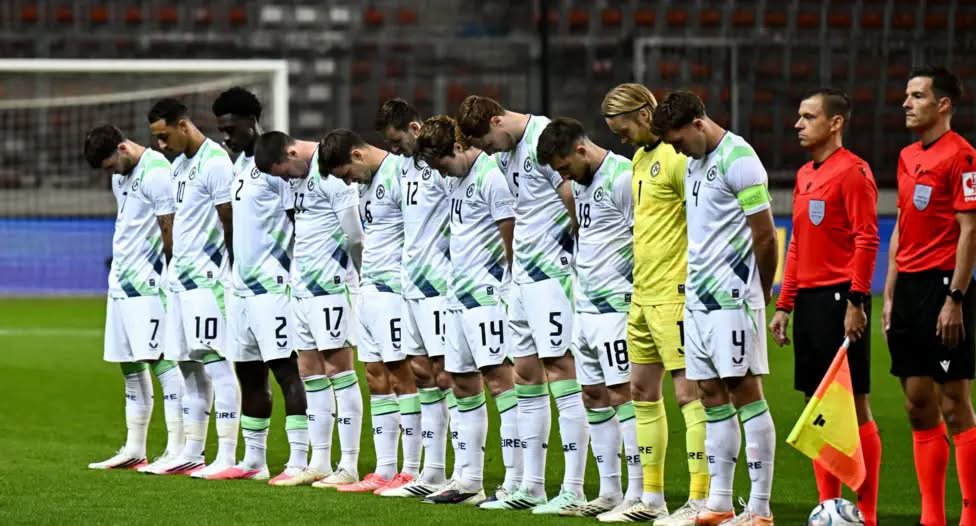
Republic of Ireland players declined to take part in the customary pre-match handshake and exchange of pennants with Israel before their UEFA Nations League meeting in Debrecen, Hungary, on Sunday, September 27, amid continuing controversy over Israel’s military campaign in Gaza.
The decision formed part of measures agreed by the Irish squad before the Group B3 fixture. The Football Association of Ireland (FAI) said the players would also wear black armbands in recognition of lives lost in the conflict. The match is being played behind closed doors because of security concerns. (The Guardian)
Irish Players Opt Out of Pre-Match Formalities
FAI chief executive David Courell said the Irish squad had agreed that certain elements of the traditional pre-match ceremony would not involve the Republic of Ireland players.
Those measures included the handshake and exchange of pennants between the teams.
The decision followed several days of discussions within the Irish camp over whether the team should participate in the fixture at all.
According to the FAI, a significant majority of the players ultimately voted to play the match, while agreeing on measures intended to express their unease about the circumstances surrounding the fixture. (The Guardian)
Israel’s players, meanwhile, were expected to participate in the normal pre-match formalities. Israel head coach Ran Ben-Shimon said he would shake hands with his Irish counterpart, Heimir Hallgrímsson. (The Guardian)
Gavin Bazunu Withdraws From Ireland Squad
The controversy also led Ireland goalkeeper Gavin Bazunu to withdraw from the squad.
Bazunu said his decision was based on his personal principles and opposition to the killing of innocent people. He stressed that his position was not directed against Israeli people or the Jewish community but against what he described as the situation in the region. (The Guardian)
Bazunu’s withdrawal came after extensive discussions among Ireland’s players about whether to proceed with the match.
The FAI confirmed that the squad eventually voted to fulfil the fixture, avoiding a complete boycott.
Match Moved Away From Ireland
The Nations League encounter is being played in Debrecen rather than Israel, with the fixture taking place at a neutral venue without supporters.
The return fixture between the sides is also scheduled to take place away from Ireland’s usual home venue and behind closed doors.
The unusual arrangements followed months of political and sporting controversy surrounding the fixtures, with protests and calls for Ireland to boycott its matches against Israel.
UEFA’s official fixture list confirms Israel and the Republic of Ireland are in Group B3 of the 2026/27 Nations League, alongside Austria and Kosovo. Israel began the campaign with a 3-1 defeat by Austria, while Ireland lost 1-0 to Kosovo in their opening match. (UEFA.com)
Dispute Over Ireland’s Participation
Pressure on the Irish team intensified in the days leading up to the match.
Ireland coach Hallgrímsson had previously described his team as “playing against genocide” when discussing the fixtures with Israel. He later acknowledged that he had used a strong and inappropriate word, explaining that his intention was to say that participating in the match did not mean accepting what was happening in Gaza. (The Guardian)
The comments prompted a strong response from the Israel Football Association, which criticised the Irish manager’s remarks.
The dispute added to an already politically sensitive sporting encounter.
The Irish government has been among the European governments strongly critical of Israel’s military actions in Gaza, while the FAI has previously sought UEFA action concerning Israel’s participation in European football competitions. Israel has rejected allegations concerning its conduct in Gaza and has defended its position in the wider conflict. (The Guardian)
UEFA Keeps Ireland and Israel in Same Group
The controversy has also extended to UEFA’s competition arrangements.
The FAI had asked UEFA to consider separating Ireland and Israel in future competition draws because of the circumstances surrounding their meetings.
UEFA said such requests are assessed on a case-by-case basis, particularly with regard to security considerations, and Ireland and Israel were not separated. The teams consequently remained together in Group B3 of the Nations League. (Reuters)
UEFA’s published schedule lists the September 27 match as Israel versus the Republic of Ireland, followed by a return fixture on October 4. (UEFA.com)
Football and the Israel-Gaza Conflict
The events surrounding the match demonstrate how the Israel-Gaza conflict has continued to affect international sport.
The Irish fixture has attracted attention well beyond football because of the country’s longstanding political position on the Palestinian issue and domestic calls for sporting action against Israel.
More than 160 Irish sportspeople had signed an open letter calling for the players to boycott the fixtures, according to The Guardian. At the same time, the FAI maintained that the matches should be fulfilled rather than forfeited. (The Guardian)
The situation has placed the players, coaching staff and football authorities in a difficult position, balancing sporting obligations against strong political and public pressure.
The Irish players’ decision not to participate in the handshake therefore represents one element of a wider set of actions agreed within the squad rather than a cancellation of the match itself.
What Happens Next
The Republic of Ireland and Israel are scheduled to meet again on October 4, with the return fixture also expected to be played behind closed doors.
Ireland’s next Nations League fixture after the Israel match is against Austria on October 1, while Israel is scheduled to face Kosovo on the same date. (UEFA.com)
The immediate sporting focus remains on the Nations League campaign, but the political controversy surrounding the Ireland-Israel fixtures is likely to remain part of the public discussion surrounding both matches.
For Weng Global readers, the episode highlights the increasingly complex relationship between international sport, diplomacy and major geopolitical conflicts, while the players’ decision shows how sporting teams can become part of wider public debates even when the immediate issue is a football fixture.
Weng Global – stories beyond borders
Sources
- UEFA
- Football Association of Ireland
- Associated Press
- Reuters
- The Guardian