Reported by Simon Daniel Yusuph l Journalist at Weng Global
The Obi-Kwankwaso Movement, popularly known as the OK Movement, has rejected any proposal to merge its organisation into the Nigeria Democratic Congress (NDC), insisting that it will retain its independent national, state, local government and ward structures ahead of the 2027 general elections.
The movement’s Director-General, John Ughulu, stated the position on Wednesday, September 23, 2026, in response to comments by NDC National Leader and former Bayelsa State governor, Senator Seriake Dickson, over the role of political support groups in the party’s campaign structure.
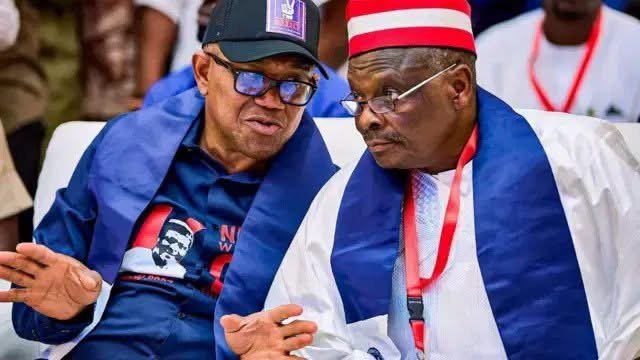
The disagreement is the latest development in a dispute that intensified after the OK Movement announced a 59-member presidential campaign council to support the NDC’s presidential ticket of Peter Obi and Rabiu Kwankwaso.
The NDC subsequently distanced itself from the council, saying the structure had not been authorised by the party’s National Working Committee. (Punch Newspapers)
OK Movement Says It Will Retain Its Structures
Ughulu said the OK Movement was not established as an appendage of the NDC and therefore would not surrender its organisational structures to the party.
He said the movement had its own leadership and internal mechanisms and would continue to operate them independently while supporting Obi and Kwankwaso.
According to reports of his statement, Ughulu argued that political cooperation with the NDC did not automatically place the movement under the party’s organisational control.
He maintained that the movement would not be “collapsed, merged or subsumed” into the NDC or another organisation.
The Director-General also rejected Dickson’s characterisation of the movement’s decision to establish a presidential campaign council as inappropriate, arguing that the OK Movement brings together Nigerians from different political backgrounds who share support for the NDC presidential ticket.
The movement’s position is that supporting candidates of a political party does not necessarily require the support organisation itself to become part of that party.
Dispute Follows NDC Rejection of Campaign Council
The latest disagreement follows the OK Movement’s announcement on September 17 of a 59-member presidential campaign council.
The council included zonal and state coordinators as well as officials responsible for areas including mobilisation, women affairs, strategy, security and legal matters.
John Ughulu was named Director-General of the council, while Saadatu Sani was named National Secretary.
The NDC later rejected the arrangement.
NDC National Chairman Moses Cleopas said the campaign council did not originate from the party and was not authorised by its National Working Committee.
The party warned that individuals, candidates or support organisations could not create campaign structures in the name of the NDC without the appropriate approval from its leadership. (Punch Newspapers)
The disagreement subsequently widened into a debate over the relationship between political parties and independent support movements.
Dickson Calls for Support Groups to Complement Parties
Dickson has argued that political support groups should complement political parties rather than establish structures that could operate alongside or compete with the official party machinery.
He made the comments in Abuja on Tuesday while receiving former Secretary to the Government of the Federation, Babachir Lawal, into the NDC.
Dickson’s position, as reported by several Nigerian media organisations, is that support groups should focus on mobilisation and assisting the political party and its candidates rather than functioning as parallel political structures.
He also criticised the decision by the OK Movement to establish its own presidential campaign council. (Punch Newspapers)
The comments prompted Ughulu’s latest response.
OK Movement Maintains It Is Independent
Ughulu disagreed with the suggestion that the OK Movement should operate under the NDC’s organisational structure.
He said the movement comprises people from different political backgrounds who share political interests around Obi and Kwankwaso.
The movement has previously described itself as a grassroots organisation with structures extending across Nigeria.
Its official website identifies Peter Obi as its presidential candidate and Rabiu Kwankwaso as its vice-presidential candidate under the NDC banner, while presenting the OK Movement as an organisation with its own stated vision and organisational identity.
The movement’s insistence on maintaining its structures therefore reflects a distinction it is drawing between political cooperation and organisational control.
Earlier Rejection of Merger
The current dispute is not the first time the OK Movement has rejected the idea of being absorbed into another political organisation.
At a National Leadership Summit in Abuja in August, the movement’s leadership rejected proposals for a merger and reaffirmed Ughulu as its Director-General.
The summit brought together leaders and coordinators from the six geopolitical zones, the 36 states and the Federal Capital Territory.
A communiqué issued after the meeting said the movement would remain independent while continuing to cooperate with organisations pursuing similar political objectives.
The leadership also argued that its grassroots structure had been built around the movement’s existing leadership and network. (ThisDayLive)
That earlier decision established the organisational position that the movement is now reiterating in response to the latest disagreement with the NDC.
Why the Dispute Matters
The disagreement highlights a broader organisational question for political campaigns ahead of Nigeria’s 2027 elections: how independent grassroots movements supporting a party’s candidates should relate to the formal structures of that party.
The OK Movement says it can support the NDC’s presidential ticket while retaining its own leadership and mobilisation network.
The NDC leadership, based on the statements reported this week, has stressed the authority of the party’s formal structures and questioned the creation of parallel campaign machinery in its name.
The difference is therefore not primarily about whether the OK Movement supports Obi and Kwankwaso. Both sides acknowledge that support.
The disagreement concerns who controls campaign structures, how those structures are authorised and how an independent movement should operate alongside the political party whose candidates it supports.
These questions could become increasingly relevant as political parties, support organisations and grassroots networks organise for the 2027 election cycle.
NDC and OK Movement Positions Remain Different
The NDC has already made clear that it did not authorise the 59-member presidential campaign council announced by the OK Movement.
The movement, however, has maintained that it has the organisational right to establish its own structures and coordinate mobilisation among its members.
The two positions leave an unresolved question over how the movement’s activities will be coordinated with the NDC’s official campaign organisation if both continue operating independently.
Neither side’s public statements reviewed for this report establish that the OK Movement has formally merged with the NDC or that an agreement has been reached to transfer its structures to the party.
Instead, the latest statements point to continued disagreement over the appropriate organisational relationship between the movement and the party.
What Happens Next
The immediate focus will be on whether the OK Movement and NDC can establish a working arrangement that allows the movement to retain its stated independence while avoiding conflicts with the party’s authorised campaign structures.
The NDC has already rejected the campaign council announced by the movement, while Ughulu has indicated that the OK Movement intends to maintain its own organisational framework.
Further statements from the NDC leadership or the movement could clarify whether the two sides can resolve the dispute through coordination or whether the disagreement over campaign structures will continue.
For now, the OK Movement says it will continue supporting Obi and Kwankwaso while retaining control of its own national, state, local government and ward structures.
The NDC, meanwhile, maintains that political support organisations must operate within the framework of the party’s authorised structures when acting in its name.
The dispute remains an organisational issue within the wider political realignment ahead of Nigeria’s 2027 general elections.
Weng Global – stories beyond borders
Sources
- Punch — reporting on the OK Movement’s refusal to surrender its structures to the NDC.
- TheCable — reporting on the NDC’s rejection of the OK Movement’s 59-member presidential campaign council.
- The Guardian Nigeria — reporting on the NDC’s position and the dispute involving the OK Movement.
- Vanguard — reporting on the movement’s earlier rejection of a merger.
- Nigeria Info FM — reporting on the OK Movement’s decision to remain independent while cooperating with allied political groups.
- OK Movement official website — information on the movement’s stated identity, objectives and political candidates.