Reported by Simon Daniel Yusuph l Journalist at Weng Global
India’s Prime Minister Narendra Modi has called for renewed purchases of Nigerian crude oil as Nigeria and India seek to rebuild bilateral trade towards its previous peak of nearly $15 billion.
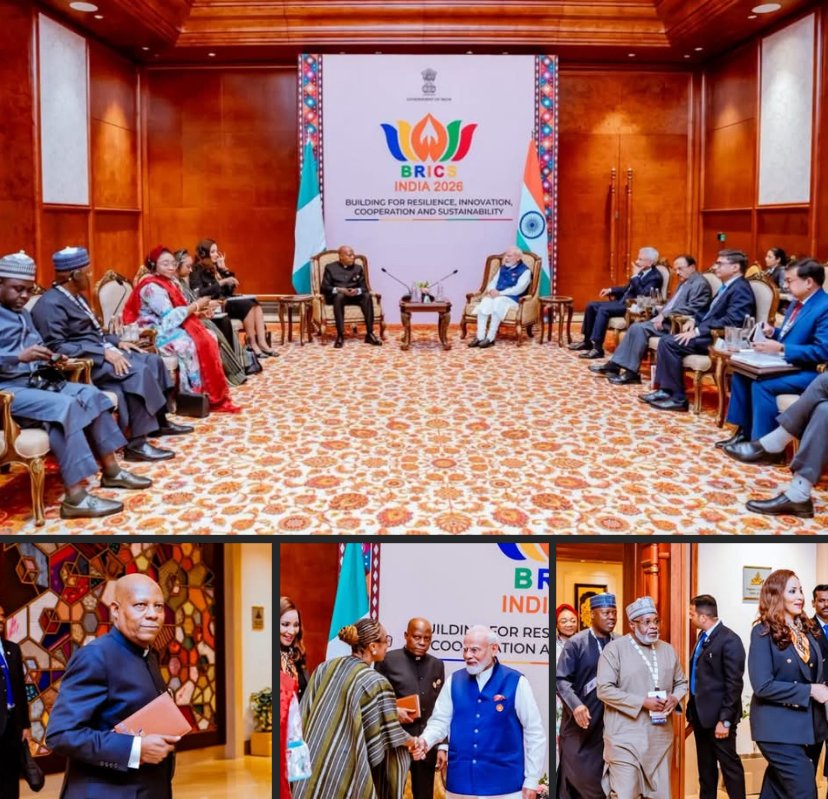
The request was made during a bilateral meeting between Modi and Nigeria’s Vice President Kashim Shettima on the sidelines of the 18th BRICS Leaders’ Summit in New Delhi, where the two countries also discussed opportunities to expand cooperation beyond oil.
The renewed focus on crude exports comes as both countries seek to reverse a significant decline in bilateral trade recorded in recent years. According to Channels Television, trade between Nigeria and India fell from about $14.95 billion in the 2021–2022 financial year to $7.13 billion in 2024–2025, before recovering to approximately $9 billion in 2025–2026.
Modi Calls for Return of Nigerian Crude
At the meeting, Modi stressed the importance of restoring energy trade between the two countries as part of efforts to return bilateral commercial relations to earlier levels.
Shettima, who is representing President Bola Ahmed Tinubu at the BRICS summit, assured the Indian leader that the Nigerian government would review India’s request for renewed crude oil purchases.
The development is significant because crude oil has historically been at the centre of Nigeria-India trade.
Data published by the Indian Consulate in Lagos shows that India imported about $10.29 billion worth of goods from Nigeria in the 2021–2022 financial year, with crude oil accounting for approximately $10.03 billion of that amount. Total bilateral trade reached $14.95 billion during the same period.
The figures demonstrate how strongly the two countries’ commercial relationship has historically depended on energy exports.
India’s renewed interest could therefore provide Nigeria with another major market for its crude, while also supporting efforts to rebuild the wider trade relationship.
Trade Relationship Fell Sharply
The push for renewed crude purchases follows a period of substantial decline in Nigeria-India trade.
The Indian Consulate records that bilateral trade increased from about $8.8 billion in 2020–2021 to $14.95 billion in 2021–2022. India was also described as one of Nigeria’s largest crude oil buyers.
More recent figures indicate that the relationship has yet to return to that earlier level.
Nigeria’s High Commission in India said recently that bilateral trade stood at about $14.95 billion in 2024–2025, compared with approximately $27 billion in 2022–2023, attributing the decline to factors including global economic uncertainty, geopolitical tensions and the absence of a substantive Nigerian head of mission in India for part of the period.
The differing figures reported for various financial years underline the importance of distinguishing between specific trade periods when assessing the relationship. However, the broader trend is clear: Nigeria and India are seeking to restore trade to significantly higher levels.
Nigeria Wants Trade Beyond Crude Oil
While Modi’s request focused on crude oil, the discussions in New Delhi were broader than the petroleum sector.
Shettima emphasised Nigeria’s desire to attract Indian investment into areas capable of supporting local manufacturing, creating employment and facilitating technology transfer.
The two countries discussed cooperation in fintech, digital public infrastructure and the creative industries. They also explored possible partnerships in defence technology, electricity generation, clean energy, pharmaceuticals, healthcare and capacity building.
That broader agenda reflects Nigeria’s effort to diversify its international economic relationships and reduce dependence on the export of raw commodities.
For Nigeria, attracting investment that creates domestic production capacity could potentially generate more lasting economic benefits than simply increasing exports of crude oil.
India’s Longstanding Economic Presence in Nigeria
India’s commercial presence in Nigeria extends well beyond the oil market.
The Indian Consulate in Lagos says more than 135 Indian-owned or Indian-operated companies have been active in Nigeria, including businesses involved in telecommunications, manufacturing, pharmaceuticals, construction, power and consumer goods.
Indian businesses have also participated in major Nigerian industrial projects.
The relationship has consequently developed into a broad commercial partnership involving energy, manufacturing, healthcare, infrastructure, pharmaceuticals and services.
This existing business network could provide a foundation for the expanded investment relationship being discussed by both governments.
Nigeria’s Position at BRICS
The discussions between Modi and Shettima also took place against the backdrop of Nigeria’s growing engagement with BRICS and other emerging economies.
Nigeria became a BRICS partner country in January 2025. Ahead of the 2026 summit, the Federal Ministry of Information said Nigeria intended to use its participation to strengthen partnerships in trade, investment, energy, agriculture, solid minerals, technology and innovation.
Shettima’s presence at the summit therefore provides Nigeria with an opportunity to pursue bilateral economic interests alongside its wider engagement with emerging economies.
The Federal Ministry of Information said Nigeria’s participation was consistent with the government’s objective of strengthening international economic partnerships, attracting investment and expanding markets for Nigerian products, including agricultural and mineral commodities.
India Remains an Important Market for Nigerian Oil
India has historically been an important destination for Nigerian petroleum exports.
The Indian Consulate’s bilateral trade brief records that crude oil represented the overwhelming majority of India’s imports from Nigeria during the 2021–2022 financial year. It also identified Nigeria as one of India’s main crude oil sources and said Nigeria ranked among India’s significant suppliers of crude oil and liquefied natural gas in 2020.
More recent Nigerian trade data also points to India’s continuing importance.
Nigeria’s trade statistics for the second quarter of 2026 showed India among the country’s largest trading partners. Trade with India was valued at about ₦4.21 trillion during the quarter, while Nigerian exports to India reached approximately ₦3.29 trillion, compared with imports of about ₦924.46 billion.
The figures indicate that Nigeria continues to run a substantial trade surplus with India, largely because of energy exports.
A Potential Opportunity for Nigeria’s Oil Sector
A stronger Indian demand for Nigerian crude could provide additional market opportunities for Nigerian producers and exporters.
However, the significance of the development goes beyond the immediate sale of additional barrels.
Nigeria has spent years attempting to improve crude production, attract investment into the petroleum industry and strengthen its position in international energy markets. At the same time, the country is seeking to develop domestic refining capacity and move gradually toward a more diversified economy.
The renewed Indian interest could therefore become part of a broader strategy in which Nigeria maintains crude oil markets while simultaneously developing manufacturing, technology, agriculture, minerals and other sectors.
The emergence of large-scale domestic refining capacity also creates the possibility of a more complex energy relationship between the two countries in the future, with opportunities extending beyond the export of unrefined crude.
Why the $15 Billion Target Matters
Restoring bilateral trade towards $15 billion would represent a significant increase from the approximately $9 billion reported for 2025–2026.
For Nigeria, stronger trade with India could mean increased demand for exports and greater opportunities for foreign investment.
For India, closer economic ties with Nigeria could strengthen access to one of Africa’s largest economies and one of the continent’s most important energy-producing countries.
The relationship also has a strategic dimension. India has increasingly sought stronger economic relationships with African countries, while Nigeria has been looking to deepen South-South cooperation and expand economic partnerships beyond traditional Western markets.
The two countries therefore have interests that extend beyond the immediate question of crude oil purchases.
Beyond Oil: Technology, Manufacturing and Investment
One of the most important aspects of the latest discussions is the emphasis on sectors beyond petroleum.
Nigeria is seeking investment that can contribute to domestic production, employment and technology transfer. India, with its large technology, pharmaceutical, manufacturing and services sectors, offers potential opportunities in several of these areas.
The discussions around fintech and digital public infrastructure are particularly relevant as Nigeria continues to expand its digital economy.
The two sides also discussed pharmaceuticals and healthcare, areas where Indian companies have established a significant presence in Africa and where Nigeria faces substantial domestic demand.
Clean energy and power generation were also identified as areas for possible cooperation, suggesting that the bilateral relationship could increasingly incorporate the energy transition alongside traditional oil trade.
What Happens Next
The immediate next step will be for Nigerian authorities to consider India’s request for renewed crude purchases, following Shettima’s indication that the government would review the proposal.
The wider economic agenda will require more detailed negotiations between government agencies, businesses and investors.
For Nigeria, the effectiveness of the renewed relationship will ultimately depend on whether discussions translate into concrete trade agreements, investment commitments, manufacturing projects and technology partnerships.
For India, renewed Nigerian crude purchases could help restore an important component of its energy relationship with Africa’s largest oil-producing economy.
The meeting between Modi and Shettima therefore marks an important attempt to reset a relationship whose commercial value has declined substantially from its earlier peak.
Whether the two countries can return bilateral trade to the $15 billion level will depend not only on crude oil purchases, but also on their ability to build new areas of economic cooperation.
For Nigeria, the wider opportunity is to use renewed demand from India as a platform for expanding exports, attracting investment and building productive capacity at home.
Weng Global – Stories beyond borders
Sources
- Channels Television — report on Nigeria and India’s plans to revive bilateral trade and renew crude oil purchases.
- Prime Minister’s Office of India — report on Narendra Modi’s meeting with Vice President Kashim Shettima at the BRICS Summit.
- Indian Consulate in Lagos — India-Nigeria bilateral economic and commercial relations.
- Federal Ministry of Information and National Orientation — Nigeria’s objectives at the 18th BRICS Summit.
- Nigerian High Commission in India — recent assessment of Nigeria-India trade and investment relations.
- Nairametrics — Nigeria’s Q2 2026 trade data involving India.