Haaland Image Appears on Cocaine Packages in Ecuador as Police Seize 469kg Drug Shipment!
An image of Norwegian football star Erling Haaland has been found on packages of cocaine seized by Ecuadorian police near the country’s border with Colombia, in an unusual case that has highlighted the branding tactics used by organised drug-trafficking networks.
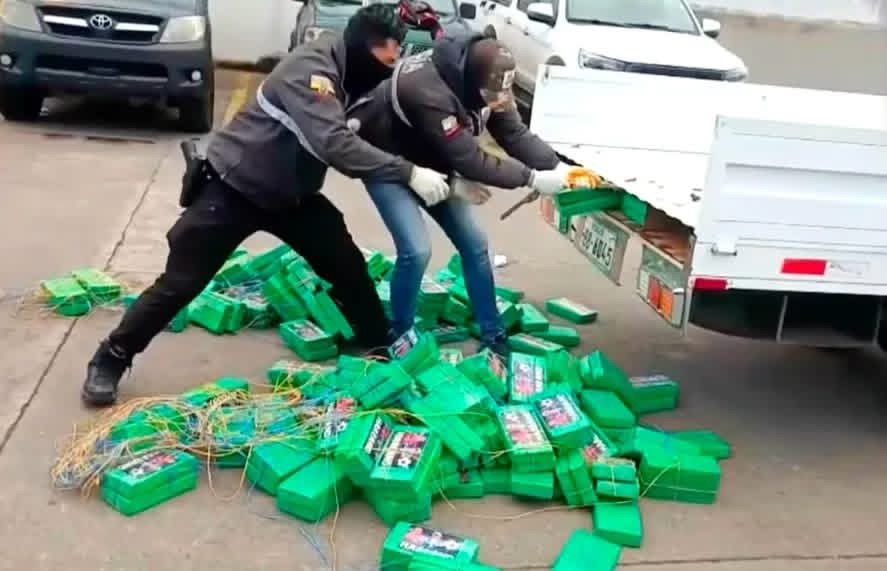
Ecuadorian authorities seized approximately 469 kilogrammes of cocaine from a truck near Tulcán, close to the Colombian border, according to reporting by the Associated Press. The drugs were concealed in a false compartment of the vehicle, while many of the green-wrapped packages carried stickers featuring the face of Haaland. (AP News)
The seizure followed an anonymous tip that led police to intercept and search the truck. Authorities arrested the driver and a woman identified as María R., who was reportedly carrying Colombian identification documents. Investigations are continuing as authorities seek to establish the wider network behind the shipment. (AP News)
The appearance of Haaland’s likeness on the illicit cargo has attracted international attention because of the footballer’s global profile. However, there is no indication that the Manchester City striker had any connection to the shipment or its trafficking.
The use of a celebrity image on drug packages is understood by law-enforcement and trafficking experts to be a form of internal branding rather than evidence of endorsement. Criminal organisations have previously used images of famous athletes and public figures to identify shipments, suppliers, destinations or particular trafficking groups.
Major Cocaine Seizure Near Colombian Border
The seizure took place in the Guagua Negro area near Tulcán, in Ecuador’s northern Carchi province.
According to reports, officers acted after receiving an anonymous tip concerning a suspicious truck. During the search, police discovered hundreds of packages hidden beneath a false floor. The packages were wrapped in green material and some bore stickers displaying Haaland’s image.
The Associated Press reported that the seized shipment weighed 469kg, equivalent to roughly 1,034 pounds. Authorities estimated its value at more than $11 million in the United States and almost $20 million in Europe, reflecting the substantial difference in cocaine prices between source, transit and destination markets. (AP News)
The seizure represents a significant disruption to an international trafficking operation, particularly given Ecuador’s role as a transit point for cocaine produced in neighbouring Colombia and Peru.
Police have not publicly identified the criminal organisation responsible for the shipment, nor have they provided a definitive explanation for why Haaland’s image was selected.
That distinction is important. The presence of a public figure’s image on illegal goods should not be interpreted as evidence of involvement, approval or knowledge.
Why Drug Traffickers Use Celebrity Images
The unusual packaging has raised questions about why criminal networks would place photographs of internationally recognised personalities on cocaine bricks.
Authorities and reporting on similar seizures indicate that such markings can serve as a form of coded identification within trafficking networks.
Drug shipments can pass through several hands between production areas and their final destinations. Distinctive colours, logos, numbers, symbols and images may therefore be used to identify a particular batch, organisation, supplier or intended recipient.
The branding can also help traffickers distinguish their products from other consignments when large quantities are being moved through complex criminal networks.
The use of celebrity imagery is not entirely new.
The Associated Press noted that football stars including Lionel Messi have previously had their likenesses found on confiscated drug packages. (AP News)
Such practices effectively appropriate the visibility of famous personalities without their consent. In Haaland’s case, the timing may be particularly notable because of his enormous international popularity following the 2026 World Cup.
The Norwegian striker scored seven goals across four matches during the tournament, helping make his image especially recognisable among football audiences worldwide. (AP News)
For organised crime groups, the recognisability of an image can potentially make it useful as a marker within an illicit distribution system.
Haaland Has No Reported Connection to Shipment
Despite the striking nature of the discovery, there is no evidence presented by Ecuadorian authorities or reputable reports linking Haaland to the cocaine shipment.
The use of his photograph appears to be unauthorised.
This distinction is critical in reporting the story responsibly. A celebrity image appearing on criminal merchandise does not establish a relationship between the individual and the criminal activity.
Haaland is one of the world’s most commercially recognisable footballers and has extensive legitimate commercial associations. His image has substantial value in advertising, sports merchandise and digital media.
The unauthorised use of his likeness on narcotics packages consequently illustrates how criminal networks can appropriate popular culture and global sporting imagery for purposes entirely unrelated to the person depicted.
The incident also demonstrates the extent to which organised crime can adapt its methods to changing social and cultural trends.
Ecuador’s Strategic Position in Cocaine Trafficking
The seizure comes against the backdrop of Ecuador’s increasingly prominent role in international cocaine trafficking.
Located between Colombia and Peru — two of the world’s major cocaine-producing countries — Ecuador has become a significant transit and export route for criminal organisations seeking to move cocaine towards North American and European markets.
The country’s Pacific coastline, commercial ports and transport infrastructure have made it attractive to trafficking organisations.
Ecuadorian authorities have reported numerous major seizures in recent years as they attempt to disrupt these networks.
The country’s location has also created significant security challenges.
According to the Associated Press, Ecuadorian police had seized around 80 tonnes of drugs during the first half of 2026. That figure followed approximately 215 tonnes seized in 2025 and nearly 295 tonnes in 2024. (AP News)
The scale of those seizures illustrates the magnitude of the challenge facing Ecuadorian law-enforcement agencies.
It also means that individual seizures, regardless of their unusual features, form part of a much larger campaign against organised trafficking.
Ecuador Intensifies Anti-Narcotics Operations
Ecuadorian authorities have increasingly relied on intelligence-led operations, vehicle inspections, port controls and cooperation among national security agencies to intercept drugs before they reach international markets.
Recent seizures demonstrate the variety of concealment techniques used by trafficking organisations.
In February 2026, Ecuadorian police announced the seizure of more than 637kg of cocaine in an operation at Costa Rica airport. The drugs were found in 643 packages and authorities said the operation disrupted a criminal structure involved in drug trafficking. (Policia Noticias)
Other operations have involved drugs concealed in courier shipments, footwear, containers and agricultural exports.
In March, Ecuadorian authorities reported finding cocaine hidden inside shoe insoles in a shipment destined for the Netherlands. Police said the drugs weighed about 322 grammes. (Policia Noticias)
In June, another operation uncovered cocaine hidden in false-bottom boxes at Quito’s international airport, with Australia listed as the intended destination. (Policia Noticias)
These cases demonstrate the increasingly varied methods used by traffickers to move drugs through Ecuador’s transport and logistics networks.
The Broader Role of Ecuador in Global Drug Trade
Ecuador’s emergence as a major cocaine transit hub has been linked to several geographical and economic factors.
Its location between Colombia and Peru provides trafficking organisations with proximity to cocaine production areas, while its Pacific ports offer access to maritime routes connecting South America with international markets.
European countries have become important destinations for cocaine trafficked through Ecuador.
Large seizures involving containers of legitimate exports have repeatedly demonstrated how criminal organisations attempt to exploit international commerce.
In July 2026, Ecuadorian authorities announced the seizure of 1.2 tonnes of cocaine hidden inside a container carrying banana purée and destined for Latvia. The drugs were divided among 1,215 packages placed inside 35 suitcases. (ECUAVISA)
The same month, authorities also reported a separate 2.4-tonne cocaine seizure at Puerto Bolívar in Machala.
The cases underline why Ecuador has become an important focus of international efforts to combat transnational drug trafficking.
Celebrity Branding and Criminal Networks
The Haaland packaging provides an unusual window into the culture and organisation of illicit drug markets.
Unlike conventional commercial companies, criminal organisations cannot advertise openly or rely on ordinary supply-chain management systems. They consequently develop alternative ways of identifying products and communicating with members of their networks.
Logos and symbols can function as covert markers.
The use of football stars is particularly striking because football enjoys enormous popularity across Latin America and beyond.
However, the practice is not necessarily intended to promote the drug to consumers in the conventional commercial sense. Instead, the images may serve operational or organisational purposes known primarily to members of the trafficking network.
Authorities have not established publicly what specific meaning Haaland’s image had in this shipment.
Consequently, any claim about the precise reason for selecting the footballer would remain speculative.
Investigation Continues
Following the seizure, Ecuadorian authorities are expected to investigate the origin of the cocaine, the intended destination of the shipment and the people responsible for organising its transportation.
The arrest of two suspects could provide investigators with leads into the wider trafficking network.
Authorities will also need to determine whether the truck was being used by an established criminal organisation and whether the shipment was part of a larger series of consignments.
The discovery of the celebrity stickers may assist investigators if similar markings have previously been associated with a particular trafficking network.
Nevertheless, police have not publicly confirmed such a connection.
The case therefore remains an active investigation.
A Symbol of a Wider Security Challenge
For Ecuador, the significance of the seizure extends well beyond the unusual appearance of a famous footballer’s face on narcotics packaging.
The 469kg cocaine shipment represents another substantial quantity of drugs intercepted before reaching international markets.
For law-enforcement agencies, the operation demonstrates the value of intelligence gathering and targeted vehicle inspections.
For policymakers, it reinforces the need for sustained investment in border security, customs enforcement, financial investigations and international cooperation.
And for the international community, it highlights the increasingly sophisticated nature of transnational criminal networks.
The use of Haaland’s image may have generated headlines because of its novelty, but the underlying issue is far more serious: a large-scale cocaine shipment was moving through a region that has become a major corridor for the international drug trade.
As investigations continue, authorities will be expected to establish who organised the shipment, where the cocaine originated, where it was intended to go and what role the suspects played.
For Haaland, the episode appears to be an unauthorised use of his image by criminals. For Ecuadorian authorities, however, it represents another front in an increasingly complex battle against organised narcotics trafficking.
The unusual packaging may have captured global attention, but the seizure itself is a reminder that behind every such shipment lies a sophisticated criminal supply chain — one that continues to challenge governments and law-enforcement agencies across Latin America, North America and Europe.
Sources
- Associated Press — Ecuador’s police seize a cocaine shipment with stickers of Norway’s soccer star Erling Haaland (AP News)
- Associated Press — Video: Ecuador police seize cocaine shipment bearing Haaland’s image (AP News)
- Africanews — Ecuador police seize 370kg of cocaine near Colombian border (Africanews)
- People — Erling Haaland’s Face Used on Blocks of Cocaine Seized by Ecuadorian Police (People.com)
- UOL — Polícia apreende carga de cocaína com adesivos de Haaland no Equador (UOL Notícias)
- Ecuador National Police — Anti-narcotics seizure operations (Policia Noticias)
Meta Description: