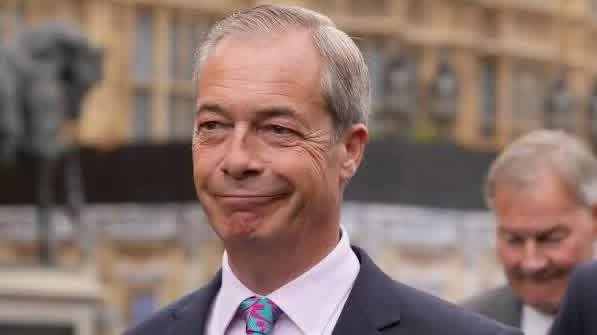
Nigel Farage Wins Clacton By-Election as Count Binface Emerges as Surprise Runner-Up!
Nigel Farage has secured re-election as Member of Parliament for Clacton after winning a closely watched by-election in the English coastal constituency, defeating satirical candidate Count Binface in a contest that was boycotted by Britain’s major political parties.
Farage, leader of Reform UK, won 22,239 votes, representing about 63 per cent of the ballots cast, while Count Binface the political alter ego of comedian Jonathan Harvey finished second with 9,455 votes, or about 27 per cent. The result was recorded in a field of 34 candidates, believed to be the largest number ever to contest a UK parliamentary election. (The Guardian)
The outcome restores Farage to the House of Commons just weeks after he resigned his Clacton seat and triggered the by-election himself. His resignation followed scrutiny over a £5 million gift from cryptocurrency investor Christopher Harborne and a parliamentary standards investigation into whether the financial support should have been declared.
Farage had presented the election as an opportunity for voters to deliver their own judgment on the controversy, framing the contest as a direct confrontation between ordinary voters and what he described as the political establishment.
His victory gives him a renewed parliamentary mandate, but it does not remove the scrutiny surrounding his financial affairs. The parliamentary investigation is expected to resume following the election, meaning the result could represent another stage rather than the conclusion of the controversy surrounding his political finances. (Financial Times)
Farage Regains Seat After Triggering Election
The Clacton by-election was an unusual contest from the outset.
Farage had won the constituency for Reform UK at the July 2024 general election, taking 46.2 per cent of the vote and defeating Conservative incumbent Giles Watling by 8,405 votes. After resigning in July 2026, Farage immediately announced his intention to seek the seat again.
Tendring District Council confirmed that polling day was set for August 13 following receipt of the parliamentary writ. The council subsequently confirmed that 34 candidates had been nominated, setting a new record for the number of candidates in a UK parliamentary election. (Tendring District Council)
The unusual character of the contest was largely shaped by the decision of Labour, the Conservatives, Liberal Democrats, Greens and other major political forces not to field candidates.
Those parties argued that Farage had created the election as a political manoeuvre to divert attention from the parliamentary standards investigation. Their decision left Reform UK facing a field dominated by independent, minor-party and novelty candidates.
Count Binface consequently became Farage’s most prominent challenger and attracted considerably more support than many observers initially expected.
Count Binface’s Unexpected Challenge
Count Binface is the satirical political persona of comedian Jonathan Harvey. The character is known for campaigning in a distinctive bin-shaped helmet and using humour to comment on British politics.
Although Binface was never expected to defeat Farage, his 9,455 votes represented a substantial share of the electorate and placed him second in the final result.
The Guardian reported that Binface’s campaign became a major feature of an election otherwise lacking the traditional contest between Labour, Conservative and Liberal Democrat candidates. (The Guardian)
His performance is particularly notable because the result gives a novelty candidate a significant share of the vote in a parliamentary election, although the unusual circumstances of the contest make direct comparisons with conventional elections difficult.
Binface himself treated the campaign with characteristic humour, presenting his candidacy as an alternative to Farage and using satire to draw attention to political issues.
The campaign nevertheless reflected a deeper reality: some voters used the election to register dissatisfaction with the circumstances surrounding the by-election and the absence of the country’s major political parties.
Major Parties Boycott Contest
The decision by the major parties to stay out of the election fundamentally altered the political dynamics in Clacton.
The Conservatives, who had finished second to Farage in 2024, announced that they would not contest what they described as a by-election created by Farage for his own political purposes. Labour and the Liberal Democrats also declined to participate. (The Guardian)
The boycott meant that Farage did not face the conventional party competition normally associated with a parliamentary election.
Reuters reported that the absence of the major parties left Farage facing more than 30 challengers, including Count Binface, while also placing the election under intense national scrutiny because of the circumstances that led to the vote. (Reuters)
Farage, however, interpreted the result as confirmation that voters had chosen to support him despite the controversy.
The Reform UK leader has argued that the electorate should be the ultimate judge of his conduct and political record. His victory allows him to return to Parliament with a fresh mandate, although opponents are likely to continue questioning whether the result can be regarded as a conventional test of Reform UK’s electoral strength.
Financial Investigation Remains
The election does not automatically bring an end to the controversy that prompted Farage’s resignation.
The Parliamentary Commissioner for Standards had opened an investigation into whether Farage properly declared a £5 million gift associated with Christopher Harborne, a cryptocurrency businessman.
Farage has disputed the interpretation of the payment and has maintained that the money did not constitute a political donation requiring declaration in the manner alleged by critics.
The issue remains significant because a finding against Farage could potentially lead to parliamentary sanctions and further political consequences.
The Financial Times reported that the standards investigation was expected to resume following Farage’s return to Parliament. The newspaper noted that the by-election had temporarily interrupted the process but that the scrutiny of Farage’s financial conduct remained unresolved. (Financial Times)
Reuters similarly reported that the financial investigation remains an important factor in assessing the significance of Farage’s victory. (Reuters)
The development means that Farage returns to Westminster while still facing questions about financial transparency and political donations.
Farage Skips Official Result Declaration
Another unusual feature of the election came on the night of the result, when Farage did not attend the official count.
The Reform UK leader said he had been warned about a potential security threat and instead attended a private event known as “Farage Fest” to celebrate his expected victory.
Reuters reported that Farage cited police warnings about a possible disruption and chose not to appear at the official count. Essex Police, however, said it had robust measures in place to protect those attending and disputed suggestions that candidates had been advised to stay away. (Reuters)
The decision generated further political criticism, with opponents arguing that a candidate who had triggered the election should have attended the formal declaration.
Farage nevertheless maintained that security concerns justified his decision.
The episode added another unusual element to an election that had already been characterised by political boycotts, novelty candidates and an unusually large ballot paper.
Low Turnout Raises Questions
Despite Farage’s commanding vote share, turnout was relatively low.
Approximately 44.4 per cent of registered voters participated, significantly below the turnout recorded at the 2024 general election in Clacton. The lower participation occurred amid a summer election campaign and intense public debate over whether the by-election was necessary.
The relatively low turnout is important when interpreting the result.
Farage won decisively among those who voted, but the result should not necessarily be interpreted as evidence that two-thirds of all Clacton voters actively support his political position.
The distinction is particularly relevant because major parties chose not to contest the election, leaving voters with a substantially different range of choices from those available during a normal general election.
Nevertheless, the scale of Farage’s victory demonstrates that he retains substantial electoral support in the constituency.
A Stronger Result Than 2024
Farage’s 2026 vote share represents a significant increase from his 2024 performance.
At the general election, he secured 46.2 per cent of the vote. In the by-election, his share rose to more than 60 per cent, although the circumstances were fundamentally different because his principal political opponents did not participate. (The Guardian)
This makes the result politically useful to Farage but difficult to interpret as a straightforward measure of Reform UK’s national popularity.
The Reform leader can point to the increased vote share as evidence that Clacton voters continue to support him despite the controversy surrounding his finances.
Opponents, meanwhile, can argue that the boycott by mainstream parties made the result less representative of a conventional general election.
Both interpretations are likely to shape the political debate in the weeks ahead.
What the Result Means for Reform UK
Farage’s return to Parliament strengthens his position as the most prominent figure in Reform UK and gives the party another opportunity to use Westminster as a platform for its political agenda.
Reform UK has built its support around issues including immigration, national sovereignty, taxation, public services and criticism of the established political parties.
The party’s strong performance in the 2024 general election demonstrated its ability to challenge the traditional Conservative-Labour political structure in parts of England.
The Clacton result, however, provides only limited evidence about its national electoral position because the contest lacked the normal presence of major opposition parties.
The wider question will be whether Reform UK can translate Farage’s personal popularity into sustained support across constituencies where voters have several serious political alternatives.
That question is particularly important as the party seeks to establish itself as a long-term force in British politics rather than a movement centred primarily around its leader.
Clacton Residents at the Centre
For residents of Clacton, the election was ultimately about choosing who should represent them in Parliament.
The constituency includes Clacton-on-Sea, Jaywick, Frinton-on-Sea and Walton-on-the-Naze and has a history of strong support for Eurosceptic and populist politics.
The area has also faced significant socioeconomic challenges, making issues such as employment, housing, public services, healthcare and local economic development important alongside national debates over immigration and Brexit.
While the national political drama surrounding Farage dominated the campaign, the responsibilities of the returning MP remain local as well as national.
Farage will now be expected to represent Clacton in Parliament and address constituency concerns while continuing to lead Reform UK.
Victory, But Not the End of the Story
Nigel Farage’s victory in Clacton is politically significant, but the circumstances surrounding the election make it one of the most unusual parliamentary contests in recent British history.
He has successfully regained the seat he voluntarily surrendered, defeating Count Binface and a large field of independent and minor-party candidates.
Yet the result leaves several questions unanswered.
The parliamentary investigation into Farage’s financial affairs remains outstanding. Questions about Reform UK’s broader electoral strength remain. And the decision by major parties to boycott the contest means the result cannot easily be compared with a conventional general election.
For now, Farage can legitimately claim that Clacton voters have returned him to Parliament.
The next test will be whether he can convert that victory into lasting political credibility while navigating the financial investigation and the wider challenge of establishing Reform UK as a durable force in British politics.
For Wengglobal, the Clacton result represents more than another by-election victory. It is a revealing episode in Britain’s changing political landscape — one in which traditional party competition, political protest, satire and questions of accountability have converged in a single constituency.
The result has returned Farage to Westminster, but the political questions that prompted his resignation have not disappeared with the ballot.
Sources
- Reuters — Nigel Farage regains UK parliamentary seat, fights off Count Binface challenge (Reuters)
- Reuters — Reform UK’s Farage faces off against Count Binface in election (Reuters)
- The Guardian — Nigel Farage wins Clacton byelection in contest boycotted by every other major party (The Guardian)
- The Financial Times — Investigation into Nigel Farage to resume after he wins Clacton by-election (Financial Times)
- The Times — Clacton by-election results: Nigel Farage wins for Reform but refuses to attend count (The Times)
- Tendring District Council — Date set for Clacton constituency by-election (Tendring District Council)
- Tendring District Council — Record number of candidates confirmed for Clacton by-election (Tendring District Council)