Netanyahu Rejects Trump’s Gaza Peace Roadmap, Deepening Rift Over Hamas Disarmament and Israeli Withdrawal!
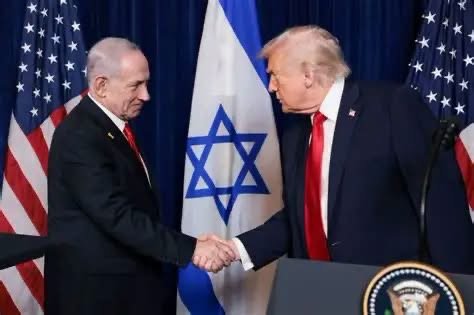
Israeli Prime Minister Benjamin Netanyahu has rejected a 15-point U.S.-backed roadmap for ending the Gaza conflict, openly challenging a proposal championed by President Donald Trump and creating one of the most significant public disagreements between the two leaders over the future of the war.
Netanyahu’s rejection came on Sunday, August 9, 2026, during a cabinet meeting in which the Israeli prime minister made clear that his government would not accept an Israeli military withdrawal from Gaza until Hamas is fully and, in his words, “genuinely” disarmed.
The development places renewed pressure on the Trump administration’s efforts to broker an end to the conflict and exposes a fundamental disagreement over the sequencing of the proposed agreement: whether Israeli forces should withdraw as part of a phased process while Hamas gives up its weapons, or whether Hamas must first surrender its entire arsenal before any Israeli withdrawal can begin.
Reuters reported that Netanyahu told his right-wing government that Israel did not accept the 15-point document and that the Israel Defense Forces would not withdraw until Hamas had been disarmed of heavy weapons, lighter weapons and all other weaponry. Netanyahu also acknowledged that Israeli and American officials were continuing discussions over the proposal, saying Washington had presented ideas that Israel considered both acceptable and unacceptable. (Reuters)
The remarks represent a significant challenge for Benjamin Netanyahu and Donald Trump, whose administrations have maintained close strategic ties but have increasingly faced differences over how the Gaza conflict should conclude.
A Plan Trump Presented as a Breakthrough
The dispute centres on a 15-point framework unveiled by Trump’s Board of Peace in July. Trump had described the initiative as a major step towards ending the Gaza war, saying it involved the complete disarmament of Hamas and other armed groups in the territory.
Under the framework, Hamas would give up its weapons, while Israeli forces would withdraw from Gaza in stages. A new Palestinian technocratic administration would take responsibility for governing the territory, while an international stabilization mechanism would assist with security.
The Washington Post reported that the plan gave Israel and Hamas a limited period to agree on the timetable and practical process for implementing Hamas’s disarmament and the withdrawal of Israeli forces. However, disagreements emerged almost immediately over which obligation should come first. (The Washington Post)
Hamas has maintained that it remains committed to the roadmap. According to Reuters, senior Hamas official Basem Naim said the group expected mediators and the United States, described as the guarantor, to press Netanyahu’s government to adhere to the agreement and avoid obstructing its implementation. (Reuters)
The group has, however, avoided describing its position simply as unconditional disarmament. Reuters reported that Hamas agreed to hand over weapons for storage under a U.S.-backed Palestinian technocratic administration, while also insisting that implementation depends on Israel fulfilling its own commitments, including withdrawal and an end to military attacks. (Reuters)
That distinction has become central to the disagreement.
Netanyahu Sets Full Disarmament as Precondition
Netanyahu’s position is that Israeli forces cannot withdraw before Hamas has been completely disarmed.
“I have heard people saying: ‘You didn’t say it.’ So here I am saying it again,” Netanyahu said in remarks reported by international media, reiterating that Israel would not withdraw until Hamas was genuinely disarmed.
The Israeli leader has also rejected any interpretation of the proposal that would allow Hamas to retain significant military capabilities after an Israeli withdrawal.
The Guardian reported that Netanyahu characterized the proposed withdrawal as unacceptable unless Hamas first gives up heavy and light weapons and other military capabilities. The newspaper described the development as a rare public break between Netanyahu and Trump, particularly because the disagreement directly concerns an initiative promoted by the U.S. president. (The Guardian)
Netanyahu has gone further by reiterating his opposition to Palestinian statehood. The Washington Post reported that the 15-point framework includes language envisioning conditions for a credible pathway toward Palestinian self-determination and statehood. Netanyahu, however, said that as long as he remains prime minister, a Palestinian state will not be established. (The Washington Post)
The issue adds another layer of complexity to an already difficult negotiation because Palestinian statehood has long been one of the central questions in efforts to achieve a lasting Israeli-Palestinian settlement.
Hamas Says It Remains Committed
While Netanyahu has rejected the framework, Hamas has publicly maintained its commitment to the roadmap.
Al Jazeera reported that Hamas reaffirmed its support for implementing the 15-point plan and called on mediators and guarantor countries to assume responsibility for preventing violations that could derail the process. (Al Jazeera)
This has created an unusual diplomatic situation in which Hamas says it remains committed to a U.S.-backed framework, while Israel — Washington’s principal regional ally — says it does not accept the document in its current form.
The central dispute is therefore not only whether Hamas will disarm, but also the terms, timing and verification of that disarmament.
Trump’s framework envisages a phased process in which the removal of Hamas’s military capabilities would be linked to an Israeli military withdrawal and the establishment of a new governing and security arrangement in Gaza.
Israel, however, is insisting that disarmament must precede withdrawal.
Pressure Builds on Trump
Netanyahu’s position now puts the Trump administration in a difficult diplomatic position.
Trump has presented the Gaza roadmap as a major achievement in his broader foreign-policy agenda and has sought to position his administration as capable of resolving major conflicts in the Middle East.
Netanyahu’s rejection means Washington must now decide how much pressure it is willing to exert on Israel to preserve the agreement.
The Guardian reported that the head of Trump’s Board of Peace, Nickolay Mladenov, said the proposal remained the only viable way forward to prevent another escalation. (The Guardian)
At the same time, Netanyahu’s domestic political calculations cannot be ignored.
Reuters reported that Netanyahu is facing an October 27 election while dealing with pressure from far-right members of his governing coalition, many of whom oppose concessions that could allow Hamas to retain influence or lead to an Israeli military withdrawal from Gaza. (Reuters)
Finance Minister Bezalel Smotrich has publicly backed Netanyahu’s position, arguing that the Israeli military should not withdraw from Gaza before Hamas is dismantled. (Reuters)
The political environment therefore creates competing pressures on Netanyahu: Washington wants progress towards implementing the Gaza roadmap, while hardline members of his coalition oppose what they regard as premature Israeli concessions.
Gaza Ceasefire Remains Fragile
The disagreement comes despite a ceasefire arrangement reached in October 2025 that was intended to reduce hostilities and create conditions for a longer-term political settlement.
However, fighting has continued, with Israeli military operations reported in Gaza even after the ceasefire.
Reuters reported that Israel had scaled back attacks in Gaza since Monday following discussions involving Mladenov, with an Israeli source saying the military had agreed to act only against what it regarded as immediate threats and to stop targeted assassinations. (Reuters)
The continuing violence has added urgency to international efforts to establish a durable political and security arrangement.
According to Reuters, Gaza health officials have reported that more than 1,250 people have been killed in Israeli attacks since the October 2025 ceasefire, most of them civilians. Four Israeli soldiers have also been killed in Gaza during the same period, according to the report. (Reuters)
The figures underline the difficulty of sustaining a ceasefire while the two sides remain divided over security control, disarmament, military withdrawal and the future governance of Gaza.
What Happens Next?
The immediate focus is likely to shift back to negotiations between Washington and Jerusalem, alongside efforts by mediators to maintain Hamas’s commitment to the proposed roadmap.
For the plan to survive, negotiators will have to bridge the fundamental disagreement over sequencing.
Hamas wants Israel to fulfil its obligations, including military withdrawal and an end to attacks, while Israel insists that Hamas must first surrender its weapons before Israeli forces leave.
The proposed governance structure also remains politically sensitive. The roadmap envisages a Palestinian technocratic administration taking responsibility for Gaza’s civilian affairs, while international mechanisms would assist with security and implementation.
Whether that arrangement can be established depends largely on whether the parties can agree on the disarmament process and credible mechanisms for monitoring compliance.
Netanyahu’s latest declaration does not necessarily mean that diplomacy has ended. He confirmed that Israeli officials are still discussing the proposal with Washington, leaving room for negotiations over specific provisions.
But his categorical rejection of the 15-point document demonstrates that the roadmap is far from implementation.
For Trump, the challenge is now to reconcile his stated ambition of ending the Gaza conflict with the security demands of Israel’s government and the conditions set by Hamas. For Netanyahu, the challenge is equally complex: maintaining his alliance with Washington while satisfying a domestic political constituency that remains deeply opposed to concessions over Hamas and Gaza.
The coming negotiations could therefore determine whether Trump’s Gaza initiative develops into a workable ceasefire and political transition, or becomes another diplomatic proposal stalled by competing demands from the parties to the conflict.
For Palestinians and Israelis, the stakes remain considerably higher than the fate of any single diplomatic document. The success or failure of the roadmap could influence the trajectory of Gaza’s security situation, humanitarian conditions, governance structure and the wider prospects for a negotiated political settlement in the Middle East.
Sources: Reuters; The Washington Post; Al Jazeera; The Guardian.