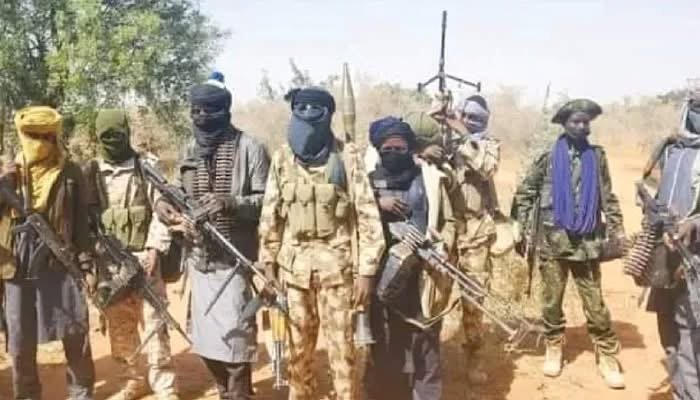
10 Police Officers, Two Civilians Killed as Security Forces Clash With Bandits in Kebbi’s Sakaba!
ABUJA, Nigeria — Ten police officers and two civilians have been killed in a violent encounter between Nigerian security forces and armed bandits in Sakaba Local Government Area of Kebbi State, highlighting the continuing security challenges confronting communities along Nigeria’s north-western border corridor.
The deadly confrontation occurred on Monday in the Rafin Makuku area of Sakaba, close to the boundary between Kebbi and Zamfara states, according to the Kebbi State Police Command.
Police spokesperson Bashir Usman said 10 police personnel were killed during the engagement, while two other officers sustained injuries and were receiving medical treatment.
Seventeen suspected bandits were also reported killed in the clash, while two civilians died.
The Associated Press, citing the police statement, reported that the confrontation occurred after security forces intercepted heavily armed men travelling on motorcycles near the Zamfara border. The area has long faced attacks by armed groups involved in banditry, kidnapping and other violent crimes. (AP News)
PM News Nigeria separately reported that the clash occurred around the Rafin Makuku axis of Sakaba Local Government Area and said the attackers were believed to have moved from the Sangeko Gap area of Dansadau District in Maru Local Government Area of Zamfara State. (PM News Nigeria)
The conflicting and rapidly developing nature of security incidents makes independent verification of casualty figures difficult in the immediate aftermath. Wengglobal therefore attributes the reported casualties to the police and other cited sources.
Police suffer heavy losses in confrontation
The death of 10 police officers represents a significant loss for Nigeria’s internal security system, particularly in an area where police personnel operate under persistent threats from heavily armed criminal groups.
According to police spokesman Bashir Usman, the officers were killed during the engagement with the armed group, while two others were wounded.
The scale of the losses underscores the risks confronting security personnel deployed to remote communities where bandit groups can exploit difficult terrain, limited infrastructure and proximity to state borders.
The attackers were reportedly travelling on motorcycles and carrying firearms when they were intercepted by security forces.
Motorcycles have frequently been used by armed groups operating across parts of north-western Nigeria because they provide mobility across rural terrain and allow attackers to move between communities and forested areas.
The reported movement of the group from Zamfara into an area near Kebbi also illustrates the cross-border nature of insecurity within Nigeria’s north-west.
State boundaries do not necessarily restrict criminal networks whose operations extend across forests, rural settlements and adjoining local government areas.
Two civilians also caught in violence
The deaths of two civilians add another dimension to the tragedy.
Residents living in communities affected by banditry frequently face the risk of being caught in armed confrontations between criminal groups and security forces.
Civilians can also become targets of attacks, kidnapping, cattle rustling and other forms of criminal violence.
In this latest incident, police said two civilians were killed during the confrontation.
The identities and circumstances surrounding the deaths of the two civilians had not been fully established in the initial reports available to Wengglobal.
Further information from the police, local authorities or relatives of the victims may provide greater clarity on how the civilians became involved in the incident.
17 suspected bandits reportedly killed
Security forces also reportedly inflicted significant casualties on the armed group.
Police said 17 suspected bandits were killed during the engagement.
PM News Nigeria reported that the group was estimated by residents to include a much larger number of armed men travelling on more than 200 motorcycles, although this detail was not included in the Associated Press account and should therefore be treated as a locally reported estimate rather than an independently verified figure. (PM News Nigeria)
The disparity between the reported size of the group and the number of casualties illustrates the uncertainty that can accompany early reports from remote conflict zones.
Such figures can change as security agencies recover bodies, assess the scene and receive additional information from communities.
For that reason, Wengglobal considers the reported figure of 17 suspected bandits killed as an official or media-reported casualty figure rather than a final independently verified count.
Sakaba remains vulnerable to bandit violence
The latest attack is not an isolated security concern for Sakaba.
The local government area, which lies in the north-western part of Kebbi State, has previously experienced attacks involving armed groups.
Its proximity to Zamfara and other areas affected by banditry has contributed to its exposure to criminal networks operating across state boundaries.
Previous reporting has documented attacks in communities around Sakaba, including Makuku and neighbouring settlements.
The persistence of insecurity in the area has had consequences extending beyond immediate loss of life.
Farmers have faced disruptions to agricultural activity, residents have been displaced and communities have struggled to maintain normal social and economic activities.
A study examining the effects of banditry on school attendance in Sakaba documented how attacks in communities including Dankolo, Jan Birni, Maganda, Doka and Rafin Gora contributed to displacement, insecurity and disruptions to education. (ResearchGate)
That history provides important context for the latest incident.
Security pressure across the north-west
The violence in Kebbi forms part of a wider security challenge across Nigeria’s north-western region.
Zamfara, Katsina, Sokoto, Kebbi and parts of Kaduna and Niger states have experienced years of armed banditry, kidnapping and attacks on rural communities.
The criminal groups involved are diverse, and the term “bandits” is often used broadly to describe armed groups involved in kidnapping, cattle rustling, robbery and attacks on communities.
Not every armed group operating in the region necessarily has the same structure, leadership or objectives.
The emergence of transnational or ideological militant networks in parts of the north-west has further complicated the security environment, making intelligence gathering and identification of armed groups increasingly important.
For Kebbi and neighbouring states, the challenge is therefore not simply to respond to individual attacks but to disrupt the networks that enable armed groups to recruit, acquire weapons, obtain information and move across difficult terrain.
The importance of intelligence-led operations
The circumstances surrounding the latest clash raise questions about intelligence and operational preparedness.
Police said the armed men were intercepted by security forces.
If confirmed, such an interception could indicate that security agencies received information about the movement of the group and were able to deploy personnel before a larger attack occurred.
Effective intelligence is particularly important in rural security operations.
Traditional intelligence from local communities can help authorities identify suspicious movements, while technological tools such as aerial surveillance, communications monitoring and data analysis can strengthen the ability of security agencies to detect and track armed groups.
However, intelligence must be combined with adequate manpower, equipment, communications systems and rapid-response capability.
The loss of 10 police officers in a single engagement illustrates the dangers faced by personnel confronting heavily armed criminal groups.
Protecting security personnel
The latest deaths also renew questions about the preparedness of Nigeria’s police for high-risk operations.
Police officers are often deployed to communities where armed groups possess superior firepower or tactical mobility.
The ability of officers to respond effectively depends on training, protective equipment, weapons, communications and access to timely intelligence.
Where police units are isolated or operate without adequate reinforcement, they can become vulnerable to ambushes.
This does not diminish the responsibility of security personnel to protect citizens. Rather, it highlights the importance of ensuring that officers tasked with confronting heavily armed groups have the resources necessary to perform that responsibility.
The deaths of the 10 officers should therefore not be viewed only as a casualty figure. Each represents a loss of a trained member of the national security system and a family member whose death will have consequences for relatives and communities.
The human cost of prolonged insecurity
For residents of affected communities, repeated attacks create a climate of fear that can become as damaging as individual incidents.
Farmers may hesitate to travel to distant fields. Parents may keep children away from school. Traders can lose access to markets. Transport operators may avoid certain routes.
When these disruptions continue for extended periods, insecurity becomes an economic problem as well as a security problem.
Agricultural production can decline when farmers cannot safely access their land.
This is particularly important in Kebbi, one of Nigeria’s major agricultural states, where farming and related activities provide livelihoods for large numbers of residents.
A community cannot develop sustainably if residents remain uncertain about their physical safety.
Need for stronger inter-state coordination
The reported movement of armed men between Zamfara and Kebbi highlights the importance of coordination between neighbouring states.
Security operations organised around administrative boundaries can be less effective when criminal groups exploit those boundaries to evade pursuit.
Joint intelligence operations, coordinated patrols and communication between police commands and military formations across state borders can improve the chances of identifying and disrupting armed groups.
The federal government and security agencies also need to maintain sustained pressure rather than relying solely on short-term responses after attacks occur.
Where criminal groups repeatedly return to the same areas, security operations should be accompanied by measures aimed at denying them access to weapons, supplies and recruitment networks.
Civilian protection must remain central
While the reported deaths of security personnel underline the risks faced by police officers, the protection of civilians must remain at the heart of Nigeria’s security response.
Communities should not be left to negotiate their safety with armed groups.
Residents need confidence that security agencies can respond rapidly when threats emerge.
At the same time, civilians should avoid confronting heavily armed groups directly. Community members can play an important role by providing credible information to authorities, but direct confrontation can expose them and their families to unnecessary danger.
Building trust between security agencies and local communities is therefore essential.
Residents are more likely to share information when they believe authorities can protect them and maintain confidentiality.
Accountability and investigation
The deaths of 10 police officers and two civilians also warrant a thorough investigation.
Authorities should establish the circumstances of the confrontation, determine how the armed group entered the area, assess the response of security forces and establish the identities of those killed.
Where evidence of criminal responsibility is established, suspects should be prosecuted in accordance with Nigerian law.
Investigations should also examine whether there were intelligence failures, operational shortcomings or other factors that could have contributed to the loss of security personnel.
Accountability is important not only for justice but also for improving future security operations.
A continuing test for Nigeria’s security strategy
The Sakaba confrontation is another reminder that Nigeria’s fight against armed banditry remains far from over.
Despite repeated military and police operations across the north-west, armed groups continue to exploit remote terrain and porous boundaries to threaten communities.
The latest casualties demonstrate the price being paid by both security personnel and civilians.
For Wengglobal, the incident should prompt a renewed focus on the underlying security architecture in the north-west: intelligence gathering, inter-state coordination, police capacity, community protection, rural infrastructure and prosecution of criminal networks.
The immediate priority is to support the injured officers, assist the families of those killed and ensure that the civilian victims are not forgotten.
The longer-term challenge is to prevent another community from experiencing the same tragedy.
The deaths of 10 police officers, two civilians and the reported 17 bandits represent more than a statistic in Nigeria’s expanding security ledger.
They are a measure of the human cost of a conflict that continues to undermine public safety, economic activity and confidence in vulnerable communities.
Until armed groups are denied the freedom to operate across rural areas and security institutions are sufficiently equipped to protect citizens and themselves, incidents such as the Sakaba clash will remain a serious threat to Nigeria’s stability.
Sources
- Associated Press (AP) — “Authorities say 10 Nigerian police officers were killed in gunbattle with rebels in the north,” August 11, 2026. (AP News)
- PM News Nigeria — “17 bandits, 10 policemen killed in fierce Zamfara-Kebbi gun battle,” August 11, 2026. (PM News Nigeria)
- Premium Times — Reporting and archive material on security incidents in Kebbi State and statements from the Kebbi Police Command. (Premium Times Nigeria)
- PUNCH — Previous reporting on the impact of banditry on farming and communities in Kebbi and neighbouring north-western states. (Punch Newspapers)
- Associated Conflict Data / ACLED reporting — Documentation of insecurity incidents and fatalities in Kebbi State. (ECOI.net)