Infantino’s 2027 FIFA Re-Election Faces Growing Revolt as Europe Withdraws Support While Africa, Latin America Rally Behind Him!
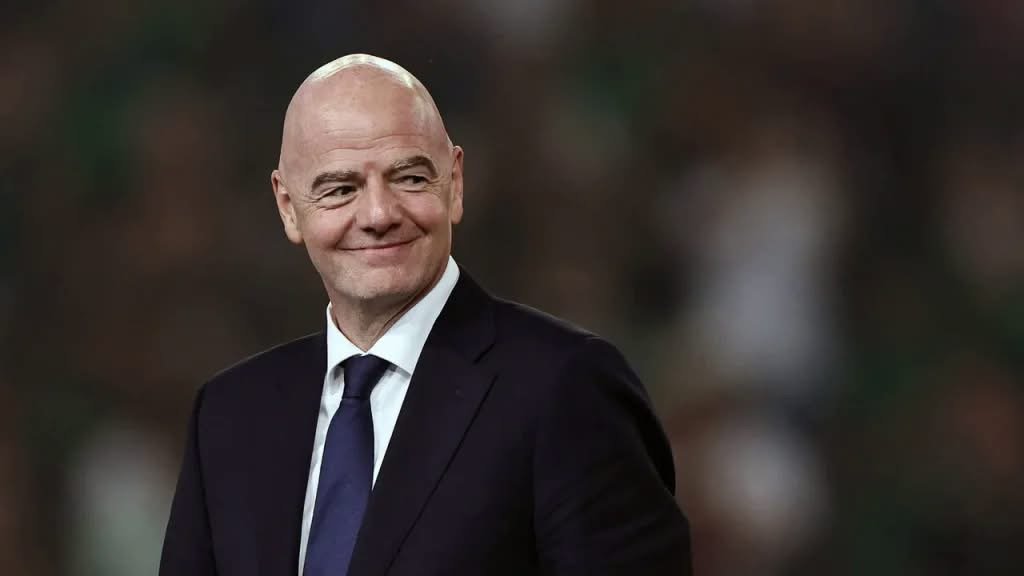
The race for the presidency of FIFA is entering a turbulent new phase, with Gianni Infantino retaining substantial support across Africa, parts of Asia and Latin America while a growing group of European football associations openly withdraw their backing and demand changes to FIFA’s leadership.
Infantino, who has led FIFA since 2016, announced in April that he would seek another term when FIFA’s current presidential mandate expires in 2027. The election is scheduled for March 18, 2027, at the FIFA Congress in Rabat, Morocco. FIFA has 211 member associations, with each association entitled to one vote in the presidential election. (Inside FIFA)
What initially appeared to be a straightforward re-election campaign has, however, become considerably more complicated following the collapse of a controversial FIFA investment proposal and a widening dispute over governance, consultation and the direction of world football.
Africa remains Infantino’s strongest political base
The most significant bloc still publicly committed to Infantino is Africa.
The Confederation of African Football (CAF) announced in April that its 54 member associations had unanimously agreed to support Infantino’s re-election for the 2027–2031 term. That endorsement gives the FIFA president a potentially decisive voting bloc and represents the clearest collective commitment to his candidacy among FIFA’s six continental confederations. (Confédération Africaine de Football)
The African bloc includes Algeria, Angola, Benin, Botswana, Burkina Faso, Burundi, Cabo Verde, Cameroon, Central African Republic, Chad, Comoros, Congo, Côte d’Ivoire, Democratic Republic of the Congo, Djibouti, Egypt, Equatorial Guinea, Eritrea, Eswatini, Ethiopia, Gabon, The Gambia, Ghana, Guinea, Guinea-Bissau, Kenya, Lesotho, Liberia, Libya, Madagascar, Malawi, Mali, Mauritania, Mauritius, Morocco, Mozambique, Namibia, Niger, Nigeria, Rwanda, São Tomé and Príncipe, Senegal, Seychelles, Sierra Leone, Somalia, South Africa, South Sudan, Sudan, Tanzania, Togo, Tunisia, Uganda, Zambia and Zimbabwe. (The National)
However, the political picture should not be confused with an independently verified count of votes that Infantino will ultimately receive in 2027. CAF’s collective endorsement is significant, but national associations retain the formal voting power at the FIFA Congress.
Reuters reported on August 7 that CAF and several national associations continued to rally behind Infantino despite the crisis, reinforcing the importance of Africa to his re-election strategy. (Reuters)
Latin America also tilts towards Infantino
South America remains another important source of support.
CONMEBOL, the South American football confederation, has previously backed Infantino and, according to recent reporting, has rejected attempts to remove the FIFA president outside the established electoral process.
Argentina has also publicly defended Infantino. Reuters reported that the Argentine Football Association praised his decade in charge and supported continuity at FIFA. Mexico has similarly broken with the broader criticism emerging from CONCACAF, arguing against attempts to remove Infantino without a vote involving FIFA’s 211 members. (Reuters)
The 10 CONMEBOL members are Argentina, Bolivia, Brazil, Chile, Colombia, Ecuador, Paraguay, Peru, Uruguay and Venezuela. While the bloc has historically been highly supportive of Infantino, its current position is better described as pragmatic support rather than an unconditional public campaign on his behalf. The Guardian has reported that CONMEBOL’s recent public posture has been cautious, with the confederation seeking to protect South America’s influence and negotiating position within FIFA. (The Guardian)
Asia presents a more complicated picture
The Asian Football Confederation has become one of the most important swing blocs in the developing confrontation.
The AFC has historically been a strong supporter of Infantino, but it reacted negatively to the way FIFA’s proposed investment scheme was presented. The confederation called for greater transparency, consultation and appropriate governance procedures.
That does not, however, amount to a collective decision to oppose Infantino.
Reuters reported on August 7 that the AFC had expressed solidarity with UEFA and CONCACAF in their criticism, while individual Asian associations including Indonesia, the Philippines and Qatar had publicly backed Infantino. (Reuters)
The Guardian has likewise described the Asian bloc as divided. Qatar, the United Arab Emirates and Saudi Arabia have been identified as influential supporters, while questions remain over whether the AFC leadership will ultimately remain aligned with Infantino or seek a different candidate. (The Guardian)
This makes Asia potentially crucial to the 2027 contest. If the AFC remains divided, Infantino could lose part of a traditionally reliable voting base. If it consolidates behind him, his electoral advantage would become substantially stronger.
Europe emerges as the centre of opposition
The sharpest challenge to Infantino is coming from UEFA.
Europe has 55 FIFA member associations, making it the largest single confederation by membership. Several European associations have now either withdrawn earlier endorsements or explicitly refused to support Infantino’s re-election.
The publicly reported opponents include Albania, Croatia, Denmark, England, Finland, Germany, Greece, Netherlands, Norway, Serbia, Sweden and Wales, although the precise status of every national association should be treated carefully because positions are changing and not every reported position has been communicated through a formal FIFA election document.
Wales was among the first associations to formally withdraw its support, citing concerns over governance, leadership, communication and decision-making. England, Serbia and Finland have also withdrawn earlier endorsements, while Sweden has publicly opposed Infantino’s 2027–2031 candidacy. (The Guardian)
Norway has gone further than simply withdrawing support. On August 7, Norwegian Football Federation president Lise Klaveness publicly called for Infantino to resign, arguing that he no longer has the institutional trust required to lead FIFA. Reuters described Norway’s intervention as a major escalation in the dispute. (Reuters)
Germany, meanwhile, is among the countries that had not endorsed Infantino’s candidacy in the earlier campaign, while the Netherlands, Greece, Denmark, Albania and Croatia have emerged among the European associations reported as opposing or withdrawing support.
The European rebellion is politically significant because UEFA has also threatened a boycott of FIFA competitions if its governance concerns are not satisfactorily addressed. The dispute intensified after FIFA abandoned its controversial plan to raise billions of dollars by selling stakes in the commercial rights of the World Cup and other competitions to private investors. (The Guardian)
CONCACAF could become another battleground
North and Central America and the Caribbean may ultimately determine whether the European challenge develops into a serious electoral threat.
CONCACAF’s 41 member associations collectively condemned the investment proposal, describing it as evidence of serious governance and leadership failures and calling for a broader reckoning over Infantino’s presidency. (The Guardian)
Yet collective criticism of the proposal has not automatically translated into a uniform national decision to oppose Infantino.
Mexico, one of CONCACAF’s most influential members and a 2026 World Cup co-host, has publicly supported the principle that any attempt to remove Infantino must follow FIFA’s established democratic process. Reuters reported that Mexico has therefore positioned itself differently from CONCACAF’s broader institutional criticism. (Reuters)
The United States, Canada, Costa Rica and Jamaica are among countries whose calculations could also be influenced by their football, commercial and hosting interests, meaning that the eventual CONCACAF voting pattern cannot yet be treated as settled. (The Guardian)
Oceania remains uncertain
The Oceania Football Confederation, which has 11 member associations, has not emerged as a clearly unified anti-Infantino bloc.
New Zealand has strongly criticised FIFA’s abandoned investment proposal, while the broader OFC position has remained less definitive. The Guardian reported that support for Infantino continues to exist among other Oceanian associations. (The Guardian)
That leaves Oceania as another potentially important bloc in a contest where even relatively small shifts in voting alliances could become politically consequential.
The confirmed picture: supporters versus opponents
Based on publicly reported positions available by August 8, 2026, the clearest picture is as follows:
Strongly or collectively backing Infantino:
CAF’s 54 member associations; Argentina; Mexico; and several Asian associations, including Qatar, Indonesia and the Philippines.
Publicly opposing, withdrawing support or calling for a change in leadership:
Albania, Croatia, Denmark, England, Finland, Germany, Greece, Netherlands, Norway, Serbia, Sweden and Wales.
Position not yet reliably settled at national-association level:
Many members of AFC, CONCACAF, CONMEBOL and OFC, including countries whose confederations have criticised FIFA’s recent decisions but whose individual associations have not formally withdrawn support.
This distinction is essential. Claims that “all 211 nations” have either backed or rejected Infantino are misleading. More than 200 FIFA members had formally endorsed his candidacy earlier in the year, according to The Guardian, but a series of European withdrawals has since altered the political landscape. (The Guardian)
What happens next?
Infantino remains the clear favourite on the available evidence, but his path to another term is no longer politically uncomplicated.
Africa’s 54 votes provide a powerful foundation. Latin America’s continued support strengthens his position, while individual Asian endorsements could further protect his majority. At the same time, UEFA’s 55 associations represent the largest organised opposition bloc, and CONCACAF’s institutional criticism creates another potential source of resistance.
The most important unanswered question is whether the opposition can agree on a credible alternative candidate.
The Guardian has reported that a European-backed challenger has been discussed, while CONCACAF president Victor Montagliani has been identified as a potential successor. Montagliani has not declared a candidacy, however, and no challenger had formally emerged as of the latest major reporting. (The Guardian)
For Infantino, the immediate challenge is therefore not simply winning endorsements but maintaining the coalition that has carried him through previous elections.
For his opponents, the task is considerably harder: they must transform dissatisfaction into an organised electoral alliance capable of reaching at least 106 votes — the majority required in a 211-member FIFA Congress.
The 2027 FIFA presidential election is consequently shaping up as more than a contest over one man’s future. It is becoming a wider test of how global football should be governed, how much authority a FIFA president should exercise, and whether the world’s football associations are prepared to challenge the concentration of power at the top of the game’s governing institution.
For now, Infantino retains the advantage. But the withdrawals from Europe, Norway’s demand for his resignation and the uncertainty within Asia and CONCACAF have ensured that the road to Rabat is no longer a guaranteed coronation.
Sources and further reading
- Reuters — Infantino allies rally as Norway FA demands FIFA president’s resignation
- The Guardian — The Fifa family: which confederations could support Infantino or turn against him?
- The Guardian — More European countries’ FAs withdraw support for Infantino
- The Guardian — More than 200 FIFA members endorse Infantino for fourth term
- Associated Press — Canada’s Carney says he has no confidence in FIFA’s Infantino
- Al Jazeera — Africa and Asia back Infantino for unique fourth term as FIFA president
- FIFA — Infantino announces he will stand for re-election in 2027
- CAF — CAF member associations unanimously support Infantino’s re-election