Reported by Weng Patrick Atokor | Journalist at Weng Global
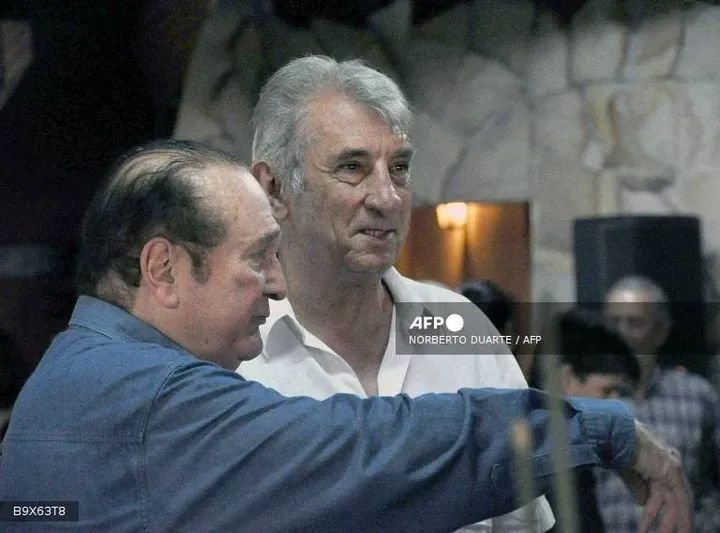
Argentine football is mourning the loss of one of its greatest icons after former national team captain and Boca Juniors legend Antonio Ubaldo Rattin died at the age of 89.
Rattin’s passing was confirmed by Boca Juniors, the only club he represented throughout his professional playing career. In a heartfelt tribute, the Argentine giants described him as an “idol and emblem” whose influence on the club and the nation’s football history will never be forgotten.
Widely regarded as one of Argentina’s finest defensive midfielders, Rattin spent 14 seasons with Boca Juniors between 1956 and 1970. During that time, he made more than 380 appearances, scored 28 goals, and helped the club win multiple Argentine league titles while also reaching the 1963 Copa Libertadores final. His commanding presence, leadership, and uncompromising style earned him legendary status among Boca supporters.
On the international stage, Rattin represented Argentina in the 1962 and 1966 FIFA World Cups and captained the national team during the tournament in England.
Although his career featured numerous achievements, Rattin remains best remembered worldwide for one of football’s most controversial moments. During Argentina’s 1966 World Cup quarter-final against England at Wembley Stadium, German referee Rudolf Kreitlein sent him off for dissent. Unable to communicate effectively because of the language barrier, Rattin refused to leave the pitch immediately, insisting he had not understood the referee’s decision. The incident delayed the match and became one of the defining moments in World Cup history.
The controversy had a lasting impact on football. The confusion surrounding Rattin’s dismissal highlighted the need for a universal system of communication between referees and players. FIFA subsequently introduced the now-famous yellow and red card system, first used at the 1970 FIFA World Cup, fundamentally changing the way the game is officiated worldwide.
Following his retirement from professional football, Rattin briefly managed Boca Juniors before moving into public service, later serving as a member of Argentina’s Congress. Throughout his life, he remained closely connected to Boca Juniors and frequently reflected on his pride in representing only two teams—his beloved club and the Argentine national team.
His death comes during Argentina’s campaign at the 2026 FIFA World Cup, with players paying tribute by wearing black armbands in his memory. Football fans across Argentina and beyond have also remembered him as one of the sport’s defining figures, whose influence extended beyond trophies to shaping the modern rules of the game.
Antonio Rattin leaves behind an enduring legacy as a Boca Juniors icon, an Argentine football great, and a player whose controversial moment on the world’s biggest stage helped transform football officiating for generations.
Sources: Reuters, Associated Press (AP), ESPN, Punch Sports, Boca Juniors.