Reported by Simon Yusuph | Journalist at WengGlobal
US Secretary of State Calls for Review as Balogun’s Dismissal Sparks Global Debate Over Officiating Standards
The controversial red card shown to United States striker Folarin Balogun during a crucial FIFA World Cup match has ignited widespread debate, with U.S. Secretary of State Marco Rubio describing the decision as one that “screwed” the American team and urging football authorities to review the incident.
Rubio’s unusually direct comments have added a political dimension to an already heated football controversy, as fans, analysts, and former players continue to question whether the dismissal was justified. The incident has dominated international sports headlines and renewed calls for greater consistency in officiating and wider use of technology in elite football competitions.
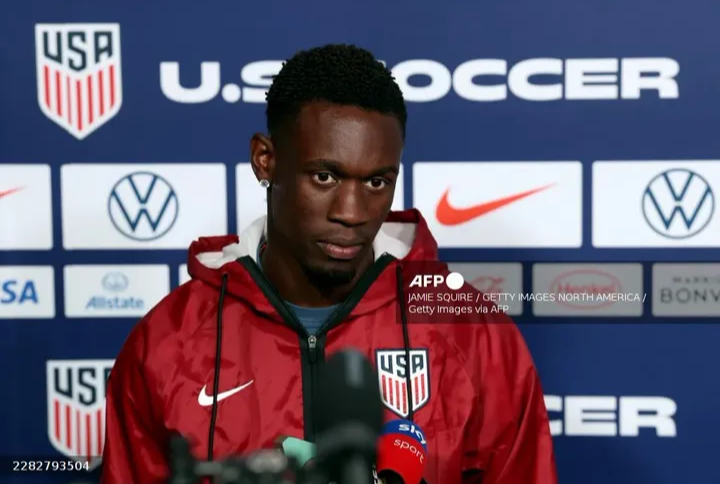
Balogun, who represents the United States internationally after switching allegiance from England, was sent off following a challenge that match officials deemed worthy of a straight red card. The decision immediately shifted the balance of the contest, forcing the United States to play with ten men during a critical stage of the match.
The dismissal proved costly as the U.S. struggled to maintain its tactical shape and eventually fell short, prompting criticism from supporters and football experts who believe the referee’s interpretation significantly influenced the outcome.
Rubio Questions Officiating
Speaking after the match, Rubio expressed frustration over the decision, arguing that the United States had been unfairly disadvantaged.
“The USA got screwed,” Rubio said, according to multiple international media reports, adding that the incident deserves a formal review and appeal if tournament regulations permit.
Although political leaders rarely comment on refereeing decisions in international football, Rubio’s remarks quickly attracted global attention, reflecting the growing significance of soccer within the United States and the heightened expectations surrounding the national team.
His comments also resonated with many American supporters who flooded social media with clips of the incident, arguing that similar tackles in previous matches had resulted in yellow cards rather than outright dismissals.
Balogun at the Centre of the Storm
Balogun has emerged as one of the United States’ most important attacking players since committing his international future to the U.S. Soccer Federation.
The striker has consistently demonstrated his ability to stretch opposing defences with his pace, movement, and finishing ability, making him a central figure in the team’s attacking system.
His absence after the red card significantly altered the tactical approach of the United States, leaving the team with fewer attacking options while also increasing defensive pressure.
Neither Balogun nor U.S. Soccer immediately issued extensive public comments on the referee’s decision, although officials are expected to review the incident internally before determining whether any formal representation can be made to tournament organisers.
Debate Over VAR Intensifies
The incident has reignited discussions surrounding the effectiveness of the Video Assistant Referee (VAR) system.
Critics argue that VAR was introduced precisely to eliminate clear officiating errors in decisive moments. Supporters of the technology believe the Balogun incident demonstrates that football still faces challenges regarding subjective interpretation, even with video review.
Several former referees interviewed by international broadcasters acknowledged that while referees must make split-second decisions, consistency remains one of football’s biggest challenges.
Others defended the match officials, arguing that dangerous tackles must continue to be punished firmly to protect player safety, even when such decisions prove controversial.
Football Community Divided
Reaction across the football community has been sharply divided.
Some analysts contend that the referee applied the Laws of the Game correctly, particularly if excessive force or serious foul play was identified during the challenge.
Others insist that slow-motion replays and alternative camera angles suggest the contact did not warrant a straight red card.
Former players appearing on sports television programmes noted that identical incidents have often resulted in yellow cards, reinforcing concerns about inconsistency between competitions and referees.
The debate has also spread across social media platforms, where millions of fans continue to share clips, tactical analyses, and expert opinions regarding the dismissal.
What the Laws of the Game Say
Under the IFAB Laws of the Game, a player may receive a straight red card for serious foul play if the challenge endangers the safety of an opponent or uses excessive force.
However, the interpretation of those standards often depends on the referee’s assessment of speed, intensity, point of contact, and intent.
VAR may recommend an on-field review if officials identify a “clear and obvious error,” but the final decision always rests with the referee.
This subjectivity has frequently generated controversy during major international tournaments despite technological improvements.
Implications for the United States
Losing a key striker during a high-stakes World Cup fixture carries significant consequences.
Balogun’s dismissal not only affected the immediate result but also raised concerns about player availability should suspensions follow under tournament disciplinary rules.
For head coach Mauricio Pochettino, the incident presents additional tactical challenges as the United States seeks to maintain momentum against increasingly competitive international opposition.
The controversy may also intensify calls for FIFA and IFAB to continue refining officiating guidelines to ensure greater consistency across elite competitions.
Politics Meets Football
Rubio’s comments illustrate how football has become an increasingly important component of American sporting culture.
Traditionally overshadowed by American football, basketball, and baseball, soccer has experienced remarkable growth in popularity across the United States.
Political figures now regularly engage with major football events, particularly as the country prepares to host the FIFA World Cup alongside Canada and Mexico.
While government officials hold no authority over refereeing decisions, public statements from senior political leaders can amplify scrutiny surrounding controversial moments.
FIFA Yet to Respond
As of publication, FIFA had not issued any official statement regarding Rubio’s remarks or the Balogun incident.
Tournament organisers generally refrain from publicly evaluating individual refereeing decisions while competitions remain ongoing.
Should the U.S. Soccer Federation decide to submit observations regarding the incident, any review would be conducted according to existing disciplinary procedures rather than political commentary.
Looking Ahead
Whether Balogun’s red card ultimately stands as a correct application of the Laws of the Game or becomes another example of football’s enduring refereeing controversies, the incident has already become one of the defining talking points of the tournament.
For the United States, attention will now shift toward regrouping and maintaining focus on upcoming fixtures.
For FIFA, the debate serves as another reminder that even in the era of VAR, refereeing decisions remain capable of shaping tournaments, influencing public confidence, and generating global discussion far beyond the football pitch.
As football continues to evolve, calls for greater transparency, consistency, and accountability in officiating are unlikely to diminish. The Balogun controversy—and Marco Rubio’s unusually forceful intervention—will remain part of that wider conversation as the tournament progresses.
Sources
- Reuters
- Associated Press (AP)
- ESPN
- BBC Sport
- Sky Sports
- FIFA
- The Athletic