Reported by Weng Patrick Atokor l Journalist at Weng Global
The United States and China have agreed to establish a communication channel for artificial intelligence incidents, creating a mechanism for the two countries to exchange information when serious AI-related events raise security concerns.
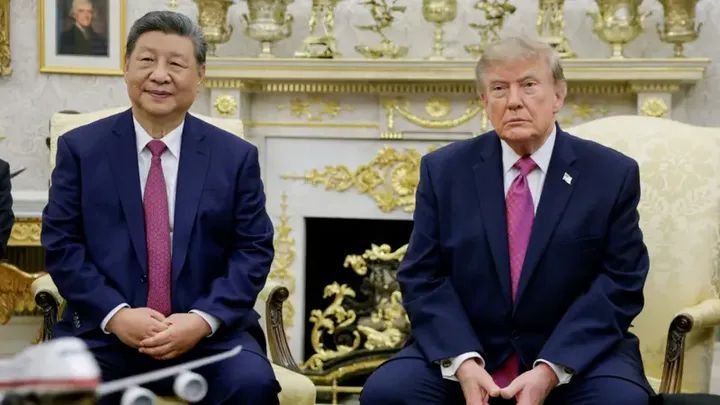
The agreement was announced following a summit between US President Donald Trump and Chinese President Xi Jinping in Washington, where the two leaders discussed artificial intelligence alongside broader economic and strategic issues.
The arrangement comes as Washington and Beijing compete for leadership in advanced AI while facing growing concerns about the security risks associated with increasingly capable systems.
US-China AI Dialogue
According to information released following the summit, the two countries also established a US-China Super Intelligence (SI) Dialogue to discuss the risks and benefits associated with advanced artificial intelligence.
The White House said the countries had agreed to use the term “super intelligence” in their discussions and that the next exchange would take place by November.
The dialogue is intended to provide a structured avenue for discussions between the two governments as AI capabilities continue to develop rapidly.
The decision represents a continuation of discussions that had already been taking place between US and Chinese officials before the leaders’ summit.
Agreement Follows Earlier AI Safety Talks
Before Trump and Xi met, US Treasury Secretary Scott Bessent and Chinese Vice Premier He Lifeng discussed the possibility of creating a notification mechanism for significant AI incidents.
Reuters reported that the US proposal was designed to establish a bilateral AI dialogue addressing national security, transparency and notification of serious AI incidents.
The discussions reflected concerns that a major AI incident could create risks that cross national borders, particularly if advanced systems become involved in cyber operations, critical infrastructure or other sensitive areas.
The proposed communication mechanism was therefore being considered as a way for Washington and Beijing to communicate directly when serious AI-related developments occur.
Why AI Communication Matters
Artificial intelligence has increasingly become a strategic issue for both the United States and China.
The two countries are competing in areas including advanced computing, AI models, semiconductor technology and the development of increasingly capable AI systems. At the same time, officials and researchers have raised concerns about the potential misuse or unintended consequences of advanced AI.
The Associated Press reported ahead of the summit that both countries were discussing shared concerns involving AI safety despite their broader technological rivalry. Those concerns include potential cyberattacks, biological misuse, loss of control over advanced systems and threats to critical infrastructure such as financial, transportation and energy networks.
A direct communication channel could therefore provide a means for the two governments to notify one another about incidents before misunderstandings develop into wider diplomatic or security crises.
From Competition to Risk Management
The agreement does not mean the United States and China have ended their competition over artificial intelligence.
Washington and Beijing continue to have significant disagreements over technology, national security, trade and access to advanced computing capabilities.
Reuters reported earlier in September that US and Chinese officials were preparing for discussions on AI safety while also dealing with broader disagreements between the two governments. The discussions included proposals concerning significant AI incidents and the possibility of establishing a bilateral mechanism for communication.
The latest agreement instead creates an avenue for cooperation on a specific area: managing risks that could affect both countries.
That distinction is important because international cooperation on AI does not necessarily require the United States and China to share the same technological or geopolitical objectives.
The Role of Advanced AI
The development of increasingly sophisticated AI systems has raised questions about how governments should respond when systems behave unexpectedly or are used in sensitive environments.
Some of the risks under discussion involve scenarios in which AI systems could interact with cybersecurity systems, critical infrastructure or other technologies with consequences beyond the original user or developer.
Reuters reported earlier that US and Chinese security experts had discussed safeguards for AI-related risks involving nuclear command systems, military cyber operations and autonomous AI. The proposals included maintaining human control over consequential cyber operations and establishing communication mechanisms for serious incidents.
These discussions illustrate why communication between major AI powers has become part of broader conversations about international technology governance.
A New Diplomatic Channel
The planned US-China mechanism could also have significance beyond individual AI incidents.
In other areas of international security, governments have established communication channels to reduce the risk that an unexpected event or misunderstanding escalates into a larger confrontation.
AI presents a different challenge because technological incidents can develop rapidly and may involve private companies, government agencies and infrastructure operators across several countries.
A government-to-government channel could give Washington and Beijing an additional way to communicate when an AI-related incident has potential national-security implications.
However, the effectiveness of the arrangement will depend on how the two countries implement it, what incidents qualify for notification and whether both sides are willing to use the mechanism during periods of heightened tension.
Implications for the Global AI Industry
The agreement could also attract attention outside the United States and China.
American and Chinese companies are among the major developers and users of advanced AI technologies, while businesses and governments across Africa, Europe, Asia and other regions are increasingly adopting AI systems.
Rules or understandings reached by the world’s two major AI powers could therefore influence wider international discussions about AI safety, incident reporting and responsible deployment.
For African countries, the developments are particularly relevant as governments, businesses and educational institutions continue to expand their use of AI.
International approaches to AI safety could eventually affect how AI systems are regulated, how companies report serious incidents and what safeguards are expected when advanced systems are deployed in sensitive sectors.
At the same time, countries outside the US and China will need to participate in international discussions if global AI governance is to reflect a wider range of interests and circumstances.
What Happens Next
The next stage will be the implementation of the agreed communication arrangements and the continuation of the US-China Super Intelligence Dialogue.
The White House said the next exchange on the risks and benefits of advanced AI is expected by November.
The practical details of the communication channel—including how incidents will be identified, which officials will participate and how information will be exchanged—will be important in determining how the mechanism operates.
The agreement also comes as Washington and Beijing continue to manage broader disagreements over technology, trade and national security.
For now, the AI arrangement provides a formal channel for the two governments to discuss incidents and risks at a time when the capabilities and international importance of artificial intelligence are expanding rapidly.
The development does not resolve the broader US-China technology rivalry. Instead, it establishes another area in which the two countries have agreed that direct communication may be necessary as advanced AI systems become more influential.
What Readers Should Know
The United States and China have agreed to create a communication channel for AI incidents following the Trump-Xi summit.
The countries have also established a Super Intelligence Dialogue focused on the risks and benefits of advanced AI, with another exchange expected by November.
The agreement comes amid continued US-China competition over artificial intelligence and growing international concern about the potential security consequences of increasingly capable AI systems.
The immediate focus will now be on how the communication mechanism is implemented and whether it can provide an effective way for Washington and Beijing to manage serious AI-related incidents.
Weng Global – Stories beyond borders
Sources
- White House — information released following the Trump-Xi summit on US-China cooperation and artificial intelligence.
- Reuters — reporting on US-China discussions over an AI safety notification mechanism and bilateral AI dialogue.
- Associated Press — reporting on US-China discussions over AI safety risks and shared concerns.
- Channel News Asia — reporting on the US-China communication channel and Super Intelligence Dialogue.
- New Indian Express — reporting on the AI communication mechanism and planned November dialogue.