Rescued Kwara Nurse Recounts Six Months in Terrorist Captivity, Says She Delivered 10 Babies Without Gloves
ILORIN, Kwara State — August 8, 2026 — Amirah Salihu, a nurse rescued after spending nearly six months in terrorist captivity following the February attack on communities in Kaiama Local Government Area of Kwara State, has recounted how she assisted pregnant women through childbirth with virtually no medical equipment, including helping deliver 10 babies with her bare hands.
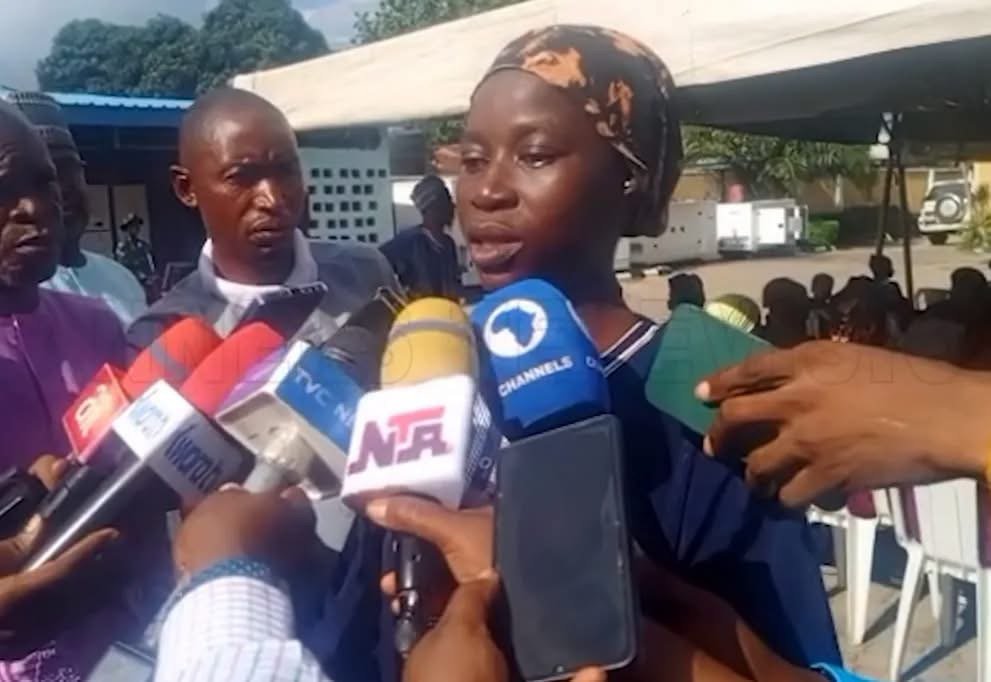
Salihu, the daughter of Woro community leader Umar Salihu, was among the residents abducted during the February 3 attack on Woro and neighbouring Nuku communities. In an interview aired by Channels Television’s Politics Today on Friday and reported by The Punch, she described months of hunger, exposure, inadequate shelter and the absence of basic healthcare while in captivity. (Punch Newspapers)
Her account offers a rare first-hand insight into the humanitarian conditions faced by women and children held by terrorists in remote areas of Kwara State and provides a human dimension to a security crisis that has continued to draw national concern.
According to Salihu, the captors eventually discovered that she was a nurse after asking whether any healthcare worker was among the abductees. She said she initially concealed her profession but later assisted women who went into labour.
“I helped like 10 women for the delivery, without gloves. I used my hands to help them,” she said in the interview, according to The Punch. (Punch Newspapers)
Her testimony highlights not only the personal ordeal of captivity but also the extreme medical vulnerability of pregnant women forced to give birth in an environment without conventional maternity services, trained personnel or essential supplies.
Six months in captivity
Salihu was among the people taken during the February 3 assault on Woro and Nuku.
The attack became one of the most serious security incidents reported in Kwara State this year. Earlier accounts indicated that terrorists attacked the communities, killing residents and abducting women and children. The number of people taken captive became a subject of dispute, with the Kwara State Government initially reporting a significantly lower figure while the terrorist group claimed it had taken as many as 176 people. (Punch Newspapers)
Videos subsequently circulated showing groups of women and children in captivity. The footage generated widespread concern over the welfare of the victims, particularly pregnant women, children and nursing mothers.
By April, reports indicated that the captives had spent more than two months in the forest. Families and community leaders repeatedly appealed to authorities to intensify efforts to secure their release.
In July, residents and political groups were still calling for urgent action, with reports saying the victims had spent more than five months in captivity. (Punch Newspapers)
The eventual release of the victims has now provided an opportunity to understand more clearly what happened to them during that period.
Delivering babies without basic medical equipment
For Salihu, one of the most extraordinary aspects of the ordeal was the responsibility she assumed when pregnant women began going into labour.
The conditions she described were far removed from those normally associated with safe childbirth.
She said there were no gloves available when she assisted women in labour. Her account suggests that she had to rely on her knowledge as a nurse and whatever limited resources were available around her.
The absence of sterile gloves and proper delivery equipment would ordinarily present serious risks to both mothers and newborns, particularly in an environment where sanitation, nutrition and access to emergency obstetric care were severely restricted.
Her testimony does not provide a complete medical record of the deliveries, and the circumstances surrounding the individual births could not independently be verified by Wengglobal. However, The Punch reported her account as given during her Channels Television interview. (Punch Newspapers)
The significance of the testimony lies in what it reveals about the conditions under which pregnant women were forced to give birth while being held captive.
It also demonstrates how professional skills can become critical for survival in humanitarian emergencies, even when the professional has no access to the facilities and equipment normally required to provide care.
Captives faced severe food shortages
Salihu also described chronic food shortages during her captivity.
She said the abductors initially provided guinea corn with salt and seasoning, but that the quantity and quality of food were inadequate.
According to her account, the captives sometimes survived on corn without oil or pepper, while on some days even the seasoning was reportedly unavailable.
She also said the captors occasionally provided fruits and a local food preparation known as kuka, but that such provisions were inconsistent.
The conditions described by Salihu are consistent with earlier accounts from other survivors and reports concerning the Woro captives, which documented severe hunger and deprivation.
The Punch previously reported that some of the released victims said they often ate only once a day and slept in the forest during their captivity. (Punch Newspapers)
The humanitarian implications are considerable.
Pregnant women require adequate nutrition and healthcare throughout pregnancy, while children are particularly vulnerable to malnutrition, dehydration and infectious disease.
When such conditions are combined with prolonged exposure to the elements and the absence of medical services, the risks become significantly greater.
Sleeping in the open and near a river
Beyond food shortages, Salihu described what appeared to be extremely difficult living conditions.
She said captives sometimes slept in or near a river and were exposed to heavy rainfall.
She also recounted that when the captives attempted to light fires, the terrorists ordered them to put them out.
Such conditions would have made maintaining warmth, preparing food and maintaining basic hygiene more difficult.
The account is particularly significant because prolonged exposure to rain and wet conditions can increase the risk of illness, especially among children, pregnant women and people already weakened by inadequate nutrition.
Salihu said she and other captives slept with their children under these circumstances.
Her testimony therefore provides another indication of the physical hardship endured by those held for months in the forest.
Terrorists wanted her to remain
The nurse also disclosed that the terrorists eventually recognised the value of her medical knowledge.
According to her, after learning that she had nursing skills, they wanted her to remain with them.
She refused.
“I want to come back,” she said, explaining why she rejected the demand. (Punch Newspapers)
The episode illustrates another dimension of captivity: the exploitation of professional skills belonging to abducted civilians.
For Salihu, her nursing knowledge became both a means of helping fellow captives and a reason the captors wanted to retain her.
Her refusal underscores the precarious position in which she found herself.
The attack also claimed members of her family
Salihu’s ordeal was compounded by personal loss.
She told Channels Television that two of her brothers were killed during the attack.
According to her account, the terrorists targeted her family because of her father’s opposition to their attempt to establish influence in the community.
She said her father had resisted the terrorists entering the community and had previously sought military protection.
However, she said the attackers arrived after the soldiers had left.
The deaths of her brothers add a deeply personal dimension to an attack that already caused extensive loss and displacement.
For Salihu, returning from captivity therefore did not mean returning to the life she had left behind.
She came back to a community marked by deaths, displacement and the disappearance of other residents.
She says there was no sexual assault
In her interview, Salihu was also asked whether women in captivity were subjected to rape or sexual assault.
She answered that she was not aware of any such incident among the captives.
“No case of rape or sexual assault,” she said. (Punch Newspapers)
Wengglobal notes that this is the survivor’s personal account and should not be interpreted as proof that no sexual violence occurred among all victims or during the entire period of captivity.
The distinction is important in responsible reporting of conflict-related sexual violence, where victims may be unable or unwilling to disclose traumatic experiences.
Children died during captivity
The rescue has also revealed the human cost of the prolonged ordeal.
According to the Kwara State Government, 13 children died in captivity, while 12 other children remained behind at the time of the initial report on the survivors’ return. The governor later received the rescued victims in Ilorin and visited a general hospital where 14 sick victims were receiving treatment, including three women who had given birth during captivity. (Punch Newspapers)
The reported deaths underline the vulnerability of children subjected to prolonged deprivation and exposure.
They also raise questions about the humanitarian consequences of keeping large numbers of civilians in remote locations without reliable access to food, clean water, medicine and emergency healthcare.
For families who survived, freedom has therefore come alongside grief.
A wider security crisis in Kwara
The Woro attack did not occur in isolation.
Kwara has experienced a series of kidnapping and terrorist incidents, particularly in parts of the state bordering areas affected by criminal and insurgent networks.
An analysis by Foundation for Investigative Journalism documented multiple attacks across Kwara in 2026, identifying the February 3 Woro assault as a major escalation. The organisation reported that terrorists killed residents and abducted as many as 176 people. (Fij)
Earlier reporting by Premium Times also documented how the Kwara Government acknowledged videos showing women and children abducted from Woro and said it was working with security agencies and community leaders to identify and secure their release. (Premium Times Nigeria)
The prolonged captivity generated increasing public pressure.
By July, residents of Kaiama organised protests demanding the release of the victims, while opposition parties accused the state and federal governments of failing to act quickly enough. Those political claims were contested and should be understood as statements from opposition groups rather than independently established findings. (Punch Newspapers)
The challenge after rescue
The return of survivors marks the beginning of another phase of the crisis.
Freedom from captivity does not automatically erase the physical and psychological consequences of months spent under threat.
Survivors may require medical examinations, nutritional rehabilitation, psychological support, family reunification and assistance in returning to ordinary community life.
Pregnant women and mothers who gave birth in captivity may face additional healthcare needs, while children who spent months away from normal schooling and family environments may require educational and psychosocial support.
The deaths reported during captivity also leave families facing grief alongside the practical difficulties of rebuilding their lives.
For the authorities, the responsibility now extends beyond the rescue itself.
There is a need to ensure that survivors receive appropriate care and that communities affected by the attack are protected from further violence.
The meaning of Amirah Salihu’s testimony
Salihu’s account is ultimately more than a story of survival.
It is a record of how civilians can be forced into extraordinary roles during conflict.
A nurse who entered captivity as a victim became an emergency caregiver for pregnant women. Without gloves or proper medical equipment, she used her knowledge to assist women giving birth under conditions she described as extremely harsh.
Her testimony also provides a window into the conditions experienced by people whose voices were largely heard through videos released by their captors during the months they were held.
Those images showed groups of women and children, but they could not fully communicate the daily realities of hunger, childbirth, exposure and fear.
Salihu’s account now fills in part of that missing picture.
Beyond the rescue
The release of the Woro captives should prompt renewed attention to the security challenges confronting communities in Kwara and other parts of Nigeria where civilians remain vulnerable to abduction.
Rescue operations are essential, but sustainable security requires more than recovering victims after attacks occur.
It requires intelligence-led operations, effective protection of vulnerable communities, rapid response capabilities, functioning local security structures and accountability for those responsible for attacks.
It also requires attention to the humanitarian needs of survivors.
The story of Amirah Salihu demonstrates why.
Her survival depended not only on her own resilience but also on her professional training, which enabled her to assist women during childbirth in circumstances where conventional healthcare was unavailable.
For the women she helped, that knowledge may have made the difference between life and death.
For Nigeria, the testimony is another reminder of the devastating human consequences of terrorism and prolonged captivity.
The rescued nurse has returned home, but her account leaves a difficult question for the country: how many more civilians must endure such conditions before communities can feel genuinely safe?
The answer will ultimately be measured not by statements or rescue announcements, but by whether vulnerable communities can live, work, raise children and access healthcare without fear of being taken from their homes.
Sources
- The Punch: I helped 10 pregnant women deliver babies bare-handed in captivity — Rescued Kwara nurse — report based on Amirah Salihu’s interview with Channels Television’s Politics Today. (Punch Newspapers)
- Channels Television: Interview with Amirah Salihu on Politics Today, from which her account of captivity and assisting women during childbirth was reported. The Punch report identifies Channels Television as the source of the interview. (Punch Newspapers)
- The Punch: Earlier reports on the prolonged captivity of the Woro abductees, public pressure and rescue efforts. (Punch Newspapers)
- Premium Times: Report on the Kwara Government’s acknowledgement of footage showing abducted women and children from Woro. (Premium Times Nigeria)
- TheCable: Report on abducted Kwara women and children appealing for rescue after more than two months in captivity. (TheCable)
- Foundation for Investigative Journalism (FIJ): Reporting and investigation into the Woro attack, the number of abductees and the wider security situation in Kwara. (Fij)
- The ICIR: Reporting on threats issued by terrorists concerning the abducted Kwara women and children. (icirnigeria.org)