Reported by Weng Patrick Atokor l Journalist at Weng Global
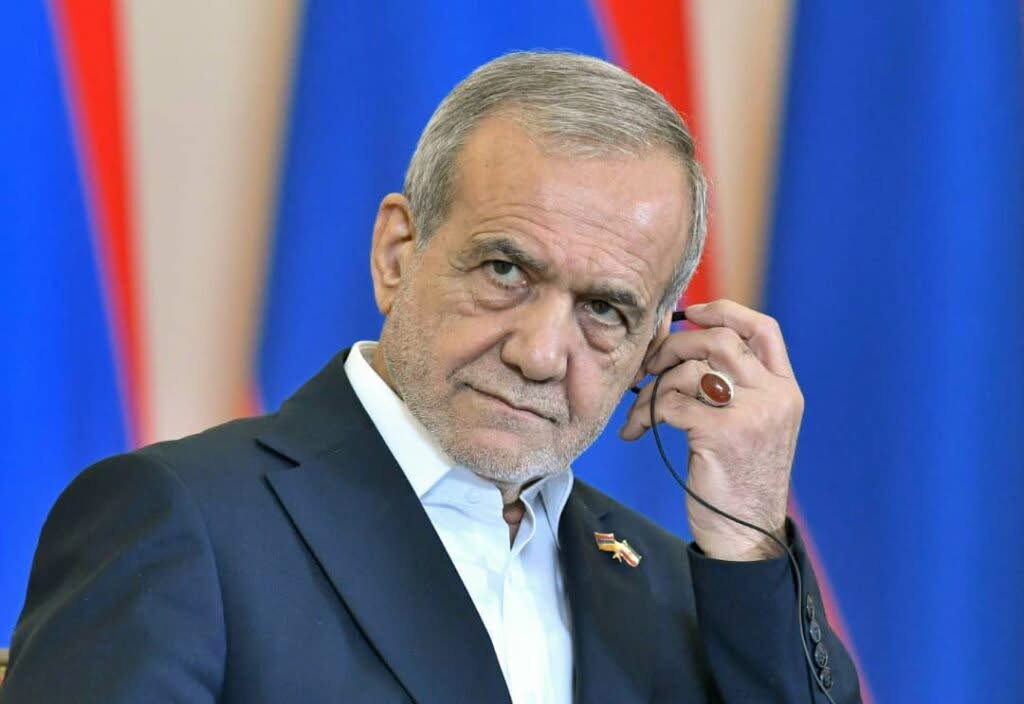
Iranian President Masoud Pezeshkian has said the United States must decide whether to bring the ongoing war with Iran to an end, while insisting that Tehran does not want the conflict to continue and remains open to resolving disputes through dialogue.
Pezeshkian made the remarks in an interview with Fox News aired on Thursday, September 24, as U.S. and Iranian representatives continued diplomatic contacts on the sidelines of the United Nations General Assembly in New York.
“When we can resolve issues through dialogue, we shouldn’t resort to killing one another,” Pezeshkian said, according to remarks translated by the broadcaster. He added that Iran did not wish to continue the conflict and said Washington would have to decide whether it wanted to end it.
The statement represents a renewed expression of Tehran’s willingness to pursue diplomacy, although major disagreements between the two sides remain unresolved.
Pezeshkian Calls for Dialogue
Pezeshkian’s comments came shortly after he addressed world leaders at the 81st United Nations General Assembly in New York, where he maintained a firm position against what Tehran regards as U.S. pressure.
The Iranian president said Iran would not surrender to Washington, while also leaving the door open to negotiations. The United Nations reported that Pezeshkian rejected restrictions on Iran’s peaceful nuclear activities, maintaining that Tehran does not seek nuclear weapons.
His latest comments to Fox News therefore combine two positions that Tehran has repeatedly sought to maintain: opposition to continued military confrontation and insistence that any diplomatic settlement must address Iran’s stated concerns.
Pezeshkian also blamed Israel for what he described as the circumstances that led to the war. That remains the Iranian government’s position and should not be treated as an independently established account of responsibility for the conflict.
Tehran Says It Is Ready for a Deal
Pezeshkian has also indicated that Iran remains willing to reach an agreement with U.S. President Donald Trump.
In the interview, he questioned why an earlier agreement had broken down and said Iran remained prepared to pursue an arrangement if Washington was willing to negotiate within international legal frameworks.
The comments come amid efforts by negotiators from the two countries to explore a possible path out of the conflict.
Reuters reported on September 24 that U.S. and Iranian negotiators in New York were examining a phased arrangement under which Iran could reopen the Strait of Hormuz while the United States would lift its economic blockade of Iranian ports.
The proposal highlights the strategic importance of the Strait of Hormuz, a major maritime route connecting the Persian Gulf with the Gulf of Oman and the wider global energy market.
Strait of Hormuz at Centre of Negotiations
The Strait of Hormuz has become one of the central issues in negotiations because of its importance to international shipping and energy supplies.
According to Reuters, Iranian and Western officials involved in or familiar with the negotiations said the two sides were discussing a phased arrangement. Under the reported proposal, Iran would allow navigation through the strait while Washington would ease or remove economic restrictions, with access to frozen Iranian assets also potentially forming part of the arrangement.
However, the negotiations remain difficult.
Neither side wants to surrender its leverage before obtaining commitments from the other, according to sources cited by Reuters. The dispute over sequencing — essentially who should make the first major concession — remains one of the obstacles to reaching an agreement.
Iran has previously signalled that it could reopen the waterway if Washington reduces military pressure and lifts its blockade.
Reuters reported on September 22 that a senior Iranian official said Tehran could reopen the strategically important waterway within a week if the United States eased military pressure and lifted the blockade on Iranian ports. Iran had also submitted a proposal for ending hostilities through intermediaries on September 16.
Trump Says Talks Are Continuing
The diplomatic contacts have taken place alongside continued public disagreement between Washington and Tehran.
U.S. President Donald Trump said on September 22 that talks with Iran were continuing and expressed the view that a settlement could eventually be reached. At the same time, Trump maintained that the United States would not allow Iran to obtain nuclear weapons.
The differing public positions illustrate the gap between the two governments.
While Tehran has emphasised the lifting of military and economic pressure and the reopening of key maritime routes, Washington has continued to focus on its security demands, including preventing Iran from acquiring nuclear weapons.
Iran has repeatedly denied seeking nuclear weapons and says its nuclear programme is intended for peaceful purposes.
Why the Strait Matters Beyond Iran and the US
The dispute over the Strait of Hormuz has consequences well beyond the two countries.
The waterway is a major route for international energy shipments, meaning prolonged disruption can affect oil markets, shipping costs and economies that depend on energy imports.
Reuters reported earlier this week that oil prices had fallen amid renewed hopes for U.S.-Iran diplomacy and signs of improving oil exports elsewhere in the region. The report highlighted the importance of developments around the Strait of Hormuz to global energy markets.
For countries in Africa, particularly those heavily exposed to global fuel prices, developments in the Middle East can have indirect economic consequences.
Higher global energy and transportation costs can contribute to increased prices for fuel, food and imported goods. Conversely, progress towards de-escalation could reduce some of the pressure created by disrupted energy and shipping routes.
The ultimate effect, however, will depend on whether diplomatic discussions produce a durable agreement rather than another temporary arrangement.
A Diplomatic Opening, but Major Differences Remain
The latest statements from Pezeshkian do not mean that a peace agreement has been reached.
Reuters reported that the United States and Iran remained far apart over how to end the conflict, even as officials continued to emphasise the need for diplomacy. Tehran has been pushing for the lifting of the U.S. naval blockade and the reopening of the Strait of Hormuz, while the two sides continue to disagree over the conditions for ending the war.
The situation therefore remains fluid.
Pezeshkian’s statement that Iran does not want to continue fighting could provide additional space for diplomatic efforts, but the outcome will depend on whether negotiators can bridge the substantial differences between the two governments.
The comments also come at a politically sensitive moment in the United States, with congressional midterm elections scheduled for November. Iranian officials have indicated that Tehran’s position on reaching an agreement does not depend on whether negotiations occur before or after the U.S. elections.
What Happens Next
The immediate focus is likely to remain on the diplomatic discussions taking place around the United Nations General Assembly and on whether the two governments can agree on a sequence for reducing military and economic pressure.
Key issues include the future of the Strait of Hormuz, the U.S. blockade, sanctions and frozen Iranian assets, Iran’s nuclear programme and broader security concerns.
For now, there is no confirmed comprehensive peace agreement.
Pezeshkian’s latest remarks show that Tehran is publicly presenting dialogue as an alternative to continued fighting, while Washington continues to weigh diplomatic engagement against its stated security objectives.
The next significant indicator will be whether the reported negotiations produce concrete commitments from both sides.
Until then, the conflict remains unresolved, and the possibility of a diplomatic settlement will depend on whether Washington and Tehran can translate their competing public positions into mutually acceptable terms.
Weng Global – Stories beyond borders
Sources
- Reuters — Reporting on U.S.-Iran negotiations, the Strait of Hormuz and possible phased arrangements.
- Agence France-Presse (AFP) — Report on President Masoud Pezeshkian’s Fox News interview and his comments about ending the war.
- Channel NewsAsia — Report on Pezeshkian’s Fox News interview and his diplomatic position.
- United Nations — Coverage of Pezeshkian’s position at the 81st General Assembly.
- Associated Press — Reporting on the U.S.-Iran conflict and Trump’s UN General Assembly remarks.