Reported by Weng Patrick Atokor l Journalist at Weng Global
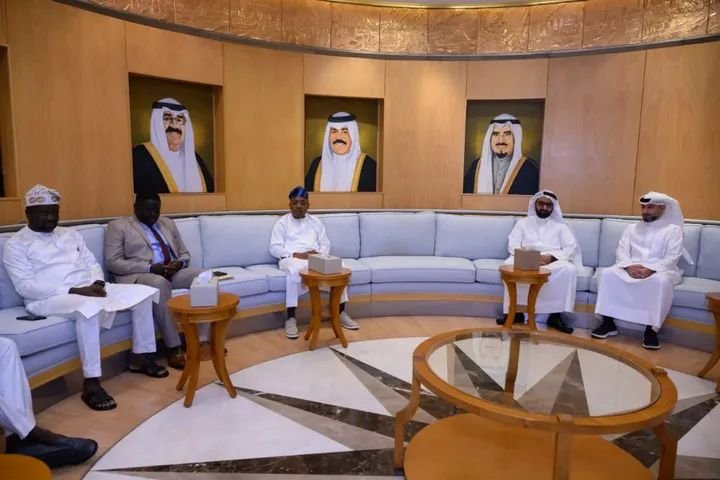
Kogi State Governor Ahmed Usman Ododo has led a high-level delegation to Kuwait as the state seeks development financing, technical expertise and strategic partnerships for projects under its 2024–2056 Development Plan.
The discussions have focused on areas including water infrastructure, irrigation, agriculture, renewable energy, solid minerals, industrial development, education and healthcare, according to information released by the Kogi State Government and reported by Nigerian media.
A major engagement during the visit was with the Kuwait Fund for Arab Economic Development (KFAED), where Ododo met the Fund’s Acting Director-General, Rashaid A. Al-Bader, and other senior officials.
The governor presented Kogi’s development priorities and sought a long-term partnership capable of supporting infrastructure and economic projects across the state.
Kogi Seeks Financing for Water, Agriculture and Energy
The proposed cooperation covers several sectors that the Kogi government considers important to its long-term development strategy.
These include water infrastructure, irrigation and agricultural transformation, power and renewable energy, solid minerals and mineral beneficiation, agro-industrial development, transport, communications and ICT, education and healthcare.
The state is also seeking technical support for project preparation, feasibility studies, engineering designs, institutional capacity development and environmental and social assessments.
According to the state government’s account of the discussions, KFAED expressed readiness in principle to work with Kogi on priority projects, subject to the required technical, financial and institutional appraisal processes.
This means the discussions should not yet be interpreted as confirmation that all proposed projects have received final financing approval. Specific projects would still need to undergo assessment and other requirements before financing and implementation.
Agriculture and Irrigation at the Centre of the Plan
Agriculture and water infrastructure are among the major areas being considered under the proposed partnership.
Kogi’s government has linked improved water infrastructure and irrigation to expanded agricultural production and the development of all-season farming.
The state also sees stronger energy infrastructure as important to agro-processing and industrialisation, while investment in mineral beneficiation could allow more processing of solid minerals within the state before they reach external markets.
The approach reflects an effort to connect infrastructure investment with broader economic activity rather than treating individual projects as isolated developments.
For example, irrigation infrastructure can support agricultural production, while reliable electricity can support processing and manufacturing activities associated with agriculture and other industries.
Talks Extend Beyond Development Financing
Ododo’s delegation also held discussions with Kuwait University on potential cooperation in education, research, innovation, engineering, agriculture, water-resource management and technology.
The governor met the university’s president, Professor Dina Musaed Al-Mailem, with the discussions exploring opportunities for knowledge exchange and capacity development involving tertiary institutions in Kogi.
The delegation also met Sheikh Humoud Jaber Al-Ahmad Al-Sabah, Governor of Kuwait’s Al Ahmadi Governorate.
Those discussions considered possible cooperation in areas including infrastructure, investment, industry and development experience, as well as the possibility of establishing a sister-government relationship.
Another engagement involved Kuwait’s Minister of Electricity, Water and Renewable Energy, Dr Subaih Abdulaziz Al-Mukhaizeem, with discussions reportedly covering water infrastructure, irrigation, renewable energy and power development.
From Diplomatic Discussions to Technical Work
One of the key developments from the Kuwait mission is the planned transition from high-level discussions to technical project preparation.
Technical teams are expected to work on project documentation, feasibility studies, technical assessments and other preparatory requirements.
This stage will be important in determining which proposals can progress from discussions to bankable projects and, ultimately, financing and implementation.
The distinction is significant because international development financing normally requires projects to meet technical, financial, institutional and environmental requirements before funding is committed.
For Kogi, the immediate challenge will therefore be translating the broad areas identified during the Kuwait engagements into clearly defined projects with feasibility documentation, financing structures and implementation plans.
What the Kuwait Engagement Could Mean for Kogi
If the discussions eventually result in financing agreements and project implementation, the proposed areas of cooperation could affect several parts of Kogi’s economy.
Investment in water and irrigation could support agricultural communities and food production. Energy projects could strengthen the infrastructure available to businesses and agro-processing activities, while investment in solid-mineral processing could support greater local value addition.
Education and research partnerships could also provide opportunities for technical knowledge transfer and institutional cooperation.
However, these potential outcomes depend on the completion of the required appraisal processes and the eventual approval and financing of specific projects.
At this stage, the available reports indicate that the Kuwait engagement has established a framework for further technical cooperation rather than confirming implementation of every project discussed.
Nigeria-Kuwait Cooperation
The Kogi mission also forms part of a broader effort by the state government to attract international development and investment partnerships.
The governor acknowledged the support of President Bola Ahmed Tinubu and the Nigerian Embassy in Kuwait during the engagement, according to reports on the visit.
For a Nigerian state seeking large-scale infrastructure financing, international development institutions can provide an additional channel for accessing technical expertise and potentially longer-term financing arrangements.
The terms, conditions and financial implications of any eventual agreement will nevertheless need to be examined once specific projects reach the financing stage.
What Happens Next?
The next phase is expected to centre on technical work between Kogi officials and their Kuwaiti counterparts.
That process is expected to include project documentation, feasibility studies, technical assessments and other preparatory activities required for further consideration.
The outcome of those assessments will determine which projects proceed and what form any eventual financing or partnership arrangements take.
For now, the Kuwait visit has expanded Kogi’s engagement with international development institutions and opened discussions covering water, agriculture, energy, solid minerals, education, healthcare and industrial development.
The significance of the mission will ultimately depend on whether those discussions translate into properly assessed projects, financing agreements and completed infrastructure capable of delivering measurable benefits to residents of Kogi State.
Weng Global – Stories beyond borders
Sources
- Kogi State Government statement on Governor Ahmed Usman Ododo’s Kuwait development partnership.
- Channels Television reporting on Ododo’s Kuwait mission and engagement with the Kuwait Fund for Arab Economic Development.
- The Source report on Kogi’s discussions with Kuwaiti development and technical institutions.
- The Bureau Journal report on the development-financing discussions and proposed technical process.