Reported by Simon Daniel Yusuph l Journalist at Weng Global
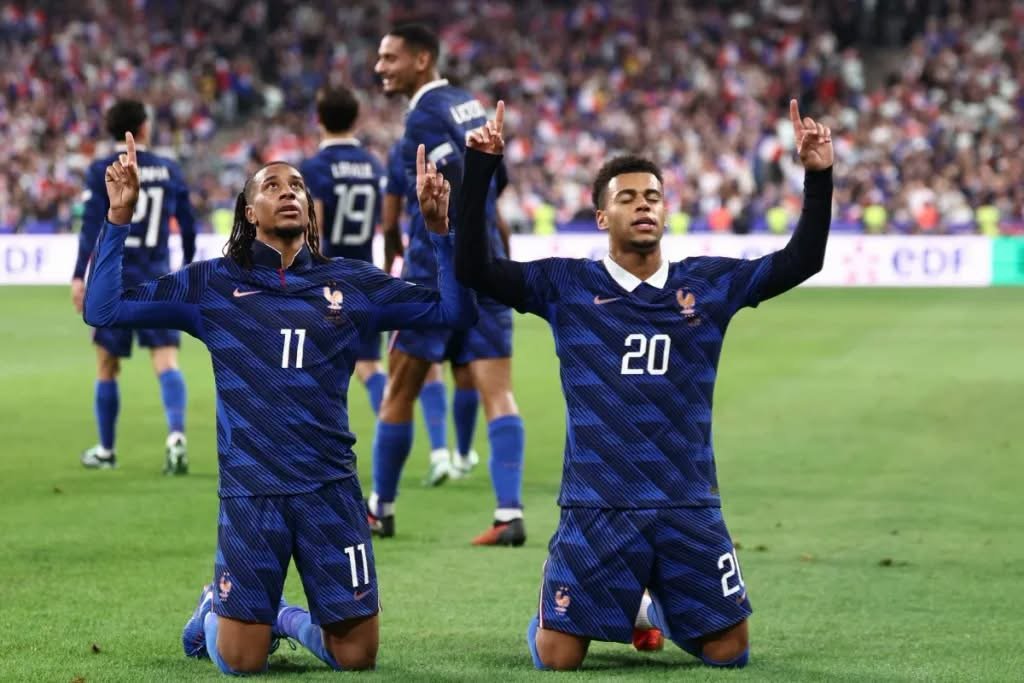
Michael Olise produced a decisive late performance as France overturned a first-half deficit to defeat Belgium 4-1 in the UEFA Nations League at the Stade de France on Monday, October 5, 2026.
The Bayern Munich forward came off the bench and transformed the contest, providing an assist for Rayan Cherki before scoring twice as France struck four times in the final 13 minutes to complete a remarkable comeback.
Belgium had looked on course for another difficult night for France after Dodi Lukebakio put the visitors ahead in the 35th minute. But France responded emphatically in the closing stages, with Désiré Doué, Cherki and Olise changing the direction of the match.
The victory keeps France at the top of UEFA Nations League Group A1 with 10 points from four matches, while Belgium remain third on six points, behind Italy on seven.
Belgium Take Advantage of Slow French Start
France entered the match looking to strengthen their position at the top of the group, while Belgium were seeking a response after their earlier defeat to the French side in Brussels.
The first half, however, belonged largely to the visitors in terms of the scoreline.
Belgium took the lead in the 35th minute when Lukebakio found the net, giving Mark van Bommel’s side a 1-0 advantage that they maintained into the interval.
The Belgian lead placed additional pressure on France and coach Zinedine Zidane, who was managing his first home match in charge of the national team.
France had already defeated Belgium 1-0 in Brussels on September 28, with Olise scoring the decisive goal after coming on as a substitute. UEFA records show that Olise’s late strike in that match was his eighth international goal for France.
His influence would become even greater in the return meeting in Paris.
Olise Changes the Game From the Bench
Zidane again turned to his substitutes when France needed a spark.
Olise was introduced during the second half and quickly became central to France’s attacking response.
The French side eventually found its equaliser through Désiré Doué in the 77th minute.
Cherki then put France ahead before Olise took complete control of the closing stages.
According to L’Équipe, Olise supplied the assist for Cherki before scoring twice himself. His first goal arrived in the 88th minute, while his second followed three minutes later to complete the 4-1 scoreline.
The sequence meant that Olise directly contributed to three of France’s four goals after entering the game as a substitute.
His performance underlined the attacking depth available to Zidane, particularly with several established players unavailable or not selected for the match.
Four Goals in the Final Stages
France’s comeback was remarkable for the speed with which it developed.
After spending much of the match behind, Les Bleus scored four times in the final 13 minutes.
Doué’s equaliser gave France renewed momentum, and Cherki then completed the turnaround before Olise added his two goals.
Reuters described the result as a remarkable comeback, with France recovering from Lukebakio’s first-half goal to win 4-1.
The result also demonstrated how quickly the balance of a match can change at international level.
Belgium had managed to protect their advantage for more than 40 minutes after going ahead. But once France found an equaliser, the visitors struggled to contain the home side’s attacking pressure.
For France, the late surge provided another example of the depth available to Zidane as he continues to establish his methods with the national team.
Zidane Secures First Home Win
The victory was also significant for Zidane, who was appointed France coach following the departure of Didier Deschamps.
The former France captain had already overseen wins in his opening matches, including the 1-0 victory over Belgium in Brussels.
However, the 4-1 victory at the Stade de France represented his first home win as France manager.
The manner of the result will add to the attention surrounding Zidane’s early tenure.
Rather than simply controlling the match from start to finish, France demonstrated its ability to recover from adversity and finish strongly.
The performance also highlighted the importance of squad depth, with substitutes playing a decisive role in the comeback.
Olise’s contribution was particularly notable because he had already produced the match-winning moment against Belgium in the previous meeting.
Olise’s Growing Importance to France
Olise’s latest performance further strengthens his position as an important attacking option for France.
The 24-year-old Bayern Munich player has increasingly become a significant figure for the national team, and his ability to influence matches from different attacking positions provides Zidane with another option.
His performance against Belgium was not simply about scoring two late goals.
He also created a goal for Cherki, meaning his introduction changed the attacking dynamic of the match.
L’Équipe reported that Olise’s first goal came after he combined with Doué before finishing across goalkeeper Maarten Vandevoordt. His second followed after Cherki and Doué combined to create another opening on the left side of the Belgian penalty area.
That combination of creativity and finishing made Olise the defining figure of France’s comeback.
Belgium’s Promising Start Fades Away
For Belgium, the result represented a significant disappointment.
The visitors had taken the lead and remained in front until the final stages, but they ultimately conceded four goals.
Belgium’s performance also has to be considered in the context of the team’s transition under new coach Mark van Bommel.
The Belgian squad includes experienced players such as Kevin De Bruyne, while younger players are also being integrated into the national team.
UEFA’s match information shows that De Bruyne and Youri Tielemans were among Belgium’s experienced midfield options, while players including Dodi Lukebakio and Mika Godts provided attacking threats.
Despite their defeat, Belgium remain in contention in Group A1 with six points.
The result therefore does not eliminate their hopes of progressing, but it increases the importance of their remaining group fixtures.
France Strengthen Position at Top of Group
The three points further strengthen France’s position in Group A1.
After four matches, France lead the group with 10 points.
Italy are second with seven points, Belgium are third with six, while Türkiye remain bottom without a point after four matches, according to the latest standings reported following Monday’s fixtures.
Italy also won on Monday, defeating Türkiye 3-1.
That result keeps the pressure on France at the top of the group and ensures that the remaining fixtures will continue to have significance for qualification and final group positioning.
France’s advantage, however, means the team enters the remaining stage of the group campaign from a strong position.
A Second Victory Over Belgium
The result was France’s second victory over Belgium in the same Nations League campaign.
The first came in Brussels on September 28, when Olise scored an 88th-minute winner after coming off the bench.
That match ended 1-0 and was decided by a spectacular individual effort from the Bayern Munich player. UEFA reported that Olise collected possession around the halfway line, advanced towards the Belgian penalty area and curled the ball into the bottom-left corner.
A week later, Belgium again struggled to contain him.
This time, however, Olise’s contribution went far beyond a single decisive goal.
His brace and assist helped France turn a 1-0 deficit into a 4-1 victory.
The two matches also underline how influential substitutes can be in high-level international football, particularly when opponents begin to tire in the closing stages.
Why the Result Matters
France’s victory matters beyond the three points because it reinforces the team’s position at the top of its Nations League group while giving Zidane another important result early in his tenure.
The comeback also provides evidence of France’s attacking depth.
Even when the starting XI was unable to break Belgium’s defensive structure consistently, the introduction of players from the bench eventually changed the match.
For Olise, the performance represents another important step in his development with the national team.
His consecutive decisive displays against Belgium — first with the winner in Brussels and then with two goals and an assist in Paris — have made him one of the most influential players in France’s current Nations League campaign.
The result also provides Zidane with further evidence that his squad contains players capable of changing matches late.
However, the comeback should not obscure the weaknesses France showed earlier in the game.
Conceding the opening goal and struggling to break Belgium down for long periods remain areas that the coaching staff will need to address as the competition progresses.
What Happens Next
France will continue their Nations League campaign in November when the group stage reaches its final round of fixtures.
The group-stage campaign is scheduled to conclude between November 12 and 17, with the knockout phase due to begin in March 2027.
France’s immediate objective will be to maintain their position at the top of Group A1 and secure the strongest possible route into the next phase.
Belgium, meanwhile, will need to recover from the heavy defeat and collect points from their remaining matches if they are to remain competitive in the group.
For Zidane, the coming fixtures will provide further opportunities to refine his squad and establish a playing identity.
For Olise, attention will turn to whether he can maintain the level of impact he has shown in recent international matches.
His back-to-back performances against Belgium have already made him a central part of the story surrounding France’s Nations League campaign.
The 4-1 scoreline ultimately tells only part of the story.
France were behind for most of the contest, but a dramatic late surge — driven in large part by a substitute who had already decided the previous meeting — transformed the match.
Olise’s two goals and assist ensured that France left the Stade de France with another victory, while Belgium were left to reflect on a match that slipped away in its final stages.
Weng Global – stories beyond borders
Sources
- UEFA
- Reuters
- L’Équipe
- The Guardian
- TF1