Reported by Weng Patrick Atokor | Journalist at Weng Global
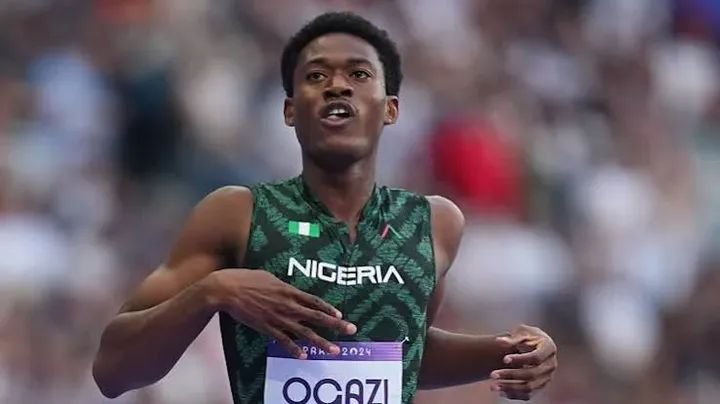
Nigerian 400m record holder Samuel Ogazi says his ambition goes beyond winning races, revealing that he wants to establish records and achievements that will remain difficult for future generations of athletes to surpass.
The 20-year-old sprinter has emerged as one of Nigeria’s biggest athletics prospects after a remarkable 2026 season that has seen him repeatedly rewrite the national record in the men’s 400 metres.
Ogazi’s rapid rise reached another level in June when he clocked 43.38 seconds at the 2026 NCAA Division I Outdoor Track and Field Championships in Eugene, Oregon, to win the men’s 400m title.
The performance was not only a new Nigerian national record but also a new US collegiate record, surpassing Michael Norman’s previous collegiate mark of 43.61 seconds set in 2018.
World Athletics lists Ogazi’s 43.38 seconds as his personal best and the Nigerian national record. The time also placed him fourth on the men’s 400m all-time list at the time of the performance, behind Wayde van Niekerk, Michael Johnson and Butch Reynolds.
For Ogazi, however, the numbers appear to represent only one part of a much bigger ambition.
𝗔𝗺𝗯𝗶𝘁𝗶𝗼𝗻 𝗯𝗲𝘆𝗼𝗻𝗱 𝗺𝗲𝗱𝗮𝗹𝘀
Ogazi has made it clear that he does not want his career to be remembered simply because he won races or collected medals.
His stated ambition is to leave behind a legacy strong enough to inspire future generations while creating records that will stand for many years.
“I want to leave records that will be hard to break,” Ogazi said, reflecting the mindset behind his rapid progression in the event.
That mentality is significant given the history of Nigeria’s 400m event.
Before Ogazi arrived at the top level, the Nigerian record belonged to Innocent Egbunike, one of the country’s greatest quarter-milers. Egbunike ran 44.17 seconds in Zurich in August 1987, establishing a mark that remained untouched for almost four decades.
Ogazi eventually broke that record in May 2026 when he ran 44.02 seconds at the Torrin Lawrence Memorial in Athens, Georgia.
The teenager’s performance immediately signalled that Nigeria had entered a new era in the men’s 400m.
But rather than being satisfied with replacing one historic record, Ogazi continued pushing the standard.
Two weeks later, he lowered the Nigerian record again, running 43.95 seconds to win the men’s 400m at the SEC Track and Field Championships.
That performance made him the first Nigerian to run below 44 seconds in the men’s 400m and established him as one of the fastest quarter-milers in collegiate athletics.
His progression would continue in Eugene.
𝗙𝗿𝗼𝗺 𝟰𝟰.𝟬𝟮 𝘁𝗼 𝟰𝟯.𝟯𝟴
One of the most remarkable aspects of Ogazi’s 2026 campaign has been the speed with which he has continued to improve.
In May, he moved from 44.02 seconds to 43.95 seconds.
A month later, he produced an even more extraordinary performance by running 43.38 seconds to defend his NCAA title.
According to World Athletics, the 43.38-second performance was the fastest 400m time in the world at that point in the season and improved Ogazi’s Nigerian record once again.
The NCAA also confirmed that Ogazi broke Michael Norman’s US collegiate record with the performance.
The achievement underlined just how far the Nigerian athlete has travelled in a relatively short period.
Ogazi was already an Olympic finalist at the Paris 2024 Games, but his 2026 season has transformed him from a promising young athlete into an established international 400m contender.
His latest performance has also changed expectations around what may be possible for Nigerian men’s quarter-milers in the years ahead.
𝗧𝗵𝗲 𝗷𝗼𝘂𝗿𝗻𝗲𝘆 𝘁𝗼 𝘁𝗵𝗲 𝘁𝗼𝗽
Ogazi’s breakthrough did not happen overnight.
The Nigerian athlete has steadily developed since emerging on the international scene, with his performances improving year after year.
His appearance in the 400m final at the Paris 2024 Olympics was already a historic achievement.
He became the first Nigerian man in more than three decades to reach an Olympic 400m final, following in the footsteps of Egbunike, who had previously represented Nigeria at the highest level.
Ogazi ran a personal best of 44.41 seconds in the Olympic semi-final in Paris to secure his place in the final.
That experience gave him exposure to the pressure and intensity of competing against the world’s best athletes.
Rather than allowing the occasion to overwhelm him, Ogazi used it as another step in his development.
Two years later, his performances suggest that the Olympic experience has contributed to his growth into a more confident and accomplished athlete.
𝗔 𝗿𝗲𝗰𝗼𝗿𝗱 𝗵𝗼𝗹𝗱𝗲𝗿 𝗯𝘂𝗶𝗹𝗱𝗶𝗻𝗴 𝗮 𝗹𝗲𝗴𝗮𝗰𝘆
Records in athletics are often viewed as temporary because every generation produces athletes capable of pushing established boundaries.
Ogazi knows this reality.
His own Nigerian record replaced one that had stood for nearly 40 years.
Egbunike’s reaction to the achievement was particularly significant because it demonstrated how one generation can pass the baton to another.
Following Ogazi’s first national record in May, Egbunike congratulated him and backed the young sprinter to achieve even greater milestones.
Egbunike also reminded Ogazi of the responsibility that comes with becoming the new face of Nigerian 400m athletics.
For Ogazi, that responsibility appears to extend beyond personal success.
He is now competing with the expectation that he can become one of the defining Nigerian athletes of his generation.
His desire to establish records that will be difficult to break reflects the ambition of an athlete who understands that sporting greatness is measured not only by what happens during a career but also by what remains after it.
𝗖𝗼𝗺𝗺𝗼𝗻𝘄𝗲𝗮𝗹𝘁𝗵 𝗚𝗮𝗺𝗲𝘀 𝗴𝗼𝗹𝗱 𝗮𝗱𝗱𝘀 𝘁𝗼 𝗯𝗿𝗲𝗮𝗸𝘁𝗵𝗿𝗼𝘂𝗴𝗵 𝘆𝗲𝗮𝗿
Ogazi’s outstanding season has also translated into major international success.
At the 2026 Commonwealth Games in Glasgow, Scotland, he won gold in the men’s 400m, further strengthening his position among the leading quarter-milers in the Commonwealth.
The victory added another major achievement to a season that has already included an NCAA title and multiple Nigerian records.
His Commonwealth success is particularly important because it gives Ogazi another major championship victory outside the collegiate system.
It also provides a strong indication of his ability to perform when representing Nigeria on the international stage.
With the NCAA and Commonwealth titles now added to his growing list of achievements, the next phase of his career will be about competing consistently against the world’s best senior athletes.
𝗡𝗶𝗴𝗲𝗿𝗶𝗮’𝘀 𝗻𝗲𝘄 𝟰𝟬𝟬𝗺 𝘀𝘁𝗮𝗻𝗱𝗮𝗿𝗱
Ogazi’s rise has fundamentally changed the Nigerian 400m record.
Egbunike’s 44.17 seconds stood for approximately 39 years before Ogazi lowered it to 44.02 seconds.
Within weeks, that record was reduced to 43.95 seconds and eventually to 43.38 seconds.
The progression demonstrates how quickly the standard has shifted.
It also raises an intriguing question: how fast can Ogazi eventually run?
At 20 years old, he still has considerable room for development.
His 43.38-second national record already places him among the fastest quarter-milers in history, but his stated ambition suggests he is not planning to stop there.
For Nigerian athletics supporters, the possibility of further improvement represents an exciting prospect.
The country has produced some outstanding 400m athletes over the decades, including Egbunike and Sunday Bada, but Ogazi now has an opportunity to establish a new chapter in that history.
𝗧𝗵𝗲 𝗯𝗶𝗴𝗴𝗲𝗿 𝗽𝗶𝗰𝘁𝘂𝗿𝗲
Beyond the stopwatch, Ogazi’s story represents what can happen when talent, development, opportunity and ambition come together.
His rise has provided Nigerian athletics with a new source of optimism in an event that has historically produced some of the country’s greatest track stars.
The fact that he has already broken a record that survived for almost four decades makes his current achievement even more significant.
But the young sprinter appears determined not to become another athlete remembered for one spectacular season.
Instead, he wants longevity.
He wants championships.
He wants records.
And, most importantly, he wants his name to remain relevant long after he has stopped competing.
That is the essence of his statement that he wants to leave records that will be hard to break.
For Ogazi, the record book is not simply a place to be listed.
It is a legacy waiting to be written.
And after a 2026 season that has seen him move from 44.02 seconds to 43.95 seconds and finally to 43.38 seconds, Nigeria’s newest 400m star has already given the athletics world reason to believe that his biggest achievements may still be ahead of him.
Sources
- World Athletics – Samuel Ogazi athlete profile and performances.
- World Athletics – Report on Ogazi’s 43.38m NCAA championship performance.
- NCAA – Ogazi breaks the collegiate 400m record at the 2026 NCAA Championships.
- University of Alabama Athletics – Ogazi’s 44.02-second Nigerian record.
- The Guardian Nigeria – Ogazi’s national-record progression and 43.95-second performance.
- PUNCH – Innocent Egbunike’s reaction to Ogazi breaking his long-standing record.
- The Guardian – Ogazi’s record-breaking rise in Nigerian athletics.