Reported by Simon Daniel Yusuph l Journalist at Weng Global
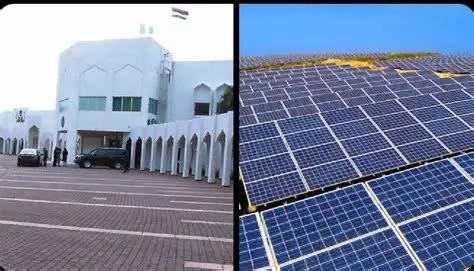
An All Progressives Congress (APC) spokesperson has defended the Federal Government’s ₦10 billion solar power project at the Aso Rock Presidential Villa, arguing that moving the presidential complex away from dependence on Nigeria’s national electricity grid could help make more electricity available to other consumers.
The project, designed to provide an alternative power supply for the seat of Nigeria’s presidency in Abuja, has generated debate over government spending, renewable energy adoption and the persistent electricity challenges facing households and businesses across the country.
Supporters of the initiative argue that solar power could improve electricity reliability at the Presidential Villa, reduce dependence on conventional power sources and potentially ease pressure on the national grid.
However, the project’s implications for electricity availability nationwide depend on several factors, including how much electricity the Villa currently draws from the grid, the capacity of the solar installation and whether the power released can be effectively redistributed to other consumers.
The specific APC spokesperson’s name and the original statement behind the latest defence could not be independently verified for this report. Weng Global therefore treats the claim that the project will free up electricity for Nigerians as the spokesperson’s reported position rather than an independently established outcome.
Why the Federal Government Approved the Aso Villa Solar Project
The Federal Government allocated ₦10 billion to the solar mini-grid project in the 2025 budget, according to previous reporting by The Guardian and other Nigerian media organisations.
The project, identified in budget documents as the solarisation of the Villa with a solar mini-grid, was intended to provide a more reliable electricity supply for the Presidential Villa, which houses the president’s residence and important administrative facilities.
The initiative emerged against the background of persistent electricity supply problems in Nigeria, where households, businesses and public institutions have increasingly turned to alternative energy sources to manage unreliable grid electricity.
The Presidential Villa is among the country’s most important government facilities. A dependable power supply is necessary for administrative operations, security systems, communications and other essential services.
Nevertheless, the decision to install a dedicated solar system attracted criticism because of the project’s reported cost and the wider electricity difficulties confronting Nigerians.
Critics questioned why the Federal Government would commit billions of naira to securing electricity for the presidential complex while many citizens continue to experience power interruptions, rising electricity costs and expensive generator dependence.
The debate has since extended beyond the choice of solar energy to questions about public spending priorities, the effectiveness of electricity sector reforms and the government’s responsibility to improve access to reliable power.
How Solar Energy Could Reduce Pressure on the National Grid
Nigeria’s national electricity grid connects electricity generated by power plants to transmission and distribution networks that deliver power to homes, businesses and public institutions.
When a large electricity consumer switches to an independent power source, the amount of electricity it draws from the national grid can decline.
If the Aso Villa solar installation supplies a substantial share of the Presidential Villa’s electricity demand, the facility could require less electricity from the grid than it previously did.
In principle, this could leave more electricity available within the wider power system, depending on generation levels, network conditions and how electricity allocations are managed.
The potential benefit is particularly relevant in a country where available electricity generation frequently falls short of demand.
However, reducing one facility’s demand for grid electricity does not automatically guarantee that households and businesses will receive more power.
The national electricity system must still have sufficient generation, transmission capacity and distribution infrastructure to deliver electricity to consumers.
Electricity previously allocated to one customer can only benefit other consumers if the system can accommodate the change and deliver the available supply where it is needed.
Consequently, the APC spokesperson’s reported argument is technically plausible as a potential benefit, but the scale of any improvement for ordinary Nigerians would require supporting electricity consumption and operational data.
The solar project should therefore be assessed not only by its ability to supply the Presidential Villa but also by its actual effect on electricity costs, grid consumption and the efficient use of public funds.
The ₦10 Billion Cost and Questions About Public Spending
The financial implications of the Aso Villa solar project remain central to the debate.
The ₦10 billion allocation in the 2025 budget attracted public attention because it was earmarked for a single government complex at a time when electricity supply remained a major concern for the wider population.
In January 2026, The Punch reported that the Federal Government had earmarked a further ₦7 billion for the Villa’s solarisation project in the 2026 budget proposal.
That additional allocation raised the importance of distinguishing between the original project cost, subsequent funding provisions and the total amount ultimately spent.
Budget allocations do not, by themselves, establish the amount of money actually disbursed or the final cost of a completed project.
A comprehensive assessment would require details of the project’s approved scope, procurement arrangements, contracts, payments, installed capacity and operational performance.
These details would help Nigerians determine whether the project delivers value for money and whether its financial benefits justify the expenditure.
The government has also faced questions about the cost of supplying electricity to the Presidential Villa.
In earlier reporting, the Director-General of the Energy Commission of Nigeria, Mustapha Abdullahi, defended the solar project by referring to the reported cost of maintaining the Villa’s electricity supply.
The Guardian reported in June 2026 that the authorities had cited an annual energy bill of approximately ₦47 billion as a reason for moving towards an independent solar power system.
That figure has been presented as part of the government’s justification for the transition. However, a proper financial assessment would need to establish precisely what the reported bill covered and how much of that expenditure the solar installation could realistically eliminate.
A solar system may reduce expenditure on grid electricity and fuel for generators, but it also involves installation, maintenance, battery replacement and other operational costs.
The project’s long-term economic value will therefore depend on the total cost of ownership, the electricity it generates and the savings achieved over its useful life.
Solar Project Raises Questions About Nigeria’s Electricity Crisis
The controversy surrounding the Presidential Villa’s solar installation reflects a broader challenge confronting Nigeria’s electricity sector.
For years, unreliable power supply has affected manufacturing, retail businesses, hospitals, schools and households.
Businesses that cannot depend on the national grid often invest in generators, solar panels, batteries and other backup systems to maintain operations.
These arrangements increase operating expenses and can make goods and services more expensive.
Small businesses are particularly vulnerable because many lack the financial resources to install large alternative power systems.
Households also face difficult choices between paying electricity bills, purchasing fuel and investing in solar equipment.
Against this background, the Federal Government’s decision to provide the Presidential Villa with an independent electricity system has become a subject of public scrutiny.
For supporters, the project demonstrates the practical value of diversifying electricity sources and reducing dependence on an unreliable grid.
For critics, it raises questions about why a government facility can receive a dedicated solution while millions of Nigerians continue to struggle with inadequate electricity supply.
Both concerns deserve consideration.
Reliable electricity at critical government facilities is important, but the project does not replace the need for broader investment in generation, transmission, distribution and electricity access.
The government’s wider responsibility remains ensuring that electricity reforms translate into measurable improvements for citizens and businesses.
Can the Project Deliver More Electricity to Nigerians?
The claim that the Aso Villa solar project will free up electricity for Nigerians requires careful examination.
Solar installations generate electricity from sunlight, reducing the need to obtain the same amount of power from conventional sources.
If the Presidential Villa’s system meets most of its electricity demand, the facility could reduce its grid consumption, particularly during periods when the solar installation and its battery storage can provide sufficient power.
However, the amount of electricity potentially freed up would depend on the Villa’s previous consumption, the solar installation’s generating capacity, storage availability and the facility’s actual operating requirements.
It would also depend on whether the electricity system can redirect or use the resulting difference in demand effectively.
No independently verified figures were available for this report establishing the amount of grid electricity the project has displaced or quantifying additional electricity delivered to other consumers as a direct result.
It would therefore be premature to conclude that the installation has already improved electricity supply to households or businesses nationwide.
To establish the project’s wider benefits, the relevant authorities would need to provide information on its installed capacity, electricity generated, grid consumption before and after commissioning, operating costs and realised savings.
Such information would allow the public to distinguish between the project’s intended benefits and its measurable results.
It would also provide a stronger basis for evaluating whether similar renewable energy installations could deliver cost-effective improvements at other public institutions.
Renewable Energy Offers Opportunities Beyond the Presidential Villa
Nigeria’s solar energy potential creates opportunities for addressing electricity challenges beyond the country’s most prominent government facilities.
Solar mini-grids and standalone systems can provide electricity to locations where extending conventional grid infrastructure is difficult or expensive.
They can also support businesses, schools, health facilities and public institutions seeking more reliable electricity.
When properly designed and maintained, these systems can reduce dependence on diesel generators and help lower exposure to fuel price fluctuations.
Nevertheless, the initial cost of installation remains a barrier for many households and small businesses.
Access to affordable financing, reliable equipment, technical expertise and after-sales support will be important if more Nigerians are to benefit from solar technology.
Government policies that encourage private investment and expand access to renewable energy could help address some of these challenges.
However, the Aso Villa project alone cannot resolve Nigeria’s electricity deficit.
A sustainable solution will require coordinated investment across the power sector, including improvements to existing infrastructure and measures to increase the quantity and reliability of electricity available to consumers.
The government’s ability to demonstrate measurable results from its own energy projects could also influence public confidence in renewable energy investments.
What Nigerians Should Watch Next
The next important development is evidence of the project’s operational performance and its contribution to reducing electricity expenditure.
The State House and relevant energy authorities can help clarify the project’s results by publishing information on its capacity, commissioning status, electricity output and financial performance.
A comparison of the Presidential Villa’s grid consumption before and after the transition would help establish whether the solar system has reduced its demand for electricity from the national network.
Details of the project’s total expenditure and long-term maintenance costs would also help the public assess whether the investment represents value for money.
For the APC, the reported defence of the project places emphasis on the potential public benefit of reducing the Villa’s dependence on grid electricity.
That argument would be stronger if supported by verifiable figures showing how the project has improved energy efficiency and whether any resulting reduction in grid demand has benefited other consumers.
For Nigerians, the central question is not simply whether solar energy is useful. It is whether public investment in renewable energy delivers measurable benefits and forms part of a wider strategy to improve electricity access.
The project could demonstrate the advantages of alternative energy systems, but its success should be judged by evidence rather than political claims alone.
Until the relevant data become available, the suggestion that the installation will free up electricity for Nigerians should be understood as a projected benefit, not a confirmed nationwide improvement.
Weng Global – stories beyond borders
Sources
- The Guardian — Reporting on the ₦10 billion Aso Rock solar mini-grid project, published July 19, 2025.
- The Punch — Reporting on the additional ₦7 billion allocation for the Presidential Villa’s solar project, published January 29, 2026.
- The Guardian — Reporting on the planned transition of the Presidential Villa away from the national grid, published June 13, 2026.
- The specific APC spokesperson’s statement — The name of the spokesperson and the original statement could not be independently verified for this report.