Reported by Simon Daniel Yusuph l Journalist at Weng Global
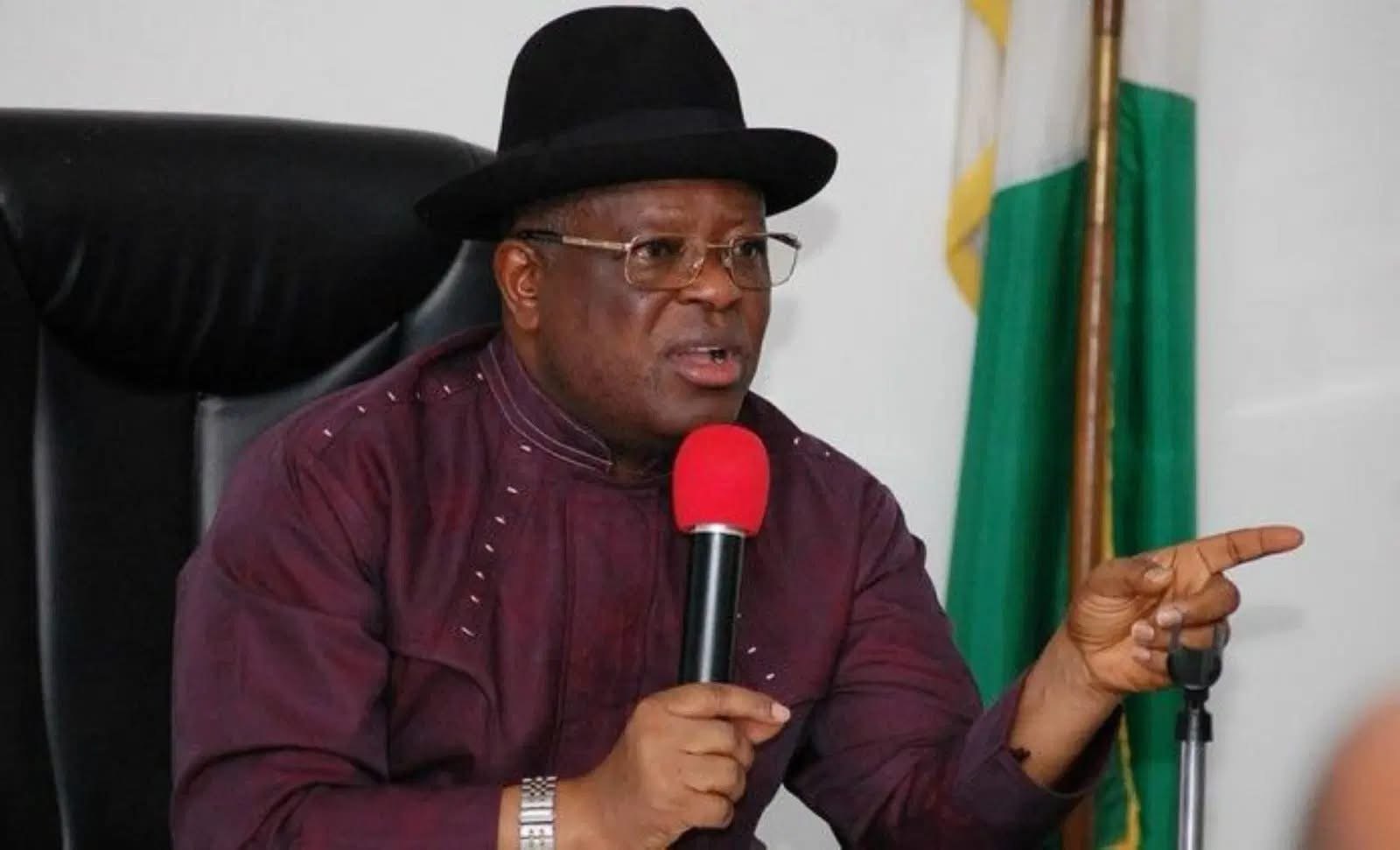
Minister of Works, David Umahi, has listed major federal road and bridge projects he said have been completed or are ready for commissioning under President Bola Ahmed Tinubu’s administration, as the Federal Government prepares to begin construction work on the Bida-Lapai-Lambata road in Niger State.
Umahi made the disclosure while briefing journalists on the progress of major federal road projects across Nigeria on Wednesday, October 8, 2026. He also warned contractors handling federal projects that the government would intensify monitoring and could involve anti-corruption agencies where public funds had been released without corresponding project delivery.
The projects listed by the minister span several regions, including the Kano-Maiduguri corridor, Nasarawa, Benue-linked routes, Rivers State, Enugu, Jigawa, Bauchi, Lagos and Ogun.
The announcement comes as the Ministry of Works continues to defend the Tinubu administration’s infrastructure programme while also confronting longstanding challenges involving inherited contracts, delayed construction, funding constraints and contractor performance.
Umahi lists completed and advanced projects
According to Umahi, the projects completed or sufficiently advanced for commissioning include sections of the 70-kilometre Kano-Maiduguri Road, including portions around Hadejia.
He also listed the 43-kilometre Keffi-Mararaba Road, which is being handled by China Harbour, and the 15-kilometre Lafia Bypass.
Another project mentioned was the 7.9-kilometre Bonny Island Road in Rivers State.
The minister also cited the Obajana Junction concrete pavement on the Lokoja-Benin corridor, the Danbatta-Demesu Road, rehabilitation work on the Gombe-Bauchi Road and the Azare axis connecting Jigawa and Bauchi.
Several bridge and urban infrastructure projects were included in the list. These are the Apapa five-span bridge, the Eke-Obinagu 23-span flyover in Enugu and the 75-metre Tizm Bridge, also in Enugu.
In the South-West, Umahi listed the 24-kilometre Sagamu Interchange-Iperu Junction Road in Ogun State among the projects that had reached completion or were ready for commissioning.
The list provides a snapshot of the Federal Government’s claimed infrastructure delivery across different parts of the country, although individual projects differ in scope, status and the extent to which they were inherited, rehabilitated or newly executed.
Bida-Lapai-Lambata construction set for next phase
Umahi also announced that construction of the Bida-Lapai-Lambata road would be flagged off the following week.
The development is significant because the corridor has faced prolonged construction difficulties and has remained a major concern for road users in Niger State.
The Federal Ministry of Works had only recently intensified intervention on the inherited Bida-Lapai-Lambata corridor, describing it as an important economic route connecting communities and supporting the movement of agricultural produce, goods and people.
During a September inspection, Minister of State for Works Bello Muhammad Goronyo directed contractors to accelerate remedial, palliative and permanent works on the corridor. The ministry described the approximately 123.4-kilometre Bida-Lapai-Lambata project as an inherited project being implemented under a Presidential/NNPC Tax Credit financing arrangement.
The planned construction announcement therefore represents a further step in the Federal Government’s effort to address the road’s longstanding deterioration.
The corridor has also attracted pressure from residents and stakeholders in Niger State, who have repeatedly called for urgent intervention because of the road’s importance to commerce, transportation and local communities.
In August, Umahi assured Niger South stakeholders that work would resume on the delayed project after representatives of the area appealed for federal action.
Government steps up monitoring of contractors
The announcement of completed projects was accompanied by a tougher message to contractors handling federal infrastructure projects.
Umahi has warned contractors who receive federal funds but fail to execute their contractual obligations that they could face investigations and efforts to recover public money.
The minister said the Ministry of Works had strengthened its project monitoring system and was involving the Economic and Financial Crimes Commission, the Independent Corrupt Practices and Other Related Offences Commission, civil society organisations and student groups in monitoring activities.
He said the government planned aggressive site visits and supervision.
The minister’s position reflects an increasing emphasis by the Works Ministry on monitoring projects after contracts have been awarded and funds released.
Umahi has also criticised contractors who, according to him, devote greater attention to state government projects than to federal contracts despite receiving federal funds.
He warned that contractors could not rely on political connections or influential individuals to avoid their contractual responsibilities.
The government, he said, would either require contractors to complete projects for which they had been paid or pursue recovery of funds where contractual obligations were not met.
The approach places greater emphasis on accountability as the Federal Government attempts to demonstrate that large infrastructure allocations are translating into usable roads and bridges.
A broader infrastructure programme
The projects listed by Umahi form part of a much larger road and bridge programme being implemented across Nigeria.
The Tinubu administration inherited thousands of ongoing federal projects, many of which have required contract reviews, additional funding, redesigns or changes in construction methods.
The Federal Ministry of Works has increasingly promoted concrete pavement as part of its strategy for improving the durability of major roads.
In March, Umahi said road projects under the administration were being designed with longer-term durability in mind and argued that concrete construction could help reduce recurring maintenance problems.
The ministry has also continued to supervise major legacy projects inherited from previous administrations.
One example is the Lagos-Ibadan Expressway corridor. In January, Umahi inspected the Sagamu Interchange-Iperu Junction section and directed the contractor to complete outstanding works, including drainage and protective measures around the rigid pavement.
The 24-kilometre Sagamu Interchange-Iperu Junction section now appears among the projects Umahi has identified as completed or ready for commissioning.
This illustrates the administration’s approach of combining new projects with the rehabilitation and completion of older projects that had experienced delays.
Infrastructure investment in the South-East
Umahi’s latest remarks also come amid a continuing debate over federal infrastructure investment in the South-East.
The minister has repeatedly argued that the region is receiving a greater volume of federal infrastructure intervention under Tinubu than it did under previous administrations.
Among the major projects associated with the administration is the Calabar-Ebonyi-Benue-Kogi-Nasarawa-Abuja Trans-Sahara Superhighway.
During a June inspection tour in Ebonyi State, Umahi said the project was more than 28 per cent complete at the time and that concrete technology was being used to improve durability. The project is designed to improve connectivity across several states and eventually link the South-East, South-South and North-Central regions with the Federal Capital Territory.
The inspection also included the 1.3-kilometre Ndi-Egbe Bridge in Ebonyi State, which links the state with Cross River and was then expected to be completed by December 2026.
These projects are part of the Federal Government’s broader argument that infrastructure development should not be concentrated in one region but should connect major economic corridors across the country.
Federal Government has also announced major new projects
Beyond the projects Umahi says have been completed, the Federal Government has continued approving additional large-scale road and bridge investments.
In May, the Federal Executive Council approved contracts worth more than N7 trillion for major road and bridge projects across Nigeria, including an extension of the Lagos-Calabar Coastal Highway, reconstruction of Carter Bridge in Lagos and a new section of the Sokoto-Badagry Expressway.
The government has also approved further interventions on major corridors, including additional work on the East-West Road.
In July, Umahi announced presidential approval for another 400 kilometres of dualised East-West Road, the reconstruction of the Lagos-Ibadan Expressway using reinforced concrete pavement, completion of the abandoned Ibi Bridge in Taraba State and construction of the 5.76-kilometre Lao Bridge.
These announcements show that the administration’s infrastructure agenda involves both completing inherited projects and introducing new road and bridge schemes.
The challenge of measuring completion
While the list presented by Umahi highlights significant federal infrastructure activity, the status of individual projects remains important when assessing delivery.
A project described as completed, for example, may involve a particular section or phase of a larger corridor rather than the entire route.
The Ministry of Works itself has continued to distinguish between completed projects, projects nearing completion, ongoing projects and inherited projects requiring remedial intervention.
That distinction is particularly relevant in a country where long road corridors can stretch across multiple states and involve several contractors.
For road users, the practical test is whether completed sections are open, safe, durable and capable of supporting the movement of people and goods.
For the government, the challenge is to ensure that projects announced as completed remain properly maintained and are not quickly damaged by poor drainage, overloading, flooding or other factors.
Umahi has previously warned against the misuse of newly completed roads, including the indiscriminate parking of fuel tankers and other heavy-duty vehicles on road surfaces.
Why the projects matter
Nigeria’s road network is central to the country’s economy.
Roads connect farmers with markets, manufacturers with suppliers, workers with urban centres and communities with hospitals, schools and other essential services.
Poor roads can increase transportation costs, extend travel times, damage vehicles and make the movement of agricultural produce more difficult.
For businesses, reliable transport corridors can reduce logistics costs and improve access to regional markets.
For communities, functional bridges can make the difference between year-round access and isolation during periods of flooding or other disruptions.
The significance of the projects therefore extends beyond the construction sector.
The Kano-Maiduguri corridor, for example, is strategically important to northern commerce and movement, while routes connecting the South-East and South-South to other parts of Nigeria can support wider regional trade.
Similarly, projects around Lagos and Ogun are important because of the concentration of manufacturing, ports, commercial activity and population along the South-West corridor.
Accountability remains central
The government’s increased emphasis on monitoring reflects a broader question surrounding public infrastructure spending: whether the money committed to projects produces infrastructure that Nigerians can actually use.
The involvement of the EFCC, ICPC, civil society groups and student monitors, as described by Umahi, is intended to increase scrutiny of project implementation.
The ministry’s position is that contractors who receive public money must meet their contractual obligations.
However, effective oversight will require more than site inspections. It will also depend on transparent procurement, accurate project reporting, realistic contract pricing, timely funding, quality control and enforcement of contractual terms.
The ultimate measure will be whether roads and bridges remain functional after commissioning and whether projects deliver the economic and social benefits used to justify their construction.
What happens next
The immediate next step is the planned flag-off of construction on the Bida-Lapai-Lambata road.
The Federal Government is also expected to continue commissioning completed projects while maintaining inspections of ongoing and inherited contracts.
The Ministry of Works has indicated that monitoring will become more aggressive, particularly for projects where contractors have received funds but have failed to meet agreed obligations.
Meanwhile, major infrastructure schemes such as the Lagos-Calabar Coastal Highway, the Trans-Sahara Superhighway and other national road corridors remain at different stages of construction.
For Nigerians, attention will increasingly shift from announcements and contract awards to actual completion, opening of roads and bridges, quality of construction and long-term maintenance.
The list provided by Umahi represents the Federal Government’s account of progress under Tinubu. Continued independent monitoring of project status, costs, completion dates and public use will remain important in assessing the administration’s infrastructure record.
Weng Global – stories beyond borders
sources
- Federal Ministry of Works
- State House, Abuja
- Peoples Daily Newspaper
- Punch
- Vanguard
- The Guardian Nigeria
- Nigeria Info