Reported by Simon Daniel Yusuph l Journalist at Weng Global
Nigeria international striker Taiwo Awoniyi has revealed that a promise he made to his father is the reason he has continued pursuing education while building a professional football career.
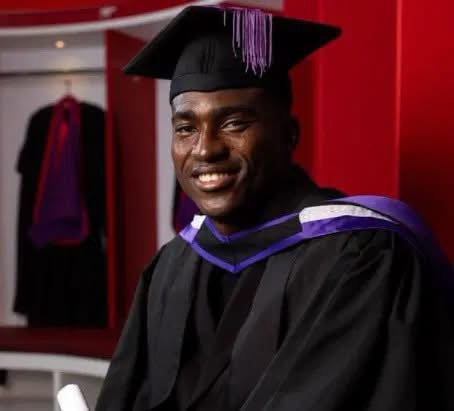
The Coventry City forward made the disclosure after completing his latest qualification at the Professional Footballers’ Association (PFA) Business School, adding another academic achievement to a career that has taken him from youth football in Nigeria to the highest levels of European football.
Awoniyi, 29, graduated from the PFA Business School in 2026 with a Postgraduate Diploma in Global Football Sport Directorship with Merit. He told BBC Sport that the qualification was his third, following a degree in business management and another diploma.
The striker said his commitment to education was rooted in his relationship with his father, Solomon, who placed considerable importance on schooling while Awoniyi was developing as a footballer.
A promise that stayed with Awoniyi
Awoniyi described himself as a “quiet dreamer” and said his decision to continue studying was linked directly to a promise he made to his father.
He explained that education remained important to him even after football began to develop into a professional career.
According to his BBC Sport interview, Awoniyi said he had promised his father that if he pursued football, he would continue studying alongside the sport. He said he had kept that commitment and was proud of what he had achieved.
That decision has now produced three academic qualifications while he has simultaneously developed a professional football career.
His latest achievement came through the PFA Business School, an educational arm of the Professional Footballers’ Association designed to help current and former professional players develop skills for careers both within and beyond football.
Awoniyi’s story therefore extends beyond a footballer obtaining another certificate. It reflects an approach in which education is treated as part of a professional career rather than something that must wait until playing days are over.
His latest qualification focuses on football leadership
Awoniyi’s latest qualification is closely connected to the industry in which he has spent his adult life.
The Postgraduate Diploma in Global Football Sport Directorship is aimed at developing knowledge and skills relevant to football leadership and administration.
The PFA Business School offers programmes designed to help players understand areas of the football industry beyond their roles on the pitch. Its programmes cover subjects including club management, football business, leadership, finance, recruitment, scouting, governance and career transition.
For an active professional footballer such as Awoniyi, such education can provide knowledge that may become relevant after retirement from playing.
It also gives players an opportunity to understand the business and administrative structures surrounding the sport in which they already work.
Awoniyi has not announced that he is retiring from football or taking up a specific administrative position. His qualification should therefore be understood as additional professional development rather than evidence of an immediate career change.
Three qualifications while playing professionally
Awoniyi said the latest qualification was his third academic achievement.
His educational journey has developed alongside a football career that has included spells in England and Germany before his move to Coventry City.
His ability to continue studying while maintaining the demands of professional football is particularly notable because the football calendar involves training, matches, travel, recovery and other club responsibilities.
Yet Awoniyi argues that professional players can create time for education if they are sufficiently committed.
He told BBC Sport that professional football does not operate like a conventional nine-to-five job and that players can sometimes finish their football responsibilities early enough to devote evenings to education. He acknowledged that the workload is demanding but said the decision ultimately depends on how willing an individual is to pursue it.
His comments challenge the idea that professional footballers have little opportunity to develop interests outside the sport.
Awoniyi says football is not everything
One of the central messages from Awoniyi’s reflections is that football should not define every aspect of a player’s identity.
The Nigerian international said there are many things bigger than football and emphasised that footballers remain ordinary human beings despite the attention surrounding their careers.
That perspective is particularly relevant in professional football, where players can become defined almost entirely by performances, transfers, injuries, contracts and results.
Awoniyi’s decision to study provides another dimension to his professional identity.
Education can give players an alternative area of personal development and potentially help them prepare for the period after their playing careers.
For younger footballers, his experience also demonstrates that pursuing a sporting career does not necessarily require abandoning formal education.
A career shaped by perseverance
Awoniyi’s football journey has already involved significant changes and challenges.
Born in Ilorin, Nigeria, he developed through the Imperial Soccer Academy before joining Liverpool. His early career included several loan spells before he established himself in German football with Union Berlin.
He subsequently returned to England and made his Premier League impact with Nottingham Forest before moving to Coventry City during the 2026 summer transfer window. Current reports identify him as a Coventry City striker.
His football career has also included a serious health setback.
In May 2025, while playing for Nottingham Forest against Leicester City, Awoniyi suffered a severe abdominal injury after colliding with a goalpost. He underwent surgery and was placed in a medically induced coma during his treatment.
The experience formed part of the wider context behind his reflections on life beyond football.
For Awoniyi, the ups and downs of a football career have reinforced the importance of developing himself in areas outside the pitch.
Education as preparation for life after football
Professional football careers are relatively short compared with many other professions.
A player can spend years preparing physically and technically for elite competition, but retirement can arrive suddenly because of age, injury, loss of form or other circumstances.
That makes preparation for life beyond playing an important issue within professional football.
The PFA Business School specifically seeks to address that challenge.
The PFA describes its business school as an educational project designed to help members develop new skills, explore career options, improve employability and increase financial stability. Its programmes include executive master’s programmes, postgraduate qualifications, diplomas and professional workshops.
The organisation’s career-transition programme also covers areas such as club management, broadcasting, scouting, football finance, entrepreneurship, personal branding and the transition from player to professional.
Awoniyi’s latest qualification fits into that broader effort to encourage footballers to prepare for the next stage of their professional lives.
Why sport-directorship studies matter
Football clubs are increasingly complex organisations involving recruitment, finance, commercial operations, data, governance, media, scouting and sporting strategy.
A sporting director can be involved in important decisions concerning recruitment, squad planning, football philosophy and the relationship between sporting and executive departments.
The PFA Business School’s football-business programmes emphasise areas such as club finance, leadership, decision-making, negotiation, recruitment, governance and strategic management.
Studying these areas can therefore give current players a different understanding of the environment in which they work.
Awoniyi’s qualification does not mean he will automatically become a sporting director, but it gives him an academic foundation relevant to that part of the football industry.
That could become useful later in his career if he chooses to remain involved in football after retiring as a player.
The importance of learning from within football
One advantage of footballers studying football management while still playing is that they can connect classroom learning with their daily experience.
A current player sees the game from the perspective of someone directly affected by decisions made by coaches, sporting directors, executives and clubs.
The PFA Business School says its practical approach includes learning through real-life scenarios and working with professionals who have experience dealing with football-management challenges.
For players, this creates the possibility of understanding why decisions are made rather than simply experiencing their consequences.
A qualification in football management can therefore complement the knowledge acquired through years of playing.
Awoniyi’s example for younger Nigerian players
The significance of Awoniyi’s decision extends beyond his personal achievements.
Nigeria has a large pool of young footballers hoping to build professional careers at home and abroad. Many focus intensely on football from an early age, sometimes at the expense of formal education.
Awoniyi’s experience offers a different message: sporting ambition and education do not necessarily have to be competing goals.
His own father reportedly maintained strong expectations around education even as his son’s football career developed.
According to reporting on his background, the emphasis his father placed on schooling was so strong that it at times nearly stood in the way of Awoniyi pursuing football professionally. He eventually found a way to continue both paths.
That balance is significant for young athletes because a successful football career is never guaranteed.
Education can provide another foundation for personal development, employment and professional opportunities regardless of what happens on the pitch.
A wider trend among professional footballers
Awoniyi is not alone in pursuing education while playing professional football.
His 2026 PFA Business School graduating class also included Everton midfielder Kiernan Dewsbury-Hall and former Chelsea and Spain captain César Azpilicueta, according to reports on the graduation.
The trend reflects a growing recognition among footballers that their professional identities can extend beyond playing.
Some players may eventually move into coaching, management, scouting, broadcasting, business, player representation or club administration.
Formal education can provide additional knowledge for those transitions.
The PFA Business School has developed programmes specifically intended to help current and former players prepare for such opportunities.
Education does not mean the end of Awoniyi’s playing career
Awoniyi’s latest qualification should not be interpreted as a signal that he is preparing to leave professional football immediately.
He remains a professional player and is continuing his football career with Coventry City.
His own comments suggest that education is something he wants to pursue alongside football rather than something he intends to use as an immediate replacement for it.
This distinction is important because the qualification is about expanding his options rather than closing one chapter.
He can continue developing as a striker while simultaneously acquiring knowledge that could prove useful later.
That approach allows him to prepare for the future without abandoning the career he has worked to establish.
What Awoniyi’s journey says about life beyond the pitch
Awoniyi’s experience raises a broader issue within professional sport: athletes are often celebrated for what they achieve competitively, but their development as individuals can receive less attention.
A footballer’s career may last only a limited number of years, while the person’s working life can continue for decades.
Developing skills, qualifications and interests outside sport can therefore help players build more sustainable careers.
For African footballers in particular, the lesson can be important.
Young players seeking international careers often face intense pressure to succeed. Having an educational foundation can provide additional resilience and opportunities when circumstances change.
Awoniyi’s story shows that academic development does not necessarily have to wait until after the final match of a playing career.
What happens next
Awoniyi’s immediate priority remains professional football with Coventry City and his continuing involvement with Nigeria.
His latest qualification gives him an additional area of expertise, but there is no confirmed indication that he is moving into football administration now.
What comes next academically or professionally will depend on how he chooses to use the qualification alongside his playing career.
For now, his achievement provides evidence of a long-term commitment to learning that began with a promise to his father.
That promise has now produced three qualifications while he continues to compete professionally.
A lesson beyond football
Taiwo Awoniyi’s story is ultimately about more than earning another qualification.
It is about maintaining personal development while pursuing a demanding professional ambition.
His father’s insistence that education remain part of his life helped shape an approach that Awoniyi has carried into adulthood.
The result is a football career accompanied by continued academic progress.
For a professional athlete whose career is measured by goals, matches and performances, his latest achievement offers a different measure of success: preparation for the future.
Awoniyi’s message is straightforward. Football can be a passion and a profession, but it does not have to be the entirety of a person’s identity.
By continuing to study while playing, he is building a second dimension to his career — one that could remain valuable long after his time on the pitch ends.
Weng Global – stories beyond borders
Sources
- BBC Sport
- Professional Footballers’ Association (PFA) Business School
- Premium Times
- Vanguard
- Punch Newspapers
- BusinessDay