Reported by Simon Daniel Yusuph l Journalist at Weng Global
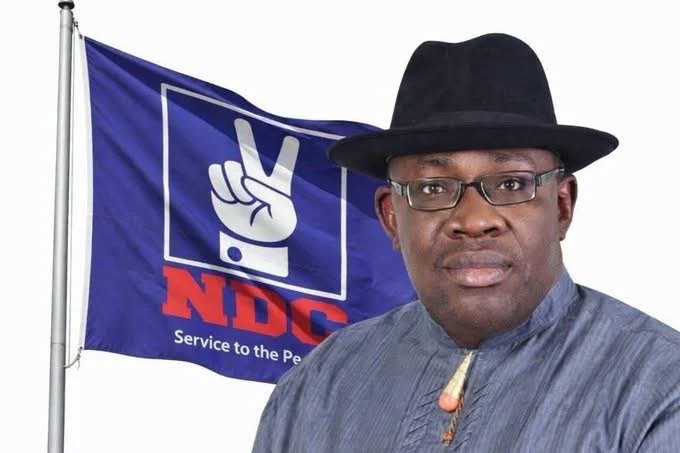
The Nigeria Democratic Congress (NDC) has dismissed allegations that its National Leader, Senator Seriake Dickson, is secretly working with the ruling All Progressives Congress (APC) to undermine the party’s 2027 presidential ticket of Peter Obi and Rabiu Musa Kwankwaso.
The opposition party described the allegation as false and politically motivated, insisting that Dickson has neither a secret nor an open arrangement with the APC and remains committed to the NDC and its presidential ticket. The rebuttal was issued on Monday, October 5, 2026, by NDC National Publicity Secretary Osa Director.
NDC Rejects Alleged Dickson-APC Arrangement
The controversy centres on claims circulating within political circles that Dickson, a former governor of Bayelsa State and current NDC national leader, could be working behind the scenes with the APC to weaken the opposition party and its 2027 presidential campaign.
The NDC rejected the claims outright.
In its statement, the party said it would ordinarily have ignored what it characterised as rumours and political “murmurs”, but decided to respond because repeated allegations could eventually be mistaken for established facts if left unchallenged.
Osa Director said the party was issuing what it described as a strong and unequivocal rebuttal to the allegations.
The NDC maintained that Dickson is not acting as a representative or proxy for the APC and has no agreement with the ruling party aimed at undermining Obi and Kwankwaso.
The party also defended Dickson’s political record, arguing that his past conduct did not support the suggestion that he would secretly work against the political platform he helped build.
Party Defends Dickson’s Political Record
The NDC said Dickson could have chosen to join the APC if his objective was political convenience, but instead participated in building the opposition platform.
The party pointed to his years in public service and his political positions as evidence of what it described as his commitment to the opposition project.
According to the NDC, the allegation that Dickson would work against his own party and its presidential ticket was inconsistent with his political record.
The party therefore urged members and supporters not to allow unverified claims to distract them from preparations for the 2027 general elections.
The NDC’s defence is, however, a statement of the party’s position. No independent evidence establishing or disproving an alleged private political arrangement between Dickson and APC figures was presented in the reports reviewed for this story.
That distinction is important because the allegation itself remains unsubstantiated publicly.
Obi and Kwankwaso’s Place in the NDC
The dispute comes against the background of a major opposition realignment that brought Peter Obi and Rabiu Musa Kwankwaso into the NDC earlier in 2026.
Obi, a former governor of Anambra State and former Labour Party presidential candidate, and Kwankwaso, a former governor of Kano State and former New Nigeria Peoples Party presidential candidate, formally joined the NDC in May.
Both men received their NDC membership cards in Abuja after a meeting with party leaders, with Dickson among the senior figures who welcomed them into the organisation.
The development significantly raised the national profile of the NDC ahead of the 2027 elections.
The party subsequently adopted Obi as its presidential candidate and Kwankwaso as his running mate. The NDC’s own website has since described the Obi-Kwankwaso ticket as its presidential ticket for the 2027 election.
Dickson has consequently become an important figure in the political structure surrounding the ticket, making claims about his alleged relationship with the APC potentially significant for the opposition campaign.
Earlier Tensions Within the Opposition Camp
The latest allegations also emerge amid earlier disagreements over the organisation of the Obi-Kwankwaso campaign.
In September, Dickson criticised the decision by the Obidient-Kwankwaso Movement, known as the OK Movement, to establish a 59-member presidential campaign council.
Dickson argued that support groups should complement the official party structure rather than establish parallel structures that could compete with the NDC’s campaign machinery.
The dispute demonstrated that there are real organisational tensions within the wider opposition movement, even though those disagreements do not establish that Dickson has any relationship with the APC.
The earlier disagreement is relevant to the latest allegation because political observers and supporters have sometimes interpreted internal disputes within opposition parties as signs of deeper divisions.
However, disagreement over campaign structures is not evidence of a secret agreement with another political party.
NDC Says Supporters Should Remain Focused
The NDC used its latest statement to call on party members, supporters and other stakeholders to remain focused on the party’s political objectives.
The party said its members should work towards securing victory for Obi and Kwankwaso, as well as other candidates contesting elections under the NDC platform.
The statement also attributed the allegations against Dickson to political opponents who, according to the party, were uncomfortable with what it described as the NDC’s growing national acceptance.
That claim, like the allegation against Dickson, represents the position of a political organisation and should not be treated as an independently established fact.
What the Allegation Means Ahead of 2027
The dispute highlights one of the central challenges facing Nigeria’s opposition parties as the 2027 general elections approach: maintaining unity among established party structures, influential political figures and large support movements.
Obi and Kwankwaso each entered the NDC with significant political followings developed over several election cycles. Their supporters have their own organisational identities, while the NDC has its formal party structures and leadership.
Managing those different interests will be important if the party is to present a coordinated national campaign.
Dickson’s position is particularly significant because he is one of the senior figures associated with the NDC’s development and has played a prominent role in the party’s engagement with Obi and Kwankwaso.
The NDC’s latest statement therefore serves two purposes: it rejects the specific allegation of an APC arrangement and attempts to reassure its supporters that the party’s leadership remains committed to the 2027 ticket.
Dickson Has Previously Emphasised NDC Loyalty
The latest denial also follows earlier statements from Dickson about his relationship with the party and the movements supporting Obi and Kwankwaso.
In September, Dickson said he was neither a member of the Obidient movement nor the Kwankwasiyya movement, stressing that his political identity was with the NDC.
He acknowledged that the two support groups had their own identities but maintained that Obi and Kwankwaso were the NDC’s presidential and vice-presidential candidates.
That position is consistent with the broader argument made by the NDC in its latest statement: that party structures and individual support movements should remain distinct while working towards the same electoral objective.
Why the Allegation Matters
The allegation matters because Nigeria’s opposition landscape is undergoing significant realignment ahead of the 2027 presidential election.
The entry of Obi and Kwankwaso into the NDC created one of the country’s most closely watched opposition political arrangements. It also brought together political constituencies that have historically operated through separate structures.
Any serious internal disagreement involving the party’s national leadership could therefore have consequences for campaign coordination, candidate mobilisation and voter confidence.
At the same time, unverified allegations can contribute to distrust within political organisations, particularly during an election cycle when parties are already dealing with competing interests and campaign structures.
For that reason, distinguishing between confirmed political developments and unsubstantiated claims is essential.
At present, the publicly available evidence reviewed by Weng Global confirms that the NDC has denied the alleged APC arrangement. It does not independently establish that such an arrangement exists.
What Happens Next
The immediate issue for the NDC will be maintaining cohesion around the Obi-Kwankwaso ticket and preventing internal disagreements from distracting from its preparations for the 2027 elections.
The party is expected to continue organising its campaign structures and mobilising supporters across the country.
How Dickson, Obi, Kwankwaso and other NDC leaders manage disagreements over party structures, support groups and campaign responsibilities will remain an important test of the party’s organisational strength.
For now, the NDC’s position is unequivocal: it rejects claims that Seriake Dickson is secretly working with the APC and says its national leader remains committed to the party and the Obi-Kwankwaso ticket.
No independent evidence of the alleged APC deal was identified in the sources reviewed for this report.
Weng Global – stories beyond borders
Sources
- Nigeria Democratic Congress
- The Guardian Nigeria
- Nigerian Tribune
- TheNewsGuru
- Leadership
- Channels Television
- Punch
- TheCable
- Premium Times
Caption