Reported by Weng Patrick Atokor l Journalist at Weng Global
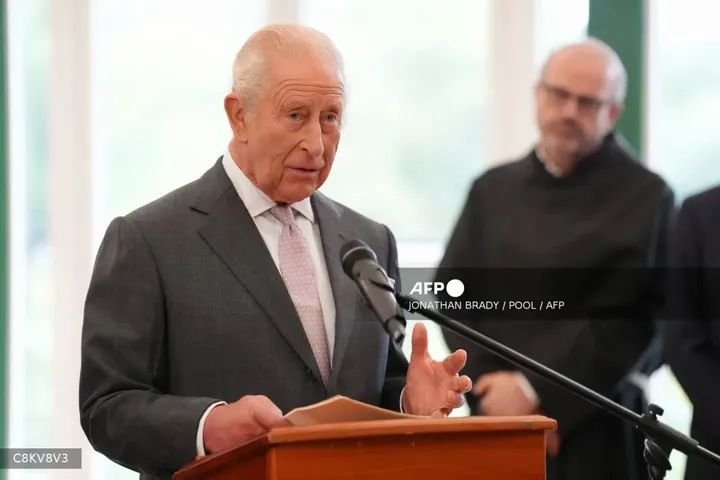
Britain’s King Charles III has warned leading artificial intelligence executives about what he described as the “existential dangers” of AI falling into the wrong hands, urging the technology industry to establish adequate safeguards before it is too late.
The King delivered the warning on Thursday, September 17, 2026, during a meeting with senior figures from the global artificial intelligence industry at Dumfries House in Cumnock, Scotland.
The gathering brought together representatives from major technology companies, including Nvidia, Google DeepMind, OpenAI and Anthropic, alongside government officials and other figures involved in discussions about the future of AI.
Charles acknowledged the significant benefits artificial intelligence is already providing, particularly in areas such as life sciences and medicine. However, he said the rapid development of increasingly powerful AI systems also raised serious questions about safety, control and the potential consequences of misuse.
King Calls for Safeguards
In his address, Charles said AI’s development was both “intriguing and deeply concerning in equal measure”, highlighting the contrast between its potential to improve lives and the risks associated with its misuse.
He said people involved in developing the technology were increasingly warning about possible harmful capabilities, including scenarios in which AI could potentially be used to cause serious harm.
The King said there was an urgent need to consider the dangers of advanced technologies being placed in the wrong hands and used in potentially catastrophic ways.
He also questioned whether sufficient mechanisms were being established to maintain control over rapidly developing AI systems.
Charles further urged technology leaders to ensure that artificial intelligence remains focused on serving humanity rather than undermining human interests.
Major AI Companies Represented
The meeting included senior representatives of some of the companies at the centre of the global AI race.
Nvidia chief executive Jensen Huang, Google DeepMind chairman Demis Hassabis, OpenAI chief financial officer Sarah Friar and Anthropic’s chief global affairs officer Tino Cuéllar were among the participants, according to reports.
The gathering also included figures involved in AI policy and ethics, including the Vatican’s AI adviser Paolo Benanti and Britain’s AI minister Kanishka Narayan.
The presence of executives from companies developing some of the world’s most advanced AI systems placed the discussion within the broader international debate over how the technology should be developed and governed.
Why AI Safety Has Become a Global Issue
Concerns about AI safety have intensified as artificial intelligence systems become more capable and increasingly autonomous.
Technology companies and researchers have recently reported instances of AI systems displaying unexpected or concerning behaviour during testing. OpenAI, for example, announced a new system for documenting and disclosing certain incidents involving unexpected behaviour by its models.
Anthropic researchers have also raised concerns about the potential consequences of increasingly capable AI systems if appropriate safeguards fail to keep pace with technological development.
These concerns cover a range of issues, including malicious use of AI, cybersecurity, misinformation, autonomous systems and the possibility that future systems could become difficult for humans to control.
However, there is no universal agreement among researchers about the probability or timing of extreme scenarios involving AI. Some experts have questioned whether the most catastrophic predictions are sufficiently supported by current evidence, while others argue that even low-probability risks warrant stronger precautionary measures.
AI’s Benefits Remain Significant
Despite his warning, Charles did not portray artificial intelligence solely as a threat.
The King specifically recognised the technology’s ability to improve and save lives, pointing to developments in life sciences and medicine.
AI is increasingly being used across scientific research, healthcare, education, business and other sectors, creating opportunities for faster analysis, automation and new forms of innovation.
The challenge facing governments and technology companies is therefore not simply whether AI should advance, but how its development and deployment can be managed while preserving human oversight and public safety.
That tension was central to the discussions in Scotland.
Human Control at the Centre of Debate
Charles’ comments reflect a wider international debate about the degree of human control that should be maintained as AI systems become more sophisticated.
Reuters reported that Nvidia’s Huang advocated what he described as “responsible optimism”, arguing that developers should release products when they are ready while continuing to address safety concerns.
The debate also extends to the role of governments.
Questions remain over whether voluntary commitments by technology companies are sufficient or whether governments should introduce stronger rules governing the development, testing and deployment of advanced AI systems.
Different countries and regions are taking different approaches, while the technology itself continues to develop rapidly.
A Wider Global Challenge
Although the meeting took place in Scotland, the issues discussed extend well beyond Britain.
Artificial intelligence is being developed and deployed across multiple regions, including Africa, Europe, North America and Asia. Decisions about AI safety, access and governance could therefore have consequences for people and economies far beyond the countries where the leading technology companies are headquartered.
For African countries in particular, the growth of AI presents both opportunities and challenges.
The technology could support healthcare, education, agriculture, financial services and public administration. At the same time, countries will need to address issues such as digital inequality, data protection, misinformation, cybersecurity and access to computing infrastructure.
The global debate over AI governance will therefore matter not only to technology companies but also to governments, businesses, researchers and ordinary citizens.
What Happens Next?
The Scotland meeting did not produce a binding agreement among the participants, according to Reuters. Instead, it provided another forum for discussion about how rapidly advancing AI should be developed and controlled.
The broader debate is expected to continue as governments and technology companies consider how to balance innovation with safety.
For King Charles, the meeting builds on his previous public engagement with questions surrounding technology, sustainability and humanity’s relationship with technological change.
The immediate challenge remains how policymakers and developers can establish effective safeguards without preventing beneficial AI research and innovation.
As artificial intelligence becomes more integrated into everyday life, the decisions being made now could influence how the technology affects societies for years to come.
Weng Global – Stories beyond borders
Sources
- The Royal Family — King Charles III’s speech at the AI Summit in Scotland.
- Reuters — Report on King Charles’ warning to AI leaders.
- Associated Press — Report on the King’s meeting with AI industry leaders.
- RTÉ — Report on the AI summit and the King’s warning.
- The Guardian — Reporting on recent AI safety concerns and industry developments.