Aregbesola Congratulates Adeleke on Osun Re-Election, Urges Unity and Fair Governance After Closely Fought Poll!
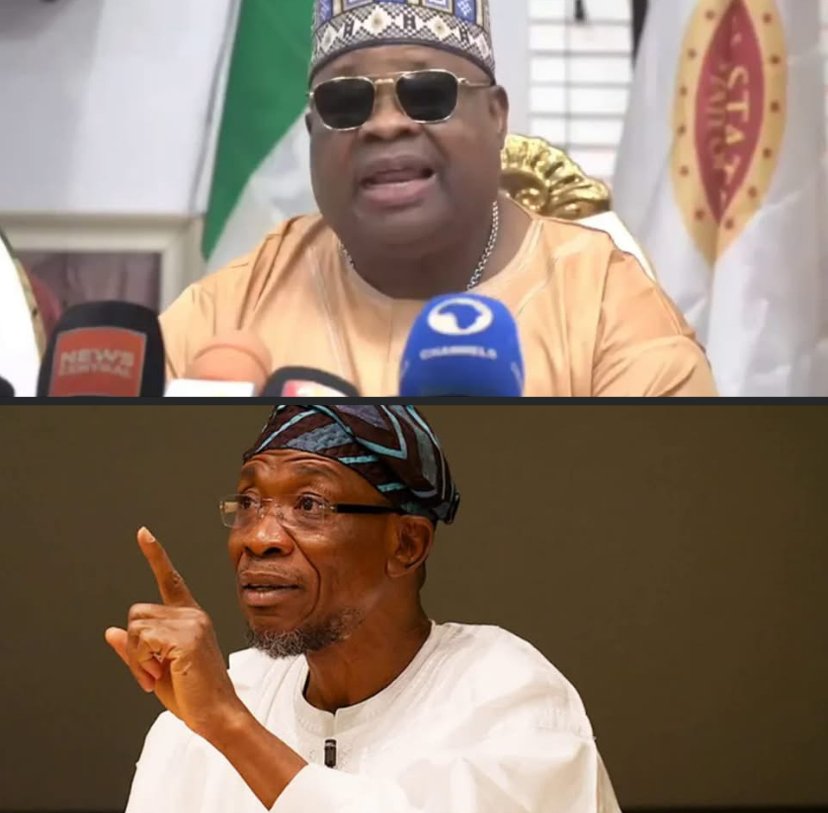
Former Osun State Governor and National Secretary of the African Democratic Congress (ADC), Ogbeni Rauf Aregbesola, has congratulated Governor Ademola Adeleke on his re-election, urging the governor to use his renewed mandate to unite the state and govern with fairness, humility and responsibility.
Aregbesola’s reaction followed the August 15, 2026 Osun State governorship election, in which Adeleke, the Accord Party candidate and incumbent governor, secured a second term after defeating his major challenger, Bola Oyebamiji of the All Progressives Congress (APC).
The former governor also commended members and supporters of the ADC for what he described as their courage, commitment and participation in the election, despite the party’s candidate, Najeem Salaam, finishing third in the contest.
In a statement released after the election, Aregbesola said the outcome should be respected because it represented the choice expressed by Osun voters through the ballot. He urged political actors and residents to put the contest behind them and focus on the unity and development of the state.
Television Continental (TVC) reported that Aregbesola congratulated Adeleke and called on him to regard the result as a renewed mandate to unite Osun and deepen development. (Trending News)
Adeleke secures second term
Adeleke’s victory represents a significant milestone in Osun’s political history.
According to reports on the final result, the incumbent polled 511,067 votes, defeating APC candidate Bola Oyebamiji, who secured 444,815 votes. ADC candidate Najeem Folasayo Salaam finished third with 17,180 votes. TVC reported that Adeleke’s winning margin was 66,252 votes, although some reports have stated slightly different margins due to arithmetic discrepancies in early publications. (Trending News)
The victory means Adeleke will remain in office for another four-year term.
It also places him among a relatively small group of politicians who have successfully secured two elected terms as governor of Osun State. Aregbesola himself governed the state for two terms between 2010 and 2018, while Olagunsoye Oyinlola also served as governor before his tenure was later affected by litigation surrounding the 2007 election.
Adeleke’s re-election consequently carries political significance beyond the immediate result. It represents the continuation of the administration that began in 2022 and provides the governor with another mandate to implement his policies and development agenda.
The Independent National Electoral Commission (INEC) had scheduled the Osun governorship election for August 15, 2026, as part of Nigeria’s off-cycle electoral calendar. (INEC Nigeria)
Aregbesola asks Adeleke to govern for all
The central message in Aregbesola’s post-election statement was an appeal for inclusive governance.
The former governor urged Adeleke to regard the election as more than a political victory, stressing that the governor’s responsibility after the election extends to all residents regardless of their political affiliations.
Aregbesola’s appeal is particularly significant because the election was fiercely contested, with the Accord, APC and ADC competing for the support of Osun voters.
Political campaigns leading to the election featured sharp disagreements over the performance of the Adeleke administration, the state’s development trajectory and the political direction of Osun.
Aregbesola therefore called on the governor to use his renewed mandate to promote unity rather than deepen political divisions.
The former governor also urged Adeleke to approach his second term with fairness and humility, signalling that the responsibility of governance after an election requires a broader approach than the mobilisation of supporters during a campaign.
His message reflects a familiar principle in democratic governance: once votes have been counted and a winner declared, the successful candidate assumes responsibility for the entire electorate.
Aregbesola’s position carries political weight
Aregbesola’s intervention is particularly notable because he was not a neutral observer in the 2026 election.
The former governor served as the National Secretary of the ADC and was a major political figure behind the party’s campaign in Osun.
His political influence was one of the factors that made the ADC a significant participant in the election.
Premium Times, in an analysis published before the poll, described the election as a major test of Aregbesola’s political influence, particularly because he was backing ADC candidate Najeem Salaam. The publication noted that Aregbesola’s political standing in Osun made the ADC a potentially significant third force in the contest. (Premium Times Nigeria)
The ADC, however, failed to translate that political expectation into a strong electoral showing.
Salaam’s 17,180 votes placed him significantly behind Adeleke and Oyebamiji.
The result is likely to generate further debate about the strength of the ADC’s political structure in Osun and the extent to which Aregbesola’s personal influence can be converted into electoral support under a different political platform.
ADC’s third-place finish
The ADC entered the election with expectations of challenging the traditional dominance of the two major political forces in the state.
Aregbesola’s political history, combined with the ADC’s attempt to position itself as an alternative platform, attracted considerable attention during the campaign.
The party also conducted its state congress in April, electing new state executives as it prepared for the governorship election. PUNCH reported that delegates from the 30 local government areas participated in the exercise held in Osogbo. (Punch Newspapers)
Aregbesola later addressed ADC stakeholders across the state and reaffirmed his commitment to the party.
PUNCH reported in May that he rejected suggestions that he was planning to return to the APC and declared his continued commitment to the ADC. (Punch Newspapers)
The election result, however, produced a disappointing outcome for the party’s governorship campaign.
Aregbesola’s decision to congratulate Adeleke despite the ADC’s defeat could therefore be interpreted as an attempt to draw a clear line between electoral competition and the responsibilities that follow an election.
It also places emphasis on democratic acceptance and peaceful political transition rather than prolonged confrontation after the polls.
Adeleke’s victory followed intense political realignment
The election was conducted amid substantial political realignment in Osun.
Adeleke entered the election under the Accord Party after leaving the PDP, the platform on which he won the 2022 governorship election.
INEC’s final list of candidates confirmed Adeleke as the Accord candidate, while Najeem Salaam represented the ADC and Bola Oyebamiji contested for the APC. (Fed Min Info & Nat Orientation)
The changing party configuration made the 2026 election particularly unusual.
Adeleke’s move away from the PDP changed the political structure that had supported his initial victory, while the ADC emerged as another major platform attempting to challenge the established political order.
The APC, meanwhile, sought to regain control of the state after losing the governorship in 2022.
The result ultimately favoured the incumbent.
Political competition now gives way to governance
With the election concluded, attention is expected to shift from campaign promises to governance.
Adeleke will now face the challenge of translating the electoral mandate into tangible improvements in areas including infrastructure, education, healthcare, workers’ welfare, agriculture and economic development.
The governor’s administration had highlighted several projects and reforms during the campaign as evidence of its performance since 2022.
His opponents, however, had questioned aspects of his record and argued that Osun required a different direction.
The renewed mandate therefore provides Adeleke with an opportunity to demonstrate whether the policies and programmes presented during the campaign can produce measurable improvements in the lives of residents.
Aregbesola’s call for fairness is relevant in this context.
The strength of a democratic mandate is not determined solely by the size of an electoral victory. It is also measured by how the winner treats citizens who supported other candidates and political parties.
Respect for voters’ decision
Aregbesola’s statement also placed emphasis on the sovereignty of voters.
His position that the decision of Osun residents should be respected is consistent with the fundamental democratic principle that political authority derives from the electorate.
That message is especially relevant after a competitive election, where supporters of different candidates may experience sharply contrasting emotions about the outcome.
In such circumstances, political leaders have an important role to play in encouraging calm, respect for the law and peaceful engagement.
The 2026 Osun election also attracted significant national attention because of the political importance of the state and the participation of influential national figures.
The election was watched closely as an indicator of political trends ahead of Nigeria’s 2027 general elections.
A new phase for Osun politics
For Aregbesola, the post-election statement represents a notable moment.
He entered the contest as one of the most prominent political figures supporting the ADC and its candidate. His party’s third-place finish means the immediate electoral objective was not achieved.
Yet his decision to publicly congratulate Adeleke places the emphasis on the broader interests of Osun rather than the fortunes of one political organisation.
For Adeleke, the congratulatory message comes with a clear political responsibility.
The governor now has the opportunity to demonstrate that his second-term administration can rise above partisan divisions and provide inclusive governance.
His challenge will be to convert the renewed electoral mandate into effective administration while maintaining accountability to the people who voted for him and those who did not.
For the people of Osun, the election has closed one political chapter and opened another.
The campaign season produced competing promises, accusations, endorsements and political realignments. The ballot has now provided the electorate’s verdict.
The task before political leaders is to respect that verdict, protect democratic institutions and ensure that governance remains focused on the welfare of citizens.
Aregbesola’s appeal for unity and fairness therefore provides a fitting post-election message: political competition may determine who occupies office, but responsible governance must serve the entire state.
As Adeleke begins his second term, the credibility of his renewed mandate will ultimately be measured not only by the circumstances of his re-election but by the quality, inclusiveness and accountability of the government that follows.
wengglobal will continue to follow developments surrounding Adeleke’s second term, the ADC’s future political strategy and the wider implications of the Osun election for Nigeria’s evolving political landscape.
Sources
- TVC News — Report on Aregbesola’s congratulatory message to Adeleke and his call for unity and fair governance. (Trending News)
- Premium Times — Pre-election analysis of Aregbesola’s political influence and the ADC’s prospects in Osun. (Premium Times Nigeria)
- PUNCH — Report on Aregbesola’s continued commitment to the ADC and the party’s Osun political structure. (Punch Newspapers)
- PUNCH — Report on the ADC’s Osun State congress and emergence of new state executives. (Punch Newspapers)
- Vanguard — Report on polling-unit results involving Aregbesola during the August 15 Osun election. (Vanguard News)
- INEC — Official election calendar confirming August 15, 2026 as the Osun governorship election date. (INEC Nigeria)
- Federal Ministry of Information and National Orientation — Report on INEC’s final list of candidates for the Osun governorship election. (Fed Min Info & Nat Orientation)