OsunDecides2026: Physically Challenged Voter Praises INEC for Priority Treatment as Disability Inclusion Gains Attention!
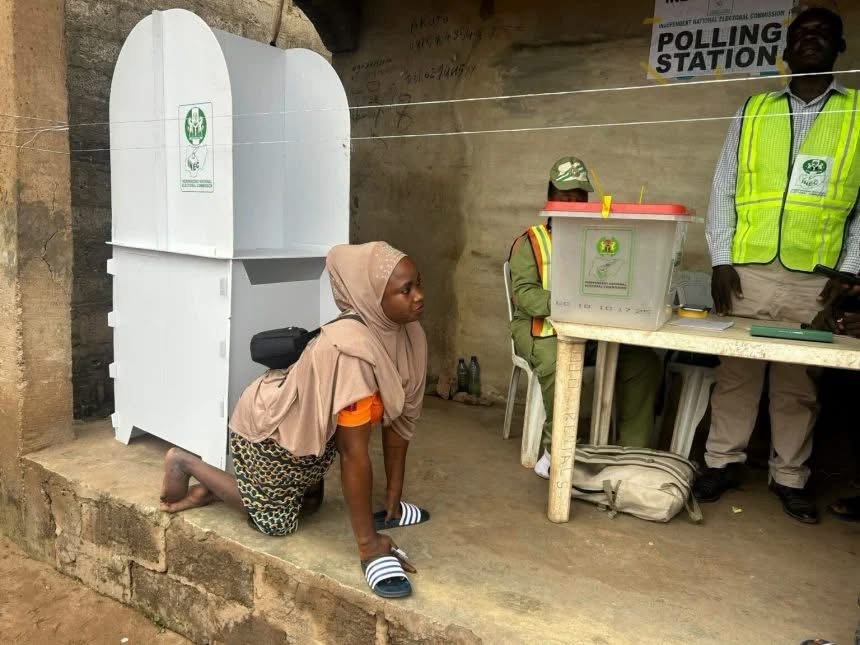
A physically challenged voter in Osun State has commended election officials for providing priority treatment and a more accessible voting experience during the 2026 governorship election, describing the assistance as an important step towards ensuring that persons with disabilities can participate in Nigeria’s democratic process with dignity and without unnecessary barriers.
The commendation comes as Osun State conducts its governorship election on Saturday, August 15, with disability inclusion emerging as an important part of discussions around voter access, electoral participation and the credibility of the exercise.
For persons with disabilities, the right to vote extends beyond simply being registered on the voters’ roll. It also requires practical access to polling locations, appropriate voting assistance, priority treatment where necessary and an environment in which voters can exercise their franchise independently and respectfully.
The experience reported by the physically challenged voter therefore provides an important perspective on the implementation of measures designed to make the electoral process more inclusive.
The Independent National Electoral Commission (INEC) has repeatedly emphasised the importance of ensuring that persons with disabilities are not excluded from elections. In June, Osun Resident Electoral Commissioner Oluwatoyin Babalola said persons with disabilities had the same right to participate in elections and that the commission was working towards making the August 15 poll more accessible. (famefoundationwg.org)
Inclusion becomes a key issue in Osun election
The focus on voters with disabilities comes after months of preparations involving electoral authorities, civil society organisations and disability advocacy groups.
TAF Africa, through its Able2Vote initiative, has been particularly active in Osun State ahead of the election. The organisation trained 150 persons with disabilities to serve as election observers and monitor accessibility and the overall voting experience across polling units. (tafafrica.co)
The initiative was designed not only to encourage participation by persons with disabilities but also to ensure that their experiences are documented from within the electoral process.
According to TAF Africa, the observers were equipped to report accessibility concerns and other challenges encountered at polling locations. The organisation said the involvement of persons with disabilities as observers was intended to strengthen accountability and ensure that disability inclusion was treated as an essential component of electoral integrity. (tafafrica.co)
Ahead of the poll, TAF Africa also conducted voter sensitisation activities across six communities in Osun, reaching more than 300 persons with disabilities between July 13 and July 17.
The campaign encouraged eligible voters with disabilities to participate in the election, reject vote-selling and understand their rights during the voting process. (tafafrica.co)
These preparations created greater attention around the practical experiences of voters with disabilities on election day.
Priority voting and dignity at polling units
Priority voting is particularly significant for voters who may face physical difficulties standing in long queues or navigating crowded polling environments.
For a physically challenged voter, being allowed to vote without having to endure prolonged waiting can make the difference between meaningful electoral participation and an unnecessarily difficult experience.
INEC has previously highlighted measures intended to assist persons with disabilities and other vulnerable voters. Reports on electoral preparations have cited priority assistance for physically challenged voters alongside other accessibility measures such as Braille ballot guides and magnifying glasses. (The Guardian Nigeria)
The reported positive experience in Osun therefore represents the practical side of policies that have increasingly become part of Nigeria’s electoral inclusion agenda.
It also reinforces the principle that accessibility should not be viewed as preferential treatment in the conventional sense, but as a means of ensuring equal opportunity for citizens who may encounter physical barriers that other voters do not face.
For wengglobal, the commendation is significant because credible elections are measured not only by the counting of ballots but also by how effectively every eligible citizen is able to participate.
A history of accessibility challenges
Despite the positive assessment from the voter, disability inclusion in Nigerian elections has historically faced significant challenges.
Persons with disabilities have often encountered polling units located in difficult-to-access environments, including buildings with steps, gutters, high pavements and other physical obstacles.
Previous election observations in Osun have demonstrated both progress and shortcomings.
During the 2022 Osun governorship election, the Campaign for Equal Voting Access for Persons with Disabilities, a programme of the Centre for Citizens with Disabilities, commended INEC for providing priority voting to persons with disabilities and other vulnerable groups in many of the polling units it observed.
The group also reported the deployment of assistive materials, including Braille guides, shades and magnifying glasses, in a significant number of polling units. (Punch Newspapers)
However, the same assessment identified polling units that remained inaccessible to voters with physical disabilities.
The Guardian reported at the time that disability advocates found shortcomings in the accessibility of some polling locations, despite acknowledging improvements in priority voting. (The Guardian Nigeria)
The mixed experience highlighted an important lesson: priority treatment alone cannot solve every challenge faced by voters with disabilities.
A voter may be allowed to move to the front of a queue but still struggle to reach a polling unit if the entrance is inaccessible. Similarly, assistive devices are useful only when they are available, properly deployed and understood by election personnel.
Osun 2026 preparations show greater attention
Preparations for the 2026 Osun election indicate that disability inclusion has received more structured attention.
TAF Africa’s engagement with INEC has focused on accessibility, voter education and observation. The organisation also announced plans to deploy sign-language interpreters at selected polling units to support voters with hearing impairments. (Osun Life)
The broader effort reflects growing recognition that persons with disabilities constitute an important segment of the electorate whose participation should not be treated as an afterthought.
INEC’s engagement with disability organisations has also provided an opportunity to identify problems that may otherwise remain invisible during election planning.
The commission’s Osun leadership has stated that accessibility and equal participation are part of its responsibility in conducting the election. The engagement with persons with disabilities and electoral officers was specifically presented as a measure to strengthen inclusive and accessible voting. (famefoundationwg.org)
More than physical access
Disability inclusion in elections involves more than ramps and shorter queues.
It also encompasses access to voter information, communication, ballot assistance and the ability to understand the voting process.
Voters with visual impairments, hearing impairments or other disabilities may require different forms of support.
Braille ballot guides, magnifying devices, sign-language interpretation and properly trained election officials can help address these different needs.
At the same time, assistance must preserve the secrecy and integrity of the ballot.
Election officials and support personnel must ensure that assistance provided to a voter does not influence the voter’s choice.
This balance between assistance and independence is central to meaningful electoral inclusion.
Civil society’s role
The role of civil society organisations has also become increasingly important in monitoring whether official commitments translate into actual experiences at polling units.
TAF Africa’s deployment of 150 observers with disabilities represents one example of a monitoring model that places citizens directly affected by accessibility challenges at the centre of election observation. (tafafrica.co)
The organisation’s work is part of a wider push to ensure that persons with disabilities are not merely viewed as beneficiaries of electoral policies but also as active participants, observers and stakeholders.
Ahead of the Osun election, media organisations were similarly urged to give greater attention to the voices and political rights of persons with disabilities.
A July reflection meeting in Osogbo involving TAF Africa, the Centre for Media and Society, the International Press Centre and the Nigerian Women Trust Fund called for more inclusive reporting of the electoral process. (QUALITATIVE MAGAZINE)
The message is straightforward: if persons with disabilities are not visible in election reporting, their experiences and concerns risk being overlooked in public policy discussions.
Participation strengthens democracy
The physically challenged voter’s positive experience should be seen within this broader context.
Every voter who is able to cast a ballot without discrimination or avoidable obstacles strengthens the principle of political equality.
For Nigeria, where concerns about voter apathy and electoral confidence remain part of wider democratic debates, making elections accessible to all eligible citizens is particularly important.
Persons with disabilities should not have to choose between exercising their civic rights and confronting unnecessary physical or administrative barriers.
The 2026 Osun governorship election provides another opportunity to assess whether the progress reported in previous elections is being sustained and expanded.
While one positive experience cannot by itself establish that every polling unit across the state is fully accessible, it is an encouraging indication that priority treatment can work when election officials understand and respect the needs of vulnerable voters.
It is equally important that election observers continue documenting areas where accessibility remains inadequate.
The road ahead
The long-term objective should be to make accessibility a routine component of election planning rather than a special intervention introduced shortly before voting day.
Polling units should be assessed in advance for physical accessibility. Election personnel should receive appropriate training. Assistive devices should be available where required, and voters with disabilities should have clear information about the support available to them.
The experience of Osun can also provide useful lessons for Nigeria’s 2027 general elections.
With the country’s democratic process depending on the participation of millions of citizens, electoral inclusion must remain a measurable component of election quality.
For wengglobal, the commendation from the physically challenged voter is therefore more than an individual expression of gratitude. It highlights the importance of translating constitutional and electoral commitments into practical experiences at the polling unit.
A credible election is one in which citizens are able to participate freely, safely and with dignity.
As Osun voters cast their ballots, the treatment of persons with disabilities offers another important measure of how inclusive the state’s democratic process has become.
The positive experience reported on election day should be welcomed, while continued observation remains necessary to determine whether accessibility and priority voting are being consistently provided across the state.
Ultimately, the goal should be simple: no eligible voter should be prevented from exercising the right to choose political leaders because of a disability.
Sources
- TAF Africa — Updates on disability inclusion, the Able2Vote initiative and training of 150 persons with disabilities as election observers for OsunDecides2026. (tafafrica.co)
- Punch — Reports on disability groups’ assessment of priority voting and accessibility during the Osun governorship election. (Punch Newspapers)
- The Guardian Nigeria — Coverage of disability advocates’ assessment of priority voting and accessibility challenges in Nigerian elections. (The Guardian Nigeria)
- Leadership — Report on PWDs’ commendation of INEC over equal voting access during the Osun governorship election. (Leadership)
- FAME Foundation — Report on INEC’s assurance of equal voting rights for persons with disabilities ahead of the 2026 Osun governorship election. (famefoundationwg.org)
- The Nation — Report on INEC’s voter-registration figures and inclusion of persons with disabilities in the Osun electoral process. (The Nation Newspaper)
- Osun Defender — Coverage of TAF Africa’s disability-focused voter sensitisation and election observation preparations in Osun. (osundefender.com)