Reported by Weng Patrick Atokor | Journalist at Weng Global
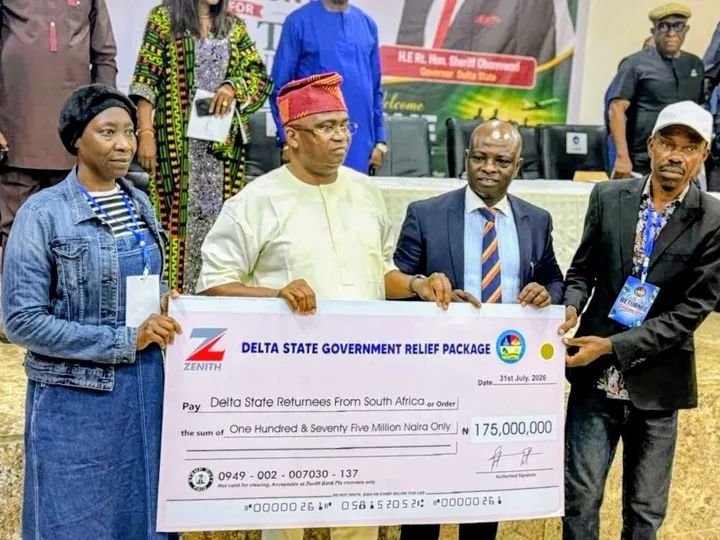
The Delta State Government has announced a comprehensive reintegration package for 86 indigenes who recently returned from South Africa following renewed xenophobic attacks, providing each affected family with ₦2 million in financial support alongside a monthly stipend aimed at helping them rebuild their lives.
The intervention underscores the state’s commitment to protecting its citizens beyond Nigeria’s borders while addressing the economic and psychological challenges faced by returnees forced to abandon their livelihoods abroad.
Lifeline for Returning Families
According to the Delta State Government, the financial assistance is designed to ease the burden on families that lost businesses, employment, homes and personal belongings during the attacks in South Africa.
Officials said each family will receive ₦2 million as startup support to encourage economic recovery, while monthly stipends will help cover immediate living expenses as beneficiaries settle back into their communities.
The government noted that the initiative goes beyond humanitarian relief by focusing on long-term reintegration through economic empowerment.
Supporting Victims of Xenophobic Violence
Many of the returnees reportedly fled South Africa after experiencing violence, intimidation and destruction of property linked to recurring xenophobic attacks targeting foreign nationals.
Several Nigerians living in South Africa have, over the years, been affected by waves of violence sparked by tensions over employment, crime and economic hardship. These incidents have often forced businesses to close and displaced thousands of migrants, including many Nigerians.
For the Delta returnees, the journey home marked the end of months of uncertainty and financial losses.
State officials said the government’s intervention is intended to restore hope while helping affected families regain financial independence.
Reintegration Beyond Financial Assistance
Authorities explained that the programme extends beyond cash support.
Beneficiaries are expected to receive guidance on investment opportunities, entrepreneurship and sustainable income-generating ventures to ensure that the financial assistance produces lasting benefits.
Government representatives said the initiative aligns with broader efforts to create employment, reduce poverty and encourage self-reliance among Delta residents.
Officials emphasized that empowering returnees economically would reduce their vulnerability and discourage risky migration driven by desperation.
Government Reaffirms Commitment
The Delta State Government reiterated that the welfare of its citizens remains a priority regardless of where they reside.
It assured returnees that they would continue receiving institutional support as they reintegrate into society, adding that collaboration with relevant agencies would help ensure successful implementation of the programme.
The administration also encouraged beneficiaries to use the funds responsibly by investing in productive ventures capable of generating sustainable income.
Renewed Attention on Xenophobia
The latest intervention has once again drawn attention to the recurring challenge of xenophobic violence in South Africa.
Nigeria and South Africa have historically maintained strong diplomatic and economic ties, but periodic attacks on foreign nationals have strained relations.
Previous outbreaks have resulted in deaths, injuries, destruction of businesses and mass evacuations, prompting diplomatic engagements between both countries.
Human rights organisations have repeatedly urged stronger law enforcement measures, public education campaigns and regional cooperation to address the underlying causes of xenophobic violence.
Calls for Lasting Solutions
Analysts argue that while humanitarian interventions remain necessary, long-term solutions require stronger protection for migrants, improved economic opportunities across Africa and sustained diplomatic engagement between governments.
They also stress the importance of addressing unemployment, inequality and misinformation, factors frequently cited as drivers of anti-foreigner sentiments.
For the Delta beneficiaries, however, the immediate concern is rebuilding lives disrupted by circumstances beyond their control.
The state’s financial package is expected to provide a fresh start for dozens of families seeking to establish businesses, secure housing and restore stability after returning home.
Hope After Hardship
Community leaders have welcomed the initiative, describing it as a compassionate response to citizens who suffered significant losses abroad.
They expressed optimism that the combination of financial grants and monthly stipends would help beneficiaries regain confidence and contribute meaningfully to the state’s economy.
As the returnees begin a new chapter, the programme stands as one of the most substantial state-level reintegration efforts for Nigerians affected by xenophobic violence outside the country.
Observers say its success will ultimately depend on effective monitoring, transparent implementation and the beneficiaries’ ability to transform the assistance into sustainable livelihoods.
Sources
- Delta State Government
- Nigeria in Diaspora Commission (NiDCOM)
- South African Government statements on xenophobic violence
- News Agency of Nigeria (NAN)